
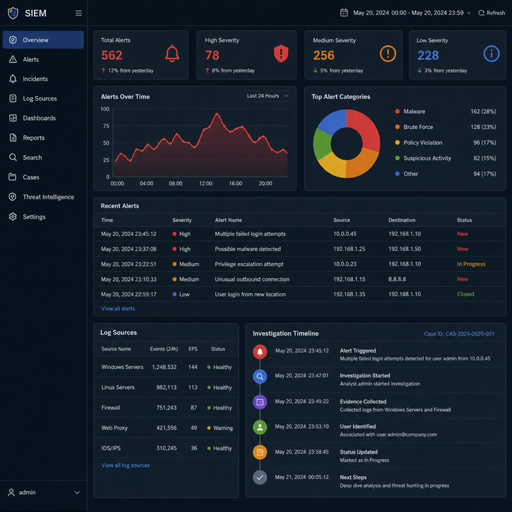
Security information and event management software is cybersecurity software that collects, organizes, analyzes, and correlates security data from across an organization’s technology environment. Often called SIEM software, it helps security teams detect suspicious activity, investigate alerts, support incident response, and document compliance-related events in one central place. In practical terms, it turns scattered logs and signals into useful security context.
What does SIEM software do?
SIEM software gives organizations a centralized view of security events across systems, users, applications, networks, cloud services, and endpoints. Instead of asking analysts to manually check separate logs in separate tools, a SIEM gathers those records, normalizes them, and highlights patterns that may indicate a threat, policy violation, misconfiguration, or operational issue.
A SIEM does not magically stop every attack by itself. Its value comes from visibility, correlation, alerting, investigation support, and audit readiness. When connected to the right sources and configured with thoughtful rules, it can help teams notice unusual login behavior, unauthorized access attempts, malware indicators, privilege changes, data movement, and other signs that something needs attention.
The core definition in plain language
A SIEM is a security monitoring platform built around two related ideas: security information management and security event management. Security information management focuses on collecting and retaining log data for analysis, reporting, and compliance. Security event management focuses on identifying meaningful security events as they happen, often through correlation rules, alerts, dashboards, and automated workflows.
Together, these functions help answer practical security questions: What happened? Where did it happen? Who was involved? Is it normal? Does it require action? That makes security information and event management software especially useful for teams that need to move from reactive log searching to more structured threat detection and investigation.
Key defining characteristics include:
- Centralized log collection: Data from firewalls, identity systems, servers, applications, endpoints, cloud platforms, and other sources flows into one system.
- Normalization and parsing: Different log formats are converted into more consistent fields so they can be searched and compared.
- Correlation: The platform connects related events, such as repeated failed logins followed by a successful login from an unusual location.
- Alerting: Security teams receive notifications when activity matches a rule, risk pattern, or behavioral anomaly.
- Search and investigation: Analysts can query historical events, trace timelines, and examine affected users or assets.
- Reporting: Built-in or custom reports support compliance monitoring tools, internal audits, and management visibility.
- Retention: Logs can be stored for a defined period to support investigations, legal needs, or regulatory requirements.
How does SIEM software work?
SIEM software works by ingesting security and operational data, enriching it with context, analyzing it for risk, and presenting findings in a form that security teams can act on. The process usually begins with data connectors or agents that send logs and telemetry into the SIEM from systems across the organization. These sources may include identity providers, endpoint protection tools, firewalls, intrusion detection systems, databases, SaaS applications, cloud infrastructure, and business-critical applications.
Once data arrives, the SIEM parses it into usable fields such as username, IP address, hostname, timestamp, event type, location, and action taken. This step matters because raw logs are often inconsistent. A firewall, cloud platform, and authentication system may describe related activity in very different ways. Normalization makes cross-system analysis possible.
The SIEM then applies detection logic. This may include simple rules, such as alerting when an administrator account fails authentication many times, and more advanced analytics, such as flagging activity that differs from a user’s normal behavior. Some SIEM platforms also use threat intelligence feeds to compare events against known malicious IP addresses, domains, file hashes, or attack patterns.
A common SIEM workflow looks like this:
- Collect: The platform ingests logs, alerts, and telemetry from connected sources.
- Normalize: Events are converted into searchable, comparable fields.
- Enrich: Asset details, user identity, geolocation, vulnerability data, or threat intelligence are added for context.
- Correlate: Related signals are grouped to reveal patterns that may not be obvious in a single log.
- Prioritize: Alerts are ranked by severity, confidence, affected assets, or business risk.
- Investigate: Analysts review timelines, search logs, and determine whether the activity is benign or malicious.
- Respond: The team escalates, documents, contains, or remediates the issue, often with help from incident response software or automation tools.
- Report: Findings are used for compliance, executive summaries, tuning, and future detection improvements.
SIEM’s role in cybersecurity operations
In many organizations, SIEM software acts as the central nervous system for security operations. It does not replace firewalls, endpoint protection, identity controls, vulnerability management, or backup systems. Instead, it brings information from those tools together so teams can understand what is happening across the environment.
This matters because modern attacks rarely occur in one isolated place. A phishing email may lead to credential theft, which may lead to suspicious cloud access, which may lead to privilege escalation and data exfiltration. Each tool may see only part of that story. A SIEM helps assemble the sequence into a timeline, giving analysts a better chance to detect and contain the threat before it becomes a serious incident.
SIEM software also supports data breach prevention by improving early detection. Prevention is not only about blocking known threats at the perimeter. It also involves spotting weak signals, catching misuse, and responding quickly when controls fail. A well-managed SIEM can help identify risky activity such as abnormal downloads, unauthorized database queries, impossible travel logins, disabled security settings, or access to sensitive systems outside normal patterns.
What is the difference between SIEM and incident response software?
SIEM software is primarily used to collect, correlate, monitor, and analyze security events, while incident response software is primarily used to coordinate what happens after a potential incident is identified. The two categories often work together, but they are not the same thing.
A SIEM may generate an alert that suggests a compromised account. Incident response software may then help assign tasks, document evidence, follow a playbook, track containment steps, notify stakeholders, and preserve an audit trail. Some platforms combine SIEM, orchestration, automation, and case management features, but the underlying distinction is still useful.
|
Capability |
SIEM software |
Incident response software |
|---|---|---|
|
Main purpose |
Detect and analyze security events |
Coordinate response activities |
|
Primary data |
Logs, alerts, telemetry, event records |
Cases, tasks, evidence, actions, communications |
|
Typical users |
Security analysts, SOC teams, compliance teams |
Incident responders, security managers, legal or IT stakeholders |
|
Key output |
Alerts, dashboards, searches, reports |
Playbooks, case records, response timelines, remediation tracking |
|
Best used for |
Visibility, detection, investigation, compliance monitoring |
Containment, coordination, escalation, post-incident review |
For smaller teams, a SIEM with basic case management may be enough at first. Larger teams often benefit from dedicated incident response workflows, especially when multiple departments need to coordinate under pressure.
Common use cases and examples
SIEM platforms are flexible because they are built around event data. The specific value depends on what data is connected, how well alerts are tuned, and whether the organization has people or processes ready to act on findings.
Practical examples include:
- Suspicious login detection: Alerting when a user logs in from a new country, at an unusual time, or from two distant locations in a short period.
- Privileged account monitoring: Tracking administrator actions, privilege changes, and access to sensitive systems.
- Malware investigation: Correlating endpoint alerts with network activity, DNS requests, and file execution logs.
- Cloud security monitoring: Watching for risky configuration changes, unauthorized API calls, or unusual data access in cloud environments.
- Compliance reporting: Producing evidence for controls related to access, authentication, log retention, and system changes.
- Insider risk detection: Identifying unusual file access, excessive downloads, or access patterns inconsistent with a user’s role.
- Data breach prevention: Detecting early signs of account compromise, lateral movement, or suspicious data transfer before damage spreads.
- Operational troubleshooting: Helping IT teams investigate outages or configuration errors when security and system events overlap.
Common misconceptions are just as important:
- A SIEM is not a substitute for skilled people. It can prioritize signals, but humans still need to validate risk and make decisions.
- More logs are not always better. Poorly selected data sources can increase cost and noise without improving detection.
- Default rules are not enough. Effective SIEM programs require tuning for the organization’s systems, users, and risks.
- Compliance is not the same as security. Reports can support audits, but strong detection and response require active monitoring.
SIEM as a compliance monitoring tool
Many organizations use SIEM software as part of their compliance monitoring tools because it can retain event records, show who accessed systems, and provide reports on security-relevant activity. This is especially helpful when internal policies or external frameworks require evidence of monitoring, access control, change tracking, or incident investigation.
The key benefit is consistency. Instead of collecting audit evidence manually from many different systems, teams can use the SIEM as a centralized source of log-based documentation. Reports can show login activity, administrative changes, blocked threats, policy violations, and other events that matter to auditors or risk teams.
However, a SIEM does not make an organization compliant on its own. Compliance depends on policies, controls, procedures, evidence quality, retention settings, and governance. The SIEM supports those efforts by making security events easier to find, preserve, and explain.
Important features to look for
The right SIEM depends on the organization’s size, data volume, cloud footprint, internal expertise, and risk profile. A small company may need straightforward monitoring and reporting. A larger enterprise may need advanced analytics, high-scale ingestion, custom detections, and integrations with many event management solutions.
Useful SIEM capabilities often include:
- Broad integrations with identity platforms, endpoint tools, network devices, cloud services, SaaS applications, and vulnerability systems.
- Flexible search so analysts can investigate quickly across users, assets, IP addresses, file names, and time ranges.
- Correlation rules and analytics that identify patterns across multiple systems rather than relying on single events.
- Custom dashboards for analysts, managers, IT teams, and compliance stakeholders.
- Alert prioritization to reduce noise and focus attention on higher-risk activity.
- Threat intelligence support to enrich events with known indicators and context.
- Retention and reporting controls that align with internal requirements and audit expectations.
- Workflow integrations with ticketing, incident response software, notification tools, and automation platforms.
Usability is also important. A powerful SIEM that nobody can configure, tune, or interpret may create more frustration than value. Teams should consider not only features, but also staffing, training, maintenance, and the quality of the detections they can realistically operate.
The practical value of SIEM software
Security information and event management software helps organizations move from scattered security data to coordinated visibility. It brings logs together, applies context, highlights meaningful activity, and supports faster investigations. When used well, SIEM software improves cybersecurity operations, strengthens compliance monitoring, and contributes to data breach prevention.
The most successful SIEM programs are not built by turning on every possible alert. They start with clear goals: protect critical systems, monitor important identities, meet reporting obligations, and reduce the time it takes to detect and respond to suspicious activity. With the right data sources, tuned rules, and response processes, SIEM becomes more than a log repository—it becomes a practical foundation for security awareness and action.
