
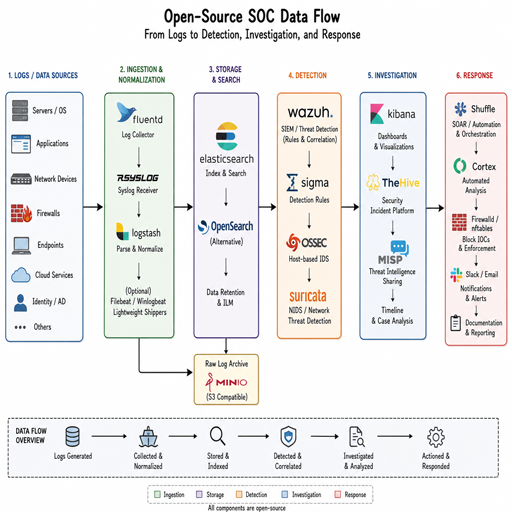
An open-source SOC is a security operations center built with community-driven, transparent, and customizable technologies instead of relying entirely on proprietary platforms. The goal is the same as any SOC: collect security data, detect suspicious activity, investigate alerts, respond quickly, and improve defenses over time. This guide explains how to approach an open-source SOC setup in a practical way, from planning and tooling to workflows, staffing, and soc best practices.
What does an open-source SOC need to do?
An open-source SOC needs to turn noisy technical signals into clear security decisions. At a minimum, it should collect logs and telemetry, normalize and search that data, generate meaningful detections, support investigations, coordinate response, and preserve evidence for review. Open source solutions can support each of these functions, but success depends less on installing many tools and more on designing a process that analysts can actually operate.
A strong security operations center usually covers five core capabilities:
- Visibility: Collect endpoint, network, identity, cloud, and application events in one place.
- Detection: Use rules, threat intelligence, baselines, and behavioral indicators to identify suspicious activity.
- Triage: Rank alerts by severity, confidence, and business impact so analysts focus on what matters.
- Response: Document repeatable actions for containment, eradication, recovery, and escalation.
- Improvement: Review incidents, tune rules, reduce false positives, and close visibility gaps.
Open source security works best when these capabilities are treated as a system. A log platform without response playbooks leaves analysts guessing. Detection rules without asset context create noise. Threat intelligence without validation can distract the team. The architecture should connect data, people, and process.
The foundation starts with scope and priorities
Before selecting open source tools, define what the SOC must protect and what risks matter most. A small organization may focus on endpoints, identity, email, and critical servers. A larger environment may also need cloud workload telemetry, container logs, network sensors, vulnerability data, and compliance reporting.
Start by answering practical scoping questions:
- What are the crown jewels? Identify the systems, data, and users that would cause the greatest damage if compromised.
- Where does useful telemetry exist? List log sources such as firewalls, authentication systems, servers, EDR agents, cloud platforms, and applications.
- Which threats are most realistic? Consider phishing, credential abuse, ransomware, exposed services, insider risk, and supply chain compromise.
- Who will respond? Clarify whether response is handled by IT, security, legal, leadership, or an external partner.
- What must be reported? Note audit, regulatory, insurance, customer, or executive reporting needs.
This planning stage prevents the common mistake of building a technically impressive platform that does not answer business-relevant security questions. The best open-source SOC setup starts narrow, proves value, then expands.
Core tool categories for an open source SOC
There is no single perfect stack. Most teams combine several open source solutions, each responsible for part of the SOC workflow. The exact choice should depend on team skill, infrastructure, data volume, and operational goals.
Log collection and SIEM-style analysis
The central platform should ingest logs, parse events, support search, and trigger detections. Common patterns include a log pipeline, searchable storage, dashboards, and alerting rules. This layer becomes the analyst’s main workspace, so reliability, query performance, and data quality matter more than visual polish.
When evaluating open source tools for this layer, check whether they support your most important log sources, retention needs, access control requirements, and rule formats. Also consider how easily your team can write, test, and maintain detections.
Endpoint and host monitoring
Endpoint telemetry helps identify malware behavior, suspicious processes, privilege escalation, persistence, and unauthorized changes. Host-based agents can monitor file integrity, system logs, running processes, configuration drift, and security events.
Endpoint data is especially valuable because many attacks unfold after an initial login or phishing event. Network logs may show a connection, but host telemetry can reveal what process made it, what user launched it, and what happened next.
Network detection and packet visibility
Network sensors add another angle by observing traffic patterns, protocol anomalies, lateral movement, command-and-control activity, and unexpected data transfers. They are useful in environments where endpoint coverage is incomplete or where servers, appliances, and unmanaged devices need monitoring.
Network detection works best when sensors are placed strategically. Monitor internet ingress and egress, critical internal segments, and paths to high-value systems. Avoid collecting more traffic than the team can store, analyze, and legally handle.
Case management and incident response
Alerts need a place to become investigations. Case management tools help track ownership, evidence, timelines, tasks, severity, and final outcomes. Without this layer, SOC work often gets scattered across chat, tickets, spreadsheets, and memory.
A good incident workflow should make it easy to answer: what happened, who is responsible, what actions were taken, what remains unresolved, and what should improve next time.
How should you design the SOC workflow?
Design the workflow around decisions, not dashboards. Analysts need a clear path from alert to triage, investigation, escalation, containment, and closure. The workflow should be simple enough to follow under pressure and detailed enough to produce consistent outcomes.
A practical open source soc workflow can look like this:
- Ingest telemetry: Collect logs from prioritized sources and verify that timestamps, hostnames, usernames, and event types are normalized.
- Apply detections: Use rules mapped to realistic threat scenarios, not just generic signatures.
- Enrich alerts: Add asset value, user context, threat intelligence, geolocation, vulnerability status, or recent authentication history.
- Triage quickly: Classify alerts as false positive, benign true positive, suspicious, or confirmed incident.
- Investigate deeply: Gather related events, endpoint evidence, network activity, and identity activity.
- Respond consistently: Follow playbooks for containment, communication, eradication, and recovery.
- Review and tune: Update detections, document lessons, and close process gaps.
This process keeps the SOC from becoming an alert factory. The purpose is not to generate the most alerts; it is to produce timely, confident action.
SOC best practices for open source environments
Open source security gives teams flexibility, transparency, and control, but it also requires discipline. Proprietary support may be limited or optional, integrations may need extra engineering, and updates must be managed carefully. Strong operating habits reduce those risks.
Use these soc best practices as guardrails:
- Start with high-value use cases. Build detections for credential abuse, phishing follow-up, malware execution, suspicious admin activity, and data exfiltration before chasing obscure threats.
- Normalize key fields early. Consistent usernames, IP addresses, hostnames, event IDs, and timestamps make investigations faster.
- Tune aggressively. Every noisy rule should be improved, suppressed, or retired. Alert fatigue is a design failure, not an analyst weakness.
- Document playbooks. Write response steps for common scenarios so the team does not improvise during incidents.
- Control access. Limit who can view sensitive logs, change detection rules, disable sensors, or close incidents.
- Back up configurations. Treat rules, parsers, dashboards, and playbooks as operational assets.
- Measure useful outcomes. Track false positive trends, time to triage, detection coverage, recurring incidents, and unresolved visibility gaps.
Security operations mature through repetition. A simple workflow that is reviewed every week will outperform a complex stack that nobody maintains.
Building detections that analysts trust
Detection quality is one of the biggest differences between a working SOC and a noisy one. Good detections are specific enough to be actionable but broad enough to catch meaningful variations of an attack technique. They also include context that helps an analyst understand why the alert matters.
Each detection should include:
- Purpose: What behavior or risk the rule is meant to identify.
- Data sources: Which logs are required for the rule to work.
- Logic: The conditions that trigger the alert.
- Severity: How urgent the alert should be and why.
- Triage steps: What the analyst should check first.
- False positive notes: Known benign causes and tuning options.
- Response guidance: Suggested containment or escalation steps.
Treat detections like living content. Attack techniques change, infrastructure changes, and business processes change. Review rules after incidents, major system changes, and repeated false positives.
Staffing, skills, and operating model
An open source SOC does not remove the need for skilled people. It changes the mix of skills required. Alongside security analysts, the team may need engineering capability to deploy tools, maintain pipelines, write parsers, automate enrichment, manage storage, and troubleshoot performance.
For smaller teams, roles may overlap. One person may handle platform administration, detection engineering, and incident coordination. That can work if expectations are realistic and the initial scope is controlled. As the SOC grows, separate responsibilities for platform operations, detection engineering, threat hunting, incident response, and governance become more important.
Training should focus on the environment the team actually defends. Analysts need to understand normal user behavior, critical systems, authentication flows, cloud architecture, and business processes. Tool knowledge matters, but environmental knowledge is what turns alerts into decisions.
A practical rollout plan
A phased rollout reduces risk and helps the team learn before the platform becomes business-critical. Begin with the minimum telemetry needed for meaningful detection, then expand based on gaps and lessons learned.
Phase 1: Baseline
- Define assets, stakeholders, escalation paths, and initial use cases.
- Deploy log collection for identity, endpoints, firewalls, and critical servers.
- Create dashboards for authentication, endpoint alerts, and high-severity events.
Phase 2: Detection and response
- Build rules for common threats and map each rule to a playbook.
- Add case management and standard severity definitions.
- Run tabletop exercises to test response ownership and communication.
Phase 3: Expansion and optimization
- Add network visibility, cloud logs, vulnerability context, and enrichment sources.
- Tune noisy detections and retire low-value alerts.
- Review metrics and improve coverage around the highest-risk assets.
Common pitfalls to avoid
The most common failure is treating an open source soc as a tool installation project. The platform may be running, but if logs are incomplete, rules are noisy, and nobody owns response, the SOC is not operational. Another pitfall is collecting everything immediately, which can create storage cost, performance issues, privacy concerns, and analyst overload.
Avoid these mistakes in particular:
- Choosing tools before defining use cases.
- Ignoring log quality and timestamp consistency.
- Building detections without triage instructions.
- Giving every alert the same priority.
- Failing to patch and maintain the SOC stack itself.
- Measuring activity instead of outcomes.
Open source tools can provide a powerful foundation, but they still need governance, ownership, and continuous care.
The path to a sustainable open-source SOC
A sustainable open-source SOC is built in layers: clear scope, reliable telemetry, useful detections, disciplined response, and regular improvement. Start with the risks that matter most, prove that the team can detect and respond to them, then expand coverage carefully.
The strongest security operations center is not the one with the longest tool list. It is the one where analysts can see what matters, understand why it matters, and act before a security event becomes a business crisis.
