
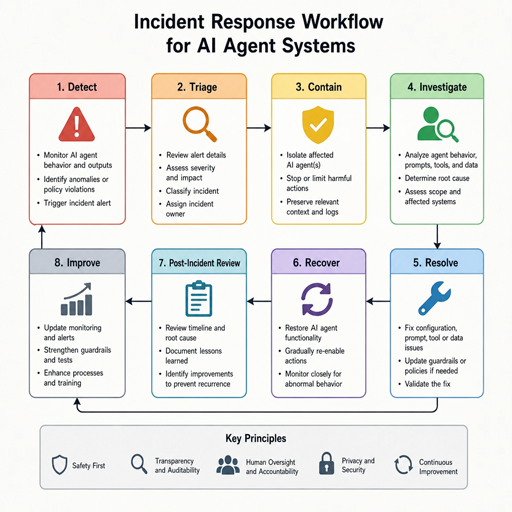
Open source incident response playbooks give teams a practical starting point for handling security incidents without writing every procedure from scratch. They are especially useful for AI agent systems, where leaked API tokens, prompt abuse, unsafe tool calls, data exposure, and dependency compromise can move quickly across connected services. This guide explains how to structure playbooks, adapt them for TypeScript AI agent environments, and align them with an incident management plan that supports NIST-style response, GDPR duties, and SOC 2 expectations.
What should an open source incident response playbook include?
An effective playbook should tell responders what to do, who owns each step, what evidence to preserve, and when to escalate. It should be specific enough to guide action during pressure, but flexible enough to fit different systems, cloud providers, model vendors, and business processes.
For AI agent systems, the playbook needs to cover both traditional security incident response and AI-specific failure modes. A leaked API token may not only expose infrastructure; it may let an attacker trigger agent workflows, access tools, query data stores, or generate costly automated actions. A strong incident response guide connects technical containment with legal, privacy, communications, and post-incident review work.
A useful open source template normally includes:
- Trigger conditions: What event activates the playbook, such as exposed credentials, abnormal agent behavior, suspicious outbound requests, or unauthorized access.
- Severity criteria: How to classify impact based on data sensitivity, customer exposure, system privilege, business disruption, and regulatory risk.
- Roles and ownership: Incident commander, technical lead, communications lead, legal/privacy contact, customer support contact, and executive escalation path.
- Containment steps: How to revoke secrets, pause agents, disable tools, rotate credentials, block indicators, isolate workloads, or limit automation.
- Evidence handling: Logs, prompts, model responses, tool calls, token usage, deployment history, commits, alerts, and access records to preserve.
- Recovery steps: Validation, redeployment, key rotation confirmation, regression checks, and monitoring after service restoration.
- Lessons learned: Root cause, detection gaps, control improvements, owner assignments, and follow-up deadlines.
Why AI agent systems need specialized response plans
AI agents often combine model reasoning, code execution, external APIs, memory, queues, SaaS integrations, and privileged tools. That means one exposed secret or unsafe instruction can create a chain reaction that is harder to understand than a single compromised web app endpoint.
Traditional incident response playbooks still matter: identify, contain, eradicate, recover, and learn. The difference is that AI systems add new evidence sources and containment decisions. Responders may need to inspect prompt history, tool invocation logs, vector database queries, retrieved documents, agent memory, autonomous task queues, and model provider audit logs. If those sources are not defined before an incident, teams may lose valuable context.
For teams building TypeScript AI agents, the response plan should account for where secrets are stored, how tools are registered, how agents call APIs, and how permissions are enforced at runtime. A TypeScript service may use environment variables, serverless secrets, CI/CD variables, package dependencies, browser-facing code, and backend orchestration. The playbook should help responders quickly answer: was the token exposed, was it used, what could it access, and what must be rotated?
Core playbooks every team should maintain
A complete incident management plan does not need hundreds of documents. It should start with a small set of high-value playbooks that match the most realistic risks, then improve them after exercises and real events.
Leaked API tokens
This is one of the most important incident response playbooks for AI agent systems. Tokens may belong to model providers, cloud services, observability tools, internal APIs, databases, payment systems, or third-party SaaS accounts. The first priority is containment: revoke or rotate the token, identify where it was exposed, and stop any running agent jobs that may be using it.
The playbook should also require a usage review. Check provider dashboards, audit logs, billing changes, unusual request volume, unfamiliar IP addresses, suspicious prompts, and unexpected tool calls. If the token could access personal data, customer data, or regulated records, privacy and legal stakeholders should assess notification duties under frameworks such as GDPR.
Prompt injection and unsafe tool use
Prompt injection can cause an agent to ignore instructions, reveal data, call tools incorrectly, or perform unauthorized actions. The response should focus on scope: which users, sessions, documents, tools, and downstream systems were affected. Containment may include disabling specific tools, blocking a retrieval source, changing system prompts, tightening allowlists, or moving high-risk actions behind human approval.
Evidence matters here. Save the original input, retrieved context, model output, tool arguments, authorization checks, and final action. Without this chain, teams may fix the visible symptom while missing the weak control that allowed the agent to act.
Data exposure through retrieval or memory
AI agents may expose sensitive data through retrieval-augmented generation, logs, cached prompts, memory stores, or overbroad connectors. The playbook should identify the source of the data, who received it, whether it was stored elsewhere, and how access controls failed. Recovery may require deleting memory entries, correcting document permissions, purging logs, and retesting retrieval boundaries.
Dependency, package, and build compromise
TypeScript projects depend on npm packages, lockfiles, CI pipelines, deployment tokens, and build artifacts. A compromised dependency or malicious package update can affect agent behavior and secrets. The playbook should include freezing deployments, checking recent dependency changes, reviewing CI logs, rotating build credentials, and redeploying from a trusted commit.
How do NIST, GDPR, and SOC 2 fit into AI incident response?
NIST, GDPR, and SOC 2 do not replace playbooks; they shape what the playbooks must prove. NIST-style guidance helps teams organize the response lifecycle, GDPR focuses attention on personal data risk and notification analysis, and SOC 2 emphasizes controlled, repeatable processes with evidence.
For practical use, map each playbook step to a control need. Detection steps support monitoring and alerting. Escalation steps support governance. Evidence collection supports auditability. Post-incident review supports continuous improvement. This is how ai incident response playbooks nist gdpr soc2 for ai agents become operational documents rather than compliance language pasted into a policy.
A simple alignment checklist can help:
- Preparation: Owners, contact paths, access to logs, token inventory, data maps, and approval paths are documented.
- Detection: Alerts cover token exposure, abnormal usage, failed authorization, unusual tool calls, and unexpected data access.
- Containment: Teams can disable agents, revoke credentials, block tools, and isolate affected services quickly.
- Assessment: Privacy, security, and business impact are reviewed using consistent severity criteria.
- Communication: Internal updates, customer communications, and regulator considerations have named owners.
- Evidence: Decisions, timestamps, logs, and remediation actions are recorded for review and audit.
- Improvement: Findings produce control changes, not just a closed ticket.
Building open source playbooks for TypeScript AI agents
Start with a generic security incident response structure, then add the AI and TypeScript details your team will actually need during an incident. The best playbooks are short enough to use live, but detailed enough to prevent guesswork.
A practical TypeScript AI agent security incident response playbook should document:
- Where secrets live: local .env files, CI variables, cloud secret managers, deployment platforms, and provider dashboards.
- How agents are paused: feature flags, queue suspension, deployment rollback, route blocking, or tool registry changes.
- Where logs live: application logs, model provider logs, tracing systems, vector database logs, API gateway records, and CI/CD history.
- Which tools are high risk: email sending, file access, database writes, payment actions, admin APIs, code execution, and external webhooks.
- How authorization works: user identity, tenant boundaries, tool-level permissions, service accounts, and approval gates.
- How recovery is verified: tests for prompt injection, permission boundaries, token validity, retrieval filtering, and unexpected tool execution.
Keep the language action-oriented. “Investigate logs” is weaker than “review model provider usage for the exposed key from the first known exposure time through revocation.” Specific verbs reduce confusion and make handoffs cleaner.
Common mistakes that weaken incident response playbooks
Many teams have documents that look complete but fail during real incidents. The problem is usually not effort; it is lack of operational detail. If responders cannot identify owners, find logs, revoke access, or classify severity quickly, the playbook is not ready.
Avoid these patterns:
- No clear incident commander: Decisions scatter across chat threads and slow containment.
- Missing AI evidence sources: Prompt history, tool calls, and retrieval context are ignored or overwritten.
- Unowned communication steps: Legal, privacy, support, and leadership learn about the incident too late.
- Overly broad severity labels: Every incident becomes “high,” or impact is minimized without analysis.
- No token inventory: Responders cannot tell what a leaked credential could access.
- No exercises: The first test of the playbook happens during a real emergency.
Maintaining playbooks as living documents
Open source incident response playbooks are starting points, not finished systems. Review them after architecture changes, new agent tools, new data connections, vendor changes, compliance updates, and tabletop exercises. Every meaningful incident or near miss should improve the process.
Assign an owner to each playbook and keep version history visible. Store templates where engineering, security, privacy, and operations teams can access them during an outage or account lockout. If your AI agents are business-critical, test the playbooks with realistic scenarios: leaked model key, malicious document injection, overbroad retrieval, compromised npm package, and unauthorized tool execution.
Good incident response is not just fast reaction. It is prepared coordination, reliable evidence, controlled containment, and disciplined learning. With focused open source templates adapted to AI agent systems, teams can move from improvisation to repeatable security incident response.
