
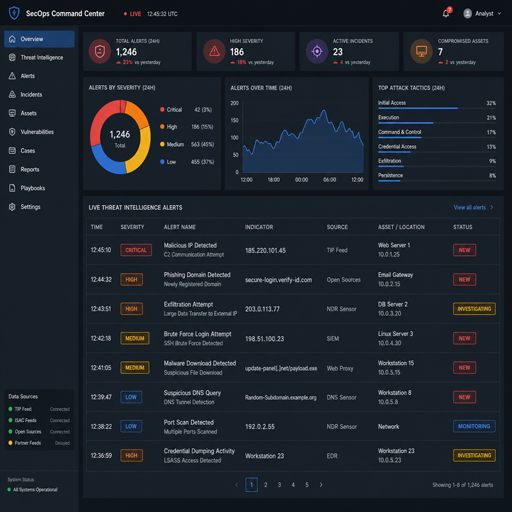
Real-time threat intelligence feeds give security teams a continuous stream of information about active and emerging cyber threats. They help organizations spot malicious indicators, understand attacker behavior, and respond faster than they could with static reports or manual research alone. Used well, these feeds turn scattered threat signals into actionable context for monitoring, detection, investigation, and prevention.
What are real-time threat intelligence feeds?
Real-time threat intelligence feeds are continuously updated sources of threat data that security tools and analysts use to identify suspicious or malicious activity as it appears. They may include indicators such as IP addresses, domains, URLs, file hashes, malware signatures, command-and-control infrastructure, phishing artifacts, vulnerability context, and attacker tactics. The goal is not simply to collect more data; it is to deliver timely, relevant intelligence that helps defenders make faster and better decisions.
Unlike periodic reports, live threat intelligence is designed to move at the pace of modern attacks. A malicious domain may be useful to know about today and irrelevant next week. An IP address used in a campaign may shift quickly. A vulnerability may become more urgent once exploitation activity is observed in the wild. Real-time threat data helps security teams account for that constant movement.
A feed can come from many sources, including commercial providers, open-source communities, industry sharing groups, internal telemetry, malware analysis systems, honeypots, dark web monitoring, phishing detection platforms, and incident response findings. The strongest programs usually combine multiple sources, then filter and enrich them so the organization is not buried under noise.
Why real-time intelligence matters in modern security
Cybersecurity has become a timing problem as much as a technology problem. Attackers automate scanning, credential abuse, phishing, exploitation, and lateral movement. If defenders rely only on delayed reports, stale blocklists, or manual investigation, they may see a threat after the opportunity to contain it has already passed.
Real-time threat intelligence feeds support proactive threat intelligence by helping teams move from “What happened?” to “What is happening now, and what should we do next?” That shift matters across the entire security lifecycle. Detection teams can improve alert accuracy. Security operations centers can triage events with more context. Incident responders can connect indicators to known campaigns. Vulnerability teams can prioritize exposures based on active exploitation rather than theoretical severity alone.
Timely intelligence is especially useful when an organization faces threats that change quickly, such as phishing campaigns, botnet activity, ransomware infrastructure, newly weaponized vulnerabilities, and credential-stuffing attacks. In these cases, a few hours can change the risk picture. A feed that updates continuously gives teams a better chance to block, detect, or investigate before damage spreads.
The core components of a useful feed
A threat feed is only valuable if its contents are relevant, trustworthy, and usable. Many organizations start by subscribing to multiple cybersecurity threat feeds, only to discover that more data can create more confusion. The real value comes from the quality of the intelligence and how well it fits the environment.
Indicators of compromise
Indicators of compromise, often called IOCs, are the most familiar content type in threat intelligence feeds. They include data points that may suggest malicious activity, such as suspicious IP addresses, malware file hashes, hostile domains, phishing URLs, registry keys, email sender patterns, or network artifacts.
IOCs are useful because they can often be matched directly against logs, endpoint telemetry, email gateways, firewalls, intrusion detection systems, and SIEM data. However, they have limits. Attackers can change infrastructure quickly, and some indicators may overlap with legitimate services. This is why IOCs should be enriched with context, confidence, severity, and expiration guidance wherever possible.
Tactics, techniques, and procedures
Tactics, techniques, and procedures, or TTPs, describe how attackers behave rather than only what specific infrastructure they use. Examples include phishing with malicious attachments, abusing valid accounts, exploiting public-facing applications, using remote management tools, or disabling security controls.
TTP-based intelligence is often more durable than a list of indicators. A domain can disappear overnight, but an attacker’s method may remain consistent across campaigns. Strong threat monitoring solutions combine fast-moving indicators with behavioral intelligence so defenders can detect both known artifacts and suspicious patterns.
Vulnerability and exploit context
Not every vulnerability deserves the same level of urgency. Real-time threat data can help teams understand which vulnerabilities are being discussed, scanned for, exploited, or packaged into attack tooling. That context helps security and IT teams prioritize patching, compensating controls, detection engineering, and executive communication.
This is particularly important for organizations with large asset inventories. A purely severity-based approach can produce overwhelming patch queues. A threat-informed approach asks: Is this weakness exposed in our environment? Is exploitation active? Are our critical systems affected? Do we have detection coverage? That framing turns vulnerability management into a more practical risk decision.
Reputation and risk scoring
Some feeds provide scores for IPs, domains, files, or URLs based on observed behavior and confidence. These scores can help automation tools decide whether to block, alert, allow, or send an event for human review. They are especially useful when paired with transparent reasoning, such as category, first-seen date, last-seen date, source count, or associated malware family.
Scores should not be treated as magic answers. A high-risk score may still need validation, and a low-risk score does not guarantee safety. The best use of scoring is to support consistent prioritization, not to replace analyst judgment.
Common types of threat intelligence feeds
Threat intelligence feeds vary widely in focus, format, and depth. Choosing the right mix depends on what you need to protect, which tools you use, and how mature your security operations are.
|
Feed type |
What it provides |
Best used for |
|---|---|---|
|
Malware feeds |
File hashes, signatures, family names, sandbox results |
Endpoint detection, malware triage, incident response |
|
Phishing feeds |
Suspicious URLs, domains, email artifacts, lure patterns |
Email security, brand protection, user protection |
|
IP reputation feeds |
Risky IPs, botnet nodes, scanners, proxy activity |
Firewall rules, SIEM enrichment, network monitoring |
|
Domain and DNS feeds |
Malicious domains, newly registered domains, DNS patterns |
Web filtering, detection engineering, threat hunting |
|
Vulnerability feeds |
Exploit activity, affected software, risk context |
Patch prioritization, exposure management |
|
Dark web and credential feeds |
Leaked credentials, chatter, marketplace signals |
Account protection, fraud monitoring, investigation |
|
Industry-specific feeds |
Threats targeting a sector or community |
Sector-focused monitoring and executive risk awareness |
Most organizations do not need every possible feed. A healthcare provider, a financial institution, a SaaS company, and a manufacturer may all require different coverage. The best feed strategy begins with the organization’s threat model, not with a shopping list of data sources.
How do real-time feeds support security operations?
Real-time feeds support security operations by adding current threat context to the tools and workflows teams already use. Instead of asking analysts to research every suspicious event from scratch, feeds can enrich alerts, identify known malicious infrastructure, surface related activity, and help teams decide what deserves immediate attention. This makes security operations faster, more consistent, and more scalable.
SIEM enrichment and alert triage
Security information and event management platforms collect logs from across the environment. Without context, those logs can be difficult to interpret. Threat intelligence feeds enrich events by showing whether an IP, domain, URL, or hash has been associated with malicious activity.
For example, a login attempt from an unusual location may be interesting. If the source IP also appears in a recent credential-stuffing feed, the alert becomes more urgent. If several users receive email messages that link to a domain recently associated with phishing, the SOC can escalate faster and search for related activity across mail, endpoint, and web logs.
Firewall, proxy, and email controls
Feeds can be used to update blocking and filtering controls. Network devices may block connections to known command-and-control servers. Secure web gateways may restrict access to suspicious URLs. Email security tools may quarantine messages that contain known phishing indicators.
Automation is useful, but it should be governed carefully. Blocking based on low-confidence indicators can disrupt business, especially when shared infrastructure or cloud services are involved. Many teams use different action levels: automatically block high-confidence threats, monitor medium-confidence signals, and enrich low-confidence events for analyst review.
Endpoint detection and response
Endpoint detection and response tools can compare local activity against threat intelligence feeds. File hashes, process behavior, command-line patterns, registry changes, and network destinations may all be enriched with external context. This helps analysts understand whether an endpoint alert is isolated noise or part of a broader campaign.
EDR integration is especially helpful during investigations. If a malicious file hash appears on one workstation, the team can quickly search for the same indicator across the fleet. If related domains or payloads are known, analysts can expand the scope of the investigation with less guesswork.
Threat hunting and detection engineering
Threat hunters use intelligence to form hypotheses. Instead of waiting for alerts, they ask questions such as: Are we seeing infrastructure associated with a current malware campaign? Do our logs show behavior consistent with a known technique? Are attackers scanning our exposed services after a recent vulnerability disclosure?
Detection engineers use the same intelligence to build and refine rules. A feed may reveal new infrastructure, but the deeper value is often in the pattern behind it. A team can convert that pattern into behavioral detections that remain useful even after individual indicators expire.
Benefits of proactive threat intelligence
Proactive threat intelligence helps teams reduce uncertainty before an incident becomes severe. It does not eliminate risk, but it improves the odds that the organization sees relevant signals early and responds with context.
Key benefits include:
- Earlier detection: Live threat intelligence can reveal suspicious activity that would otherwise look routine in isolation.
- Better prioritization: Analysts can focus on alerts linked to active campaigns, high-confidence malicious indicators, or relevant vulnerabilities.
- Faster investigations: Enriched data reduces time spent manually researching indicators across separate tools and sources.
- Stronger prevention: Security controls can block or challenge known malicious infrastructure before users or systems interact with it.
- Improved threat hunting: Teams can search for behaviors and indicators associated with current attacker activity.
- More informed vulnerability management: Patch decisions can account for exploit activity and exposure, not only severity ratings.
- Clearer communication: Security leaders can explain risk using current intelligence instead of abstract technical findings.
The practical result is a security program that reacts less blindly. Instead of treating every alert as a standalone event, the team can connect it to a broader picture of threat activity.
The difference between data, information, and intelligence
One common mistake is treating any feed as intelligence simply because it contains security-related data. Raw data becomes useful only when it is organized, contextualized, and connected to a decision.
Data is a fact without much interpretation. An IP address, file hash, or domain name may be data. Information adds meaning, such as when that domain was first observed, what malware family used it, or how confident the source is. Intelligence goes a step further: it helps someone decide what to do.
For example, “domain.example appeared in a phishing campaign yesterday” is more useful than the domain alone. “Block this domain in the email gateway, search for access attempts in proxy logs, and reset credentials for users who clicked” is intelligence applied to action. Real-time threat intelligence feeds are most valuable when they help make that final leap.
How to evaluate threat monitoring solutions
The right threat monitoring solutions should fit your environment, risk profile, tooling, and team capacity. A feed that is excellent for one organization may be noisy or irrelevant for another. Evaluation should focus on operational value rather than the largest number of indicators.
Relevance to your environment
Start by asking whether the feed covers the threats that matter to your organization. A company with heavy cloud adoption may need intelligence related to identity abuse, exposed services, SaaS threats, and cloud misconfiguration exploitation. A retailer may care deeply about payment fraud, credential abuse, phishing, and brand impersonation. A manufacturer may prioritize ransomware, remote access exposure, and operational technology risk.
Relevance also includes geography, industry, technology stack, and attacker interest. Generic global feeds can be useful, but targeted intelligence often produces better signal. The more closely a feed maps to your actual exposure, the more likely it is to produce actionable results.
Timeliness and update frequency
For real-time threat intelligence feeds, speed matters. Look for clear information about update frequency, first-seen and last-seen timestamps, expiration practices, and delivery methods. A feed that updates frequently but leaves outdated indicators active for too long may create unnecessary alerts.
Timeliness is not only about speed of publication. It is also about how quickly your systems can ingest and use the data. If a feed updates every few minutes but your SIEM imports it once per day, you are not getting real-time value.
Confidence, context, and transparency
A useful feed should explain why an indicator is included. Confidence scores, source descriptions, malware associations, campaign names, observed behavior, and timestamps help analysts judge reliability. Without context, teams may either overreact to weak signals or ignore valuable ones.
Transparency also supports tuning. If many alerts come from low-confidence indicators, the team can adjust thresholds. If certain categories consistently produce value, they can be prioritized for automation.
Integration and format support
Feeds should work with your existing security stack. Common delivery methods include APIs, TAXII, STIX, JSON, CSV, syslog, platform-native integrations, and direct connectors for SIEM, SOAR, EDR, firewall, email, and web security tools.
Integration quality is more than format compatibility. Good integrations preserve metadata, support deduplication, allow flexible filtering, and make it easy to map indicators to actions. A feed that requires constant manual handling may not deliver value at operational speed.
Noise control and false positive management
Every feed can produce false positives. The question is whether the provider and your internal processes make them manageable. Look for clear confidence levels, indicator aging, allowlist support, feedback loops, and the ability to separate monitoring from blocking.
Noise is not just annoying; it consumes analyst attention and can reduce trust in the intelligence program. A smaller set of high-quality indicators may outperform a massive feed that overwhelms the team.
Implementation roadmap for real-time threat data
Successful implementation requires more than connecting a feed to a tool. Teams need goals, ownership, workflows, and tuning. A practical rollout can follow these steps:
- Define the use cases. Decide whether the feed will support blocking, alert enrichment, threat hunting, vulnerability prioritization, fraud monitoring, incident response, or all of these.
- Map the data to tools. Identify where the feed should be consumed, such as SIEM, SOAR, EDR, firewall, email gateway, web proxy, vulnerability platform, or ticketing system.
- Set action thresholds. Determine which indicators can trigger automatic blocks, which should create alerts, and which should only enrich existing events.
- Start with monitoring. Before enforcing blocks broadly, observe alert volume, false positives, and relevance to your environment.
- Tune by category and confidence. Adjust based on source, threat type, confidence score, business impact, and asset criticality.
- Create investigation playbooks. Define what analysts should do when a feed match occurs, including log searches, containment steps, user checks, and escalation paths.
- Measure operational value. Track whether the feed improves triage, detection, response speed, or prioritization. Remove sources that add noise without action.
- Review continuously. Threats, tools, and business priorities change. Feed strategy should evolve with them.
This roadmap helps avoid a common failure pattern: buying intelligence first and deciding how to use it later. The most effective teams begin with decisions they need to improve, then choose and tune feeds around those decisions.
Best practices for using cybersecurity threat feeds
Cybersecurity threat feeds should be part of a broader intelligence process, not a standalone security strategy. They work best when they are validated, enriched, governed, and connected to response.
A strong operating model includes:
- Use multiple sources, but curate aggressively. Diverse sources improve coverage, but every source should earn its place through relevance and quality.
- Enrich before acting. Combine feed matches with asset context, user behavior, geolocation, business criticality, and recent activity.
- Apply expiration dates. Indicators should age out when they are no longer useful, especially fast-changing infrastructure.
- Separate detection from prevention. Not every match should become a block. Use confidence and impact to decide the action.
- Protect business-critical workflows. Test blocking rules carefully for systems that depend on third-party platforms, cloud services, or partner networks.
- Document analyst decisions. Capture why an alert was escalated, ignored, or tuned out so the process improves over time.
- Feed lessons back into controls. Incident findings should improve detection rules, allowlists, blocklists, and future intelligence requirements.
These practices help turn threat intelligence feeds from a stream of alerts into a disciplined capability. The goal is not to know about every threat on the internet. The goal is to know which threats matter to your organization and what to do about them.
Common mistakes to avoid
Many threat intelligence programs struggle because they focus on volume rather than value. More indicators do not automatically mean stronger protection. In fact, too much low-quality data can slow analysts down and make important signals harder to find.
Another mistake is enabling automatic blocking too quickly. Real-time feeds can support prevention, but only when confidence is high and business impact is understood. Blocking a shared IP address, a cloud-hosted service, or a legitimate domain that was briefly compromised can create avoidable disruption.
Teams also run into trouble when they do not assign ownership. Threat intelligence touches security operations, incident response, network security, vulnerability management, fraud teams, and leadership reporting. Without clear responsibility, feeds may be purchased, connected, and then left untuned.
Finally, organizations sometimes fail to measure outcomes. If a feed generates thousands of alerts but rarely changes a decision, it may not be useful. Metrics should focus on value: confirmed detections, faster triage, reduced manual research, better patch prioritization, and improved response quality.
Choosing the right feed mix
The right feed mix depends on your risk, maturity, and capacity. Smaller teams often benefit from a focused set of high-confidence feeds integrated into existing tools. Larger teams may use specialized feeds for malware, phishing, vulnerability exploitation, dark web activity, brand abuse, and industry-specific threats.
A practical selection checklist includes:
- Does the feed cover threats that are relevant to our industry, geography, technology, and exposure?
- Does it provide enough context for analysts to understand why an indicator matters?
- Does it update quickly enough for our use case?
- Does it integrate cleanly with our SIEM, EDR, firewall, SOAR, or other platforms?
- Can we filter by confidence, category, severity, source, and age?
- Can we test it before using it for automated blocking?
- Does it reduce investigation time or improve detection quality?
- Do we have enough staff and process maturity to use it effectively?
The answers should guide procurement and implementation. A feed that supports a clear workflow is more valuable than one that looks impressive in isolation.
Turning feeds into decisions
The real power of real-time threat intelligence feeds comes from decision support. A feed should help a team decide whether to block a connection, escalate an alert, open an investigation, patch a system, warn users, reset credentials, or brief leadership.
That requires a chain from signal to action. First, the feed provides current threat data. Next, security tools correlate that data with internal telemetry. Then analysts or automation workflows assess context, confidence, and business impact. Finally, the organization takes a defined action and records the outcome.
When this chain works, threat intelligence becomes more than a subscription. It becomes a feedback system for security operations. Each investigation teaches the team which sources are useful, which detections need tuning, which assets are most exposed, and which response steps work best.
A practical way forward
Real-time threat intelligence feeds are most effective when they are timely, relevant, contextual, and connected to action. They help security teams monitor active threats, prioritize risk, enrich alerts, guide investigations, and support faster response. But they only deliver value when paired with clear use cases, thoughtful integration, tuning, and human judgment.
For organizations building or improving a threat intelligence program, the best starting point is simple: identify the decisions you need to make faster. Then choose threat intelligence feeds and threat monitoring solutions that improve those decisions with reliable, current, and actionable context. That approach keeps the program focused on outcomes instead of data volume—and helps turn live threat intelligence into practical security advantage.
