
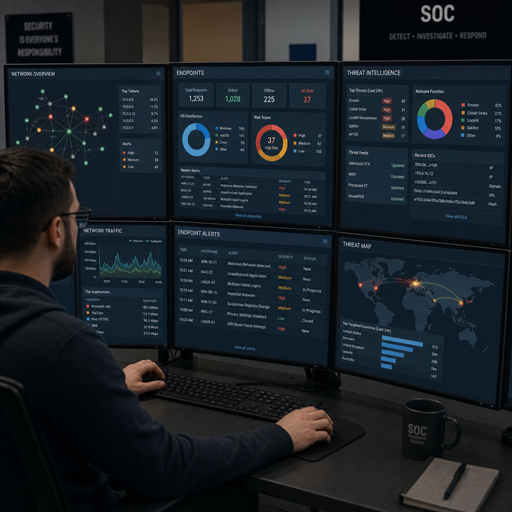
Threat hunting works best when analysts can ask better questions of their data, test hypotheses quickly, and preserve evidence as an investigation develops. Open source threat hunting tools can help teams build that capability without locking every workflow into one vendor. The strongest results usually come from combining network visibility, endpoint telemetry, detection logic, threat intelligence, and case management into a repeatable process.
What makes an open source tool useful for threat hunting?
A useful threat hunting tool helps analysts move from suspicion to evidence. It should collect the right telemetry, make that data searchable, support repeatable detection logic, and integrate with the rest of the security stack. Open source security also brings transparency: teams can inspect rules, tune parsers, adapt workflows, and learn from active communities instead of treating the platform like a black box.
When evaluating Open source threat hunting tools, focus less on popularity and more on fit. A packet analysis tool will not replace endpoint visibility, and a threat intelligence platform will not magically validate every indicator. The best threat hunting software gives your team context, speed, and confidence.
Use this practical checklist before adding another tool:
- Telemetry coverage: Does it see network traffic, host behavior, logs, files, or intelligence?
- Query and search quality: Can analysts pivot quickly from one clue to related activity?
- Detection portability: Can rules be reused across environments or converted into other formats?
- Integration options: Does it support APIs, connectors, exports, or standard formats?
- Operational burden: Can your team deploy, update, monitor, and tune it reliably?
- Investigation workflow: Does it help document findings, assign tasks, and preserve decisions?
Core open source tools for the hunting workflow
No single product covers every hunting need. The tools below are best understood as building blocks, each serving a distinct role in investigation, validation, and response.
Network visibility tools
Zeek is one of the most valuable open source tools for network-focused hunting. Rather than only generating alerts, it creates rich logs about protocols, connections, files, DNS, HTTP, TLS, and other activity. The project describes Zeek as an open source network security monitoring tool built for deep visibility into network traffic, which makes it especially useful when hunters need to reconstruct what happened before and after an alert.
Suricata complements Zeek by adding signature-based network detection, intrusion prevention options, network security monitoring, and packet analysis capabilities. It is useful when teams want known-bad traffic detection alongside protocol metadata and alerting. Suricata is often deployed at network choke points, cloud taps, or lab environments where analysts need to test rules against packet captures.
Security Onion is a broader platform for teams that want a packaged environment instead of assembling every component manually. Its documentation describes it as a free and open platform with network visibility, host visibility, intrusion detection, log management, threat hunting, and case management. It includes components such as Suricata, Zeek, Osquery, Elasticsearch-backed search, and dedicated interfaces for alerts and hunting.
Wireshark remains essential for deep packet inspection. It is not a hunting platform by itself, but it is one of the best threat analysis tools for validating suspicious traffic at the packet level. When a Zeek log or Suricata alert points to unusual behavior, Wireshark helps analysts inspect conversations, protocol fields, payload clues, and timing details.
Endpoint and system investigation tools
Osquery turns operating system state into queryable tables. Analysts can use SQL-like queries to inspect processes, users, listening ports, scheduled tasks, browser extensions, packages, and many other host artifacts. The project describes osquery as SQL-powered operating system instrumentation, monitoring, and analytics, which makes it a strong fit for hypothesis-driven endpoint hunts.
Velociraptor is designed for endpoint monitoring, digital forensics, and cyber response. It is especially useful when hunters need to collect artifacts from many systems, investigate persistence, examine execution traces, or validate whether suspicious activity occurred across a fleet. Its documentation positions it as an enterprise-grade open source platform for endpoint monitoring, digital forensic work, and incident response.
Wazuh gives teams an open source XDR and SIEM-style foundation for endpoint and cloud workload visibility. It can centralize security events, support detection and compliance use cases, and help smaller teams create a searchable monitoring layer without starting from scratch. Wazuh documentation describes it as a free and open source security platform that unifies XDR and SIEM capabilities.
Detection, malware, and intelligence tools
Sigma is not a sensor; it is a portable detection rule format. It helps teams write shareable logic for suspicious log events, then adapt that logic to different SIEM or search back ends. Sigma’s official site describes it as a generic, open, structured detection format for detecting relevant log events in a simple, shareable way.
YARA is built for pattern matching in files and malware samples. It helps analysts identify and classify malware families using strings, byte patterns, regular expressions, and rule conditions. YARA’s documentation describes it as a tool aimed at helping malware researchers identify and classify malware samples, making it a staple in malware triage and file-based hunts.
MISP is a threat intelligence sharing platform for collecting, storing, distributing, and sharing indicators and context related to cybersecurity incidents and malware analysis. It is useful when teams need to manage indicators, correlate sightings, and share intelligence internally or with trusted communities.
OpenCTI focuses on structuring cyber threat intelligence into a knowledge graph. It can manage observables, reports, relationships, threat actors, campaigns, and TTPs, with a schema based on STIX2 and integrations with tools such as MISP, TheHive, and MITRE ATT&CK.
MITRE ATT&CK is one of the most important threat hunting resources because it gives hunters a shared language for adversary behavior. MITRE describes ATT&CK as a globally accessible knowledge base of adversary tactics and techniques based on real-world observations. Hunters can use it to turn vague concerns, such as “lateral movement,” into specific techniques and data questions.
TheHive helps investigation teams organize cases, tasks, observables, and collaboration. It is most useful after a hunt produces findings that need triage, escalation, enrichment, or incident response tracking. The project describes TheHive as a scalable, open source and free security incident response platform.
How should these tools work together?
These cybersecurity tools work best as a pipeline: collect telemetry, enrich it with intelligence, hunt for behavior, validate evidence, and document the outcome. For example, Zeek or Suricata may reveal suspicious outbound traffic, Osquery or Velociraptor can check the endpoint, Sigma can turn the behavior into reusable detection logic, MISP or OpenCTI can add intelligence context, and TheHive can track the investigation.
A practical open source hunting stack might look like this:
- Collect network data with Zeek, Suricata, or Security Onion.
- Collect endpoint data with Osquery, Wazuh, or Velociraptor.
- Map behaviors to MITRE ATT&CK tactics and techniques.
- Search and test hypotheses using logs, packets, endpoint artifacts, and alerts.
- Write reusable detections with Sigma for logs and YARA for files.
- Enrich indicators in MISP or OpenCTI before acting on them.
- Document the case in TheHive or another incident workflow.
This structure prevents tool sprawl. Instead of deploying open source tools because they are interesting, each one has a job in the hunt.
Choosing the right starting point
If your team is new to hunting, begin with visibility. You cannot hunt what you do not collect. Security Onion is a strong lab or small-team starting point because it brings several capabilities together, while a more mature team may prefer to deploy Zeek, Suricata, Wazuh, and Velociraptor as separate, tuned components.
If your biggest gap is endpoint evidence, prioritize Osquery or Velociraptor. If your gap is detection engineering, start with Sigma and ATT&CK mapping. If your analysts are drowning in disconnected indicators, invest time in MISP or OpenCTI before adding another alert source.
The most effective open source security programs also set rules for maintenance. Assign owners, review detections, prune noisy indicators, back up configurations, and test upgrades before production rollout. Free licensing does not remove the need for engineering discipline.
Final takeaway
Open source threat hunting tools give defenders a flexible way to build real investigative capability. Zeek, Suricata, Security Onion, Wireshark, Osquery, Velociraptor, Wazuh, Sigma, YARA, MISP, OpenCTI, ATT&CK, and TheHive each solve a different part of the problem. Choose the tools that match your telemetry gaps, connect them into a workflow, and turn every hunt into reusable knowledge your team can apply next time.
