
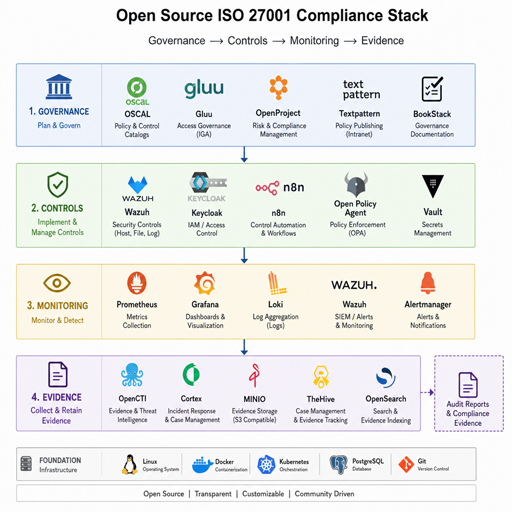
ISO 27001 can be supported with open source, but not by tools alone. The standard is about building and operating an information security management system, so open source software helps most when it produces repeatable controls, evidence, monitoring, and review workflows. This guide explains where open source security tools fit, where they do not, and how to build a practical compliance stack without mistaking “free” for “audit-ready.”
Can open source meet ISO 27001 requirements?
Yes, open source can help an organization meet many ISO 27001 requirements, provided the organization still owns the risk assessment, policies, control selection, evidence, management review, and continual improvement. ISO describes ISO/IEC 27001 as a standard for establishing an information security management system and applying risk management in a way that fits the organization’s size and needs. Open source software can support that system, but it does not replace governance, accountability, documented decisions, or certification audit preparation.
A useful way to think about ISO 27001 open source adoption is this: the standard asks whether your security management system is designed, implemented, monitored, reviewed, and improved. Tools help you prove that those things happen. They collect logs, scan infrastructure, enforce baselines, track vulnerabilities, manage access, and preserve evidence. They do not decide your risk appetite, write meaningful policies for your business, or explain why a control was included or excluded.
That distinction matters because many organizations start by searching for iso compliance software and hoping one platform will “make them compliant.” A better goal is to design an evidence system. Open source compliance works best when every tool has a clear job, every output maps to a control or risk treatment, and someone is responsible for reviewing exceptions.
ISO 27001 is a management system, not a tool checklist
ISO 27001 focuses on an information security management system, often shortened to ISMS. An ISMS is the operating model for information security: scope, leadership commitment, risk assessment, control implementation, performance measurement, internal audit, corrective action, and improvement. The technical controls are important, but they sit inside that broader management system.
The 2022 version of ISO/IEC 27001 also reshaped Annex A into 93 controls, reduced from the previous 114-control structure, according to BSI’s transition material. (bsigroup.com) Those controls are not a universal to-do list. They are a reference set used to check that necessary controls have not been missed after risk treatment decisions are made. A small SaaS company, a manufacturing site, and a healthcare supplier may all use the same standard, but their scope, assets, risks, and evidence will look different.
Open source security is therefore most effective when it supports the lifecycle of the ISMS:
- Understand the environment: asset inventories, user accounts, software versions, cloud resources, repositories, and network exposure.
- Assess risk: threats, vulnerabilities, likelihood, impact, business context, and existing safeguards.
- Treat risk: selected controls, owners, due dates, and residual risk decisions.
- Operate controls: access rules, hardening baselines, backups, monitoring, vulnerability remediation, incident response, and supplier checks.
- Collect evidence: logs, tickets, approvals, scan results, review records, training completion, change records, and management decisions.
- Improve: internal audit findings, corrective actions, recurring exceptions, and lessons learned after incidents or exercises.
The toolchain should make those steps easier to perform consistently. If it creates dashboards but no one reviews them, or produces reports that are not connected to risks and controls, it may add noise rather than compliance value.
Which ISO 27001 work can open source support?
Open source can support a large portion of ISO 27001 implementation, especially operational controls, monitoring, evidence collection, and technical validation. It is strongest where activities can be automated or repeated: configuration scanning, log aggregation, endpoint telemetry, vulnerability management, access review exports, backup checks, and security testing. It is weaker where the work requires judgment, leadership, legal interpretation, commercial commitments, or auditor-facing narrative.
Governance, risk, and documentation
For governance work, open source tools can host documents, track approvals, manage issues, and maintain a risk register. A simple combination of version control, markdown documentation, issue tracking, and a lightweight database can be enough for an early ISMS. The key is not the elegance of the repository; it is whether policies have owners, review dates, approval history, and practical links to procedures.
Risk management can also start with open tools. A spreadsheet-like database, issue tracker, or GRC-oriented open source project can record assets, threats, vulnerabilities, controls, risk ratings, owners, and treatment plans. What matters is consistency. If risk decisions are scattered across chats, tickets, and slide decks, the organization will struggle to show a coherent process during an audit.
Asset inventory and endpoint visibility
Asset inventory is a foundation for many security frameworks because you cannot protect or monitor what you do not know exists. Open source tools can discover hosts, query endpoint state, collect installed software lists, and show which systems are missing agents. osquery, for example, exposes operating system data through SQL-style queries across common desktop and server platforms.
This kind of visibility helps ISO 27001 programs answer practical questions: Which laptops have disk encryption? Which servers are running unsupported packages? Which endpoints have local admin users? Which systems have not checked in recently? Those answers become evidence for access control, vulnerability management, configuration management, and operational monitoring.
Vulnerability and configuration management
Vulnerability management is one of the clearest areas for free security tools, but it still needs process discipline. OpenSCAP provides tools for vulnerability checking and security compliance scanning, including hardening guides and configuration baselines developed by the open source community. Greenbone’s community resources support the OpenVAS ecosystem for vulnerability scanning and vulnerability management.
The compliance value comes from what happens after the scan. You need defined scan frequency, authenticated scanning where appropriate, triage rules, remediation ownership, accepted-risk decisions, and evidence that overdue findings are reviewed. A beautiful vulnerability report that nobody acts on is not a mature control.
Logging, detection, and incident response
Security monitoring helps show that controls are operating and that the organization can detect and respond to suspicious events. Wazuh positions itself as an open source platform combining SIEM and XDR capabilities, including endpoint monitoring, log analysis, vulnerability detection, file integrity monitoring, and compliance use cases.
For ISO 27001, the point is not simply to collect logs. You need to define which events matter, how alerts are prioritized, who responds, how incidents are recorded, and how lessons learned feed improvements. Open source security tools can create the technical signal; the ISMS must create the response discipline.
Identity, access, and privileged activity
Open source can support identity workflows through directory services, single sign-on, multi-factor authentication integrations, secrets management, and privileged access logging. These tools can help enforce least privilege, centralize authentication, and reduce unmanaged local accounts. They can also generate evidence for user provisioning, deprovisioning, and periodic access reviews.
The risky part is assuming that identity tooling automatically proves access control. Auditors and customers often want to see that access is approved, appropriate, reviewed, and removed when no longer needed. That means you need records of joiner-mover-leaver events, role definitions, privileged account reviews, and exceptions.
Software development and supply chain security
For engineering-led organizations, open source tools can support secure development practices through static analysis, dependency scanning, secret detection, container image scanning, infrastructure-as-code checks, and software bill of materials generation. These outputs can map to secure coding, change management, malware protection, vulnerability management, and supplier or component risk.
The practical challenge is prioritization. Scanners produce findings; compliance requires a repeatable way to decide what must be fixed, what can wait, and what risk is accepted. Integrating findings into development tickets usually creates stronger evidence than exporting occasional PDFs from a scanner.
A practical open source compliance stack
A workable iso 27001 tools stack should be built around control objectives, not tool categories. Start with the evidence you must produce, then select the simplest open source component that creates or manages that evidence reliably.
|
Compliance need |
Open source support |
Evidence to preserve |
|---|---|---|
|
ISMS documentation |
Version-controlled policies, procedures, and records |
Approval history, review dates, change logs |
|
Risk management |
Risk register in a database, issue tracker, or GRC tool |
Risk assessments, treatment plans, accepted risks |
|
Asset inventory |
Network discovery, endpoint queries, cloud inventory exports |
Asset lists, ownership, classification, status |
|
Secure configuration |
Baseline scanning and hardening tools |
Scan results, exceptions, remediation tickets |
|
Vulnerability management |
Open source scanners and package checks |
Findings, triage notes, remediation SLAs, retest proof |
|
Logging and monitoring |
SIEM, endpoint telemetry, file integrity monitoring |
Alert records, investigations, tuning decisions |
|
Access control |
Directory, SSO, MFA, secrets management |
Approvals, access reviews, deprovisioning evidence |
|
Incident response |
Case management, ticketing, playbooks |
Incident timeline, decisions, lessons learned |
|
Internal audit |
Checklists, evidence folders, issue tracking |
Audit plan, findings, corrective actions |
This table is not a prescription. A small organization may run a lean setup with a few well-maintained tools and carefully organized evidence. A larger organization may need integrations, dashboards, retention policies, and role-based workflows. In both cases, the best iso compliance software is the one your team can operate consistently.
Map tools to controls before deploying them
Tool-first compliance creates waste. It leads to overlapping scanners, duplicate alerts, and reports that do not answer auditor questions. Before adding another tool, map each capability to a risk, a control, an owner, and an evidence record.
Use a simple mapping workflow:
- Define the risk or requirement. For example: “Unauthorized administrative access could expose production data.”
- Select the control response. This might include MFA, privileged access approval, logging, and quarterly review.
- Assign an owner. The owner must be accountable for operation and evidence, not just installation.
- Choose supporting tools. Open source software may enforce the control, monitor it, or collect evidence.
- Define the evidence. Decide what record proves the control operated: ticket, log, export, screenshot, report, or meeting note.
- Set review frequency. A control without review can decay quietly.
- Record exceptions. If a system cannot meet the baseline, document the reason, compensating controls, and approval.
This approach also makes open source compliance easier to defend. Instead of saying, “We installed a SIEM,” you can say, “We monitor these event sources for these risks, review these alerts daily, escalate incidents through this workflow, and retain these records.” That is a much stronger compliance story.
How should you choose open source ISO 27001 tools?
Choose open source ISO 27001 tools by evaluating maintainability, security, evidence quality, integration effort, and operational ownership. A tool is only useful for compliance if it can be deployed reliably, kept updated, configured securely, and explained clearly to internal stakeholders and auditors. The cheapest tool on day one can become expensive if it requires constant manual work or produces evidence no one trusts.
Evaluate fit before features
A long feature list is less important than a strong fit with your environment. Consider your operating systems, cloud providers, identity stack, development workflow, and team skill level. If your infrastructure is mostly Linux servers, your best choices may differ from a company with hundreds of employee laptops, multiple SaaS platforms, and containerized workloads.
Ask these questions before adoption:
- Does the tool support the systems in the ISO 27001 scope?
- Can it export evidence in a format you can retain and review?
- Does it integrate with your ticketing, documentation, or alerting workflow?
- Is the project actively maintained and transparent about releases?
- Can your team secure, patch, back up, and monitor the tool itself?
- Does the license permit your intended internal or commercial use?
- Can you explain what the tool does without relying on vendor language?
Treat the compliance platform as part of the scope
Open source compliance infrastructure can become sensitive quickly. A SIEM may store security logs, user identifiers, hostnames, vulnerability data, and incident notes. A secrets tool may hold credentials. A documentation repository may contain policies, architecture details, and audit evidence.
That means the stack itself needs access control, backup, monitoring, patching, and retention rules. If compliance evidence is stored in an unmanaged server with shared admin access, the evidence process may create a new risk. Treat the tooling layer as production infrastructure, even if it started as a low-cost experiment.
Open source and commercial compliance platforms can work together
Open source and commercial platforms are not mutually exclusive. Many organizations use open source security tools for telemetry, scanning, and enforcement while using commercial GRC or audit readiness platforms for workflow, auditor collaboration, and executive reporting. Others start with open source while the ISMS is young, then add paid tools when scale, integrations, or customer pressure increases.
The right mix depends on cost, team capacity, assurance needs, and timeline. Open source can reduce licensing spend and increase transparency, but it may require more engineering effort. Commercial iso compliance software may reduce setup time and provide polished workflows, but it still needs accurate inputs and accountable owners.
A balanced approach often works well:
- Use open source tools where technical teams need flexibility and control.
- Use lightweight workflow tools where the main need is ownership and reminders.
- Use commercial platforms when external reporting, audit collaboration, or cross-framework mapping becomes difficult to maintain manually.
- Keep the system portable by documenting mappings, evidence locations, and control owners outside any single tool.
Security frameworks such as NIST CSF can also help structure thinking alongside ISO 27001. NIST CSF 2.0 is organized around Govern, Identify, Protect, Detect, Respond, and Recover functions, which can be useful for explaining security activities to non-specialists. ISO 27001 remains the certifiable management system, while other frameworks can provide helpful language and organization.
Common mistakes when using open source for ISO 27001
Open source security can be powerful, but compliance programs fail when implementation is informal. The most common mistakes are not technical; they are gaps in ownership, evidence, and review.
Mistake 1: confusing installation with implementation
Installing a vulnerability scanner is not the same as running vulnerability management. Installing a SIEM is not the same as operating incident detection. Implementation means the tool is configured for your scope, reviewed by an owner, tied to a procedure, and producing evidence that drives action.
Mistake 2: collecting too much evidence
More evidence is not always better. Large evidence folders filled with raw logs can make audits harder because reviewers cannot see what matters. Preserve concise, repeatable records: summary reports, tickets, approvals, review notes, exceptions, and links to retained source data when needed.
Mistake 3: leaving tool outputs unmapped
A scanner report is only useful if it maps to risks, controls, or procedures. Without mapping, teams struggle to explain why a report exists or how it supports ISO 27001. Maintain a simple evidence matrix that shows each control, responsible owner, source system, review frequency, and evidence location.
Mistake 4: ignoring tool security
Open source does not mean automatically secure. Tools need patching, hardening, access restrictions, secure backups, and monitoring. If an attacker compromises the system that stores your logs or evidence, the compliance and security impact can be serious.
Mistake 5: over-customizing too early
Heavy customization can make upgrades painful and evidence inconsistent. Start with standard deployment patterns, stable integrations, and clear procedures. Customize when there is a real control need, not just because the source code is available.
Implementation roadmap for an open source ISO 27001 program
A staged roadmap keeps the program manageable. It also helps teams avoid buying or building tools before they understand the evidence they need.
Phase 1: Define scope and evidence basics
Start by defining what is inside the ISMS: teams, systems, locations, products, cloud environments, and business processes. Then create a basic evidence structure. This could be a repository, document library, or GRC workspace with folders for policies, risk records, access reviews, vulnerability reports, incidents, internal audits, and management reviews.
At this stage, keep tooling minimal. You need clarity more than automation. Decide naming conventions, owners, review cadence, and retention expectations.
Phase 2: Build the asset and risk foundation
Next, create an asset inventory and connect it to risk assessment. Use open source discovery and endpoint tools where appropriate, but verify ownership and classification manually when needed. The goal is not a perfect inventory on day one; it is a maintained inventory that improves over time.
Once assets are visible, perform risk assessment and select treatments. This is where Annex A becomes useful as a control reference, not as a blind checklist. Document why controls apply, what tools support them, and where evidence will live.
Phase 3: Automate core technical controls
Add configuration scanning, vulnerability scanning, log collection, endpoint visibility, and access reporting. Prioritize controls that reduce real risk and produce repeatable evidence. Tune tools carefully so the team can respond to outputs instead of drowning in alerts.
For each automation, define the human review step. Automated evidence is helpful only when someone checks results, handles failures, and records decisions.
Phase 4: Connect findings to action
Move findings into tickets or tracked remediation records. Every significant vulnerability, failed baseline, access exception, or incident should have an owner and outcome. This creates a traceable path from detection to decision.
Metrics should be simple at first: overdue critical vulnerabilities, unresolved access exceptions, unreviewed alerts, failed backups, open corrective actions, and recurring policy exceptions. These measures help management review focus on risk rather than tool volume.
Phase 5: Prepare for internal audit and improvement
Before certification or external review, run an internal audit against your own policies and selected controls. Look for missing approvals, stale risks, inconsistent evidence, and tools that are installed but not operationalized. Record findings and corrective actions.
This final phase is where open source compliance becomes a real management system. The organization learns from evidence, fixes weak spots, and improves the process instead of treating ISO 27001 as a one-time documentation push.
Final takeaways
Meeting ISO 27001 requirements with open source is realistic, especially for organizations that want control, transparency, and cost flexibility. The successful pattern is not “download free security tools and pass an audit.” It is “design an ISMS, map controls to risks, use open source tools to operate and prove controls, and maintain evidence through regular review.”
If you are building an ISO 27001 open source stack, start small and make every tool accountable. Know what risk it supports, who owns it, what evidence it produces, and how exceptions are handled. That discipline is what turns open source security from a collection of utilities into a credible compliance program.
