
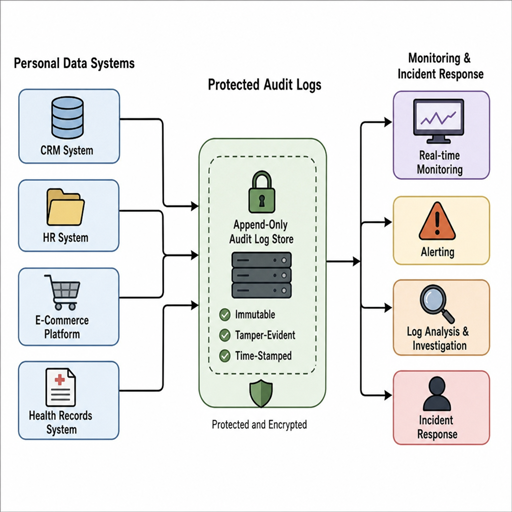
GDPR data protection logging is not a single technical standard you can install; it is a risk-based way of recording, protecting, reviewing, and retaining evidence about how personal data is accessed and processed. A strong logging program helps demonstrate GDPR compliance logging, detect misuse, support breach investigations, and prove that data protection measures are working. The key is to log enough to support accountability and security without turning the logs themselves into an unnecessary privacy risk.
What does GDPR require from logging?
The GDPR does not set one universal log format, retention period, or tool requirement. Instead, it requires controllers and processors to apply appropriate technical and organisational measures, keep records where required, protect personal data, and be able to demonstrate compliance with the regulation’s principles. Logging supports those duties when it creates reliable evidence of access, changes, disclosures, system activity, security events, and incident response decisions.
This matters because logs often become the first place an organisation looks when something goes wrong. They can show whether a user accessed a record, whether a system exported data, whether unusual activity occurred, and whether a suspected event became a personal data breach. The EDPB describes a personal data breach as a security incident involving accidental or unlawful destruction, loss, alteration, unauthorised disclosure of, or access to personal data, and organisations must document and handle breaches appropriately.
A practical GDPR logging standard should therefore answer four questions: what must be logged, why it is logged, who can view or change those logs, and how long the logs are kept. It should also explain how logs are reviewed, how alerts are escalated, and how log data is protected from misuse. Without those rules, logging can become either too thin to support accountability or too broad to satisfy data minimisation.
The role of logs in GDPR accountability
Accountability is the bridge between policy and proof. GDPR Article 5 requires personal data to be processed lawfully, fairly, transparently, accurately, securely, for specified purposes, and no longer than necessary; it also requires the controller to be responsible for and able to demonstrate compliance with those principles. Logs help provide that demonstration when they are accurate, understandable, and connected to documented procedures.
Good logs do not replace privacy governance. They support it. A record of processing activities, access control policy, incident response plan, retention schedule, and security monitoring process all become stronger when supported by reliable audit trails. Article 30 records of processing activities may include purposes, categories of data, recipients, retention periods where possible, and a general description of technical and organisational security measures, which makes logging closely connected to broader governance rather than a purely technical task.
The most useful GDPR compliance logging programs are designed around business processes. For example, a customer support platform may need access logs showing which staff member viewed a customer profile, while a payroll system may need stronger monitoring because payroll data is sensitive in practice and attractive to insiders. A marketing platform may need export and consent-change logs, while an identity system may need authentication, privilege, and failed-login records.
Core events a GDPR logging program should capture
A logging standard should identify the events that matter for privacy, security, and accountability. The right scope depends on the system, the data involved, and the risk to individuals, but the following categories are commonly important.
|
Log category |
What it should help prove |
Examples of useful events |
|---|---|---|
|
Authentication |
Who attempted to enter a system |
Successful logins, failed logins, MFA challenges, account lockouts |
|
Authorisation |
Whether access matched assigned rights |
Permission changes, role assignments, privilege escalation, revoked access |
|
Personal data access |
Who viewed or used personal data |
Record views, searches, case-file access, bulk lookups |
|
Data changes |
What changed and by whom |
Edits, deletions, corrections, imports, overwrites |
|
Exports and disclosures |
Whether data left a system |
CSV downloads, API transfers, email sends, third-party sharing events |
|
Administrative activity |
Whether system controls were changed |
Configuration changes, logging disabled, retention changes, backup restoration |
|
Security events |
Whether misuse or attack may have occurred |
Malware alerts, suspicious IPs, unusual query volume, anomalous user behaviour |
|
Incident response |
What the organisation did after detection |
Triage notes, containment actions, notifications, risk assessments |
Logs should be detailed enough to support investigation, but not so detailed that they unnecessarily duplicate the personal data being protected. In many cases, the log can record a user ID, record ID, event type, timestamp, device or network indicator, and action taken without copying full customer records, message contents, documents, payment details, or special category data.
Data minimisation applies to logs too
Logs can be personal data. Usernames, IP addresses, device identifiers, behavioural patterns, access histories, and search activity may identify or relate to a person, especially when combined with other data. EDPB guidance on access rights recognises that electronic data such as access logs, website usage history, search activity, location data, clicking activity, and behavioural data may fall within the scope of personal data depending on context.
That means GDPR data protection logging must follow the same privacy principles as other processing. The organisation should define a specific purpose for logging, collect only what is needed for that purpose, protect the log data, limit access, and keep it only as long as necessary. Security monitoring is a legitimate and important purpose, but it is not a blank cheque to record everything forever.
A useful minimisation test is simple: if the organisation could investigate the event without storing the content itself, avoid storing the content. Record that a file was downloaded, not the full contents of the file. Record that a sensitive field was changed, not necessarily the old and new value unless that level of detail is needed and protected. Record that an API call transferred a category of data, not every payload by default.
Security controls that make logs trustworthy
Logs are only useful if people can rely on them. If ordinary users can edit, delete, or disable audit trails, the organisation may lose the evidence it needs for security monitoring, disciplinary review, regulatory response, or breach assessment. ICO guidance on security outcomes states that organisations should monitor systems processing personal data, monitor user access, record user access, and have processes to act on unexpected events or indications of a breach.
Strong log security usually includes:
- Integrity protection: prevent unauthorised alteration, deletion, or overwriting of log records.
- Access restriction: allow only approved security, compliance, or administrative personnel to view detailed logs.
- Segregation of duties: avoid giving the same person full system control and unrestricted ability to modify logs.
- Time synchronisation: use consistent timestamps so events can be correlated across systems.
- Centralisation: forward important logs to a protected location outside the source system where feasible.
- Encryption and secure transfer: protect logs at rest and in transit where risk calls for it.
- Availability planning: ensure key logs remain accessible during incidents, outages, and investigations.
- Review records: document who reviewed logs, what they found, and what action was taken.
These controls turn logs from raw system exhaust into dependable evidence. They also reduce the chance that an attacker, malicious insider, or careless administrator can erase the trail after accessing personal data.
How long should GDPR logs be retained?
There is no single GDPR retention period for all logs. The right period depends on the purpose of the log, the risk of the processing, the type of personal data, legal or contractual obligations, incident investigation needs, and whether the log is still necessary. GDPR storage limitation means personal data should not be kept longer than necessary for the purposes for which it is processed, so every log category should have a defined retention rule rather than an open-ended default.
A practical retention model separates logs by purpose and risk. Security event logs may need to be kept long enough to detect delayed attacks or investigate incidents. Application debug logs may only need short retention because they can contain excessive detail and may be less relevant to accountability. Access logs for high-risk systems may justify longer retention than routine infrastructure telemetry, provided the period is documented and proportionate.
Use a retention schedule like this as a starting structure, not as a universal rule:
- Identify the log purpose. Security monitoring, audit evidence, fraud detection, troubleshooting, legal defence, regulatory response, or operational performance.
- Classify the sensitivity. Determine whether logs include user identifiers, customer identifiers, IP addresses, special category data, confidential business data, or payload content.
- Define the minimum useful period. Keep logs long enough to support the purpose, but not longer by habit.
- Apply tiered retention. Keep detailed logs for a shorter period and aggregated or anonymised metrics for longer where appropriate.
- Automate deletion. Manual cleanup is unreliable; retention should be enforced through system settings where possible.
- Review exceptions. Preserve relevant logs for active investigations, legal holds, or regulatory matters, then delete or archive them according to policy.
Retention should be understandable to non-technical stakeholders. If the privacy team, security team, and system owner cannot explain why a log is kept for a given period, the policy likely needs more work.
Breach detection and notification depend on reliable logs
Logs are central to breach response because they help establish what happened, when it happened, what data was involved, who was affected, and whether the incident creates risk to people. GDPR Article 33 requires notification to the supervisory authority without undue delay and, where feasible, within 72 hours after becoming aware of a personal data breach, unless the breach is unlikely to result in a risk to individuals’ rights and freedoms.
A weak logging setup can slow down that assessment. If the organisation cannot determine whether personal data was accessed, exported, altered, or deleted, it may struggle to make a timely and defensible breach decision. Good logs help incident teams move from speculation to evidence: which account was used, which records were touched, whether data left the environment, and what containment steps were completed.
Incident-related logging should also capture decisions. For example, the organisation should record when the incident was detected, when it was escalated, what evidence was reviewed, why a notification decision was made, and what remedial action followed. This does not mean writing a novel in the log system; it means preserving a clear timeline that supports accountability if the decision is later questioned.
Designing a GDPR compliance logging standard
A GDPR compliance logging standard should be a written, usable document that product teams, IT, security, privacy, and vendors can apply consistently. It should not be limited to a list of tools. It should define expectations for systems that process personal data and explain how those expectations change with risk.
Define logging scope by system and data type
Start with a system inventory. Identify applications, databases, identity providers, APIs, file stores, analytics platforms, support tools, HR systems, and third-party processors that process personal data. For each system, decide which events must be logged and which events should not be logged because they would capture excessive personal data.
The scope should be risk-based. A public website contact form, an employee HR platform, and a medical appointment system do not carry the same risk. The more sensitive the data and the more harmful unauthorised access could be, the stronger the audit trail and monitoring should be.
Assign ownership and review duties
Logs need owners. A system owner may be responsible for ensuring logs are generated, a security team may monitor alerts, a privacy team may advise on minimisation and retention, and a compliance or audit function may periodically test whether the standard is followed. Processors and vendors should also have clear contractual responsibilities where they operate systems on behalf of a controller.
Ownership prevents the common failure where logs exist but nobody looks at them. ICO guidance on system and network security recommends monitoring networks, systems, and applications for unusual activity, using logs to record user activity, establishing baselines, reviewing and analysing logs, and producing a documented policy that sets out logging requirements.
Set minimum log fields
Minimum fields make logs easier to understand and compare across systems. Common fields include timestamp, event type, user or service account identifier, system or application name, record or object identifier, source device or network indicator, outcome, and correlation ID. Where possible, use consistent naming conventions so incident responders can reconstruct a timeline across multiple tools.
Avoid fields that create disproportionate risk. Full passwords, authentication secrets, payment card details, private message contents, health details, and unnecessary copies of documents should not appear in routine logs. If a narrow use case requires sensitive values, apply stricter controls, shorter retention, masking, and documented approval.
Build alerting around meaningful risk
Logging without alerting can leave evidence sitting untouched until after harm occurs. Alerts should focus on activity that may indicate unauthorised access, misuse, or data loss. Examples include impossible travel, repeated failed logins, access outside normal duties, bulk exports, privilege escalation, logging being disabled, access to VIP or vulnerable-person records, and unusual API volume.
Alert design should avoid overwhelming teams. Too many low-value alerts train people to ignore them. A better approach is to define a baseline, prioritise high-risk systems, tune alert thresholds, and document the escalation path.
A practical GDPR logging checklist
Use this checklist to assess whether your current logging approach supports data protection measures rather than creating unmanaged risk.
- Purpose is documented: each major log source has a defined privacy, security, operational, or compliance purpose.
- Personal data is minimised: logs avoid unnecessary content, payloads, secrets, and sensitive fields.
- Access is restricted: detailed logs are available only to people with a genuine need.
- Integrity is protected: users cannot alter or delete logs that evidence their own activity.
- Retention is defined: each log category has a retention period and deletion process.
- Monitoring is active: high-risk events generate alerts or scheduled review tasks.
- Reviews are recorded: investigations and periodic checks leave a clear trail of findings and actions.
- Vendors are covered: processor contracts and security reviews address logging, access, retention, and incident support.
- Breach response is integrated: incident teams know which logs to preserve and how to use them in the breach assessment.
- The standard is tested: sample systems are periodically checked against the logging policy.
This checklist is most useful when applied system by system. A single “yes” at enterprise level can hide gaps in individual applications, especially older platforms, SaaS tools, and databases managed outside central IT.
Common logging mistakes that create GDPR risk
The first mistake is over-logging. Teams sometimes capture full request bodies, customer messages, identity documents, or sensitive form fields because it makes debugging easier. That may create a second store of personal data with weaker controls than the original system.
The second mistake is under-logging. If a system cannot show who accessed personal data, who exported it, or who changed permissions, the organisation may be unable to investigate suspicious activity. This weakens security operations and makes accountability harder to demonstrate.
The third mistake is treating logs as purely technical data. Logs often reveal employee behaviour, customer activity, location patterns, device details, and security weaknesses. They need privacy review, access limits, retention rules, and transparency where appropriate.
The fourth mistake is failing to test. A policy may say that access to personal data is logged, but a system update, misconfiguration, or vendor limitation may mean the actual evidence is incomplete. Periodic testing helps confirm that logging works before an incident exposes the gap.
Turning logging into a mature data protection measure
A mature logging program is deliberate, proportionate, and reviewable. It records events that matter, avoids unnecessary personal data, protects the logs themselves, and connects monitoring to incident response. It also recognises that GDPR compliance logging is not just about proving good behaviour after the fact; it is about detecting risky behaviour early enough to act.
The best next step is to create or refresh a written logging standard, then test it against your highest-risk systems first. Map the personal data in those systems, identify the events that matter, check whether logs are complete and protected, and remove any unnecessary sensitive content. From there, expand the same approach across the wider environment so GDPR data protection logging becomes a normal part of privacy-by-design, not a last-minute audit exercise.
