
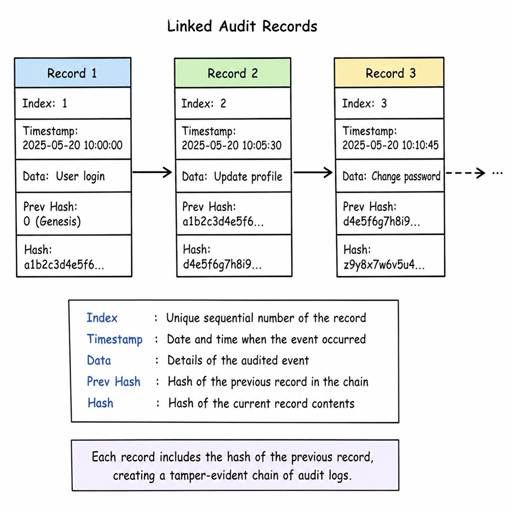
Immutable audit trails are tamper-resistant records that show what happened, when it happened, who or what initiated it, and whether the record has changed since it was written. In payment systems, financial operations, regulated workflows, and blockchain-based environments, they support compliance tracking, regulatory reporting, fraud investigation, and long-term data integrity. This guide explains how immutable records are created, maintained, reviewed, and protected without turning audit logging into a slow or unusable burden.
What makes an audit trail immutable?
An audit trail is immutable when records cannot be silently edited, deleted, reordered, or replaced after they are committed. Immutability does not mean data is magically impossible to attack; it means the system is designed so any unauthorized change becomes technically difficult, operationally restricted, and detectable through cryptographic, architectural, and governance controls.
A normal log file may show useful events, but it can often be overwritten by an administrator, application bug, compromised account, or poorly configured retention policy. An immutable audit trail adds stronger guarantees. Each entry is preserved in a way that links it to its context, protects the sequence of events, and makes later tampering evident.
At a practical level, an immutable audit trail usually combines several controls:
- Append-only storage: New events can be added, but existing events cannot be modified in place.
- Cryptographic hashing: Each record, batch, or block is fingerprinted so changes alter the expected hash.
- Sequencing: Events are ordered with timestamps, counters, block numbers, or transaction identifiers.
- Access separation: The people or systems that use records cannot freely alter the underlying audit history.
- Retention rules: Records are kept for required periods and protected from accidental deletion.
- Verification procedures: Teams regularly confirm that records remain complete and unchanged.
The strongest designs avoid depending on a single control. A database permission is useful, but not enough by itself. A hash is powerful, but it only helps if the original hash is protected. A blockchain ledger can provide strong evidence of sequence and state, but it still needs accurate event capture, identity management, and operational governance.
The business value of immutable records
Immutable records turn operational history into trustworthy evidence. That matters because many important questions are asked after the fact: Did a payment instruction change? Who approved a transfer? Which API key initiated the event? Was a compliance rule applied before settlement? Were records available for regulatory reporting when requested?
For compliance teams, immutability supports defensible compliance tracking. Instead of reconstructing activity from scattered systems, teams can review a reliable chain of events that ties user actions, automated decisions, approvals, exceptions, and outputs together. The result is not only better reporting, but also faster internal investigation and clearer accountability.
For finance and operations teams, immutable audit trails reduce ambiguity. If a dispute arises around a transaction, a refund, a reconciliation issue, or a manual override, the organization can look at the authoritative sequence rather than relying on memory, screenshots, or incomplete exports. That clarity can shorten incident response and reduce friction between departments.
For technology teams, immutable audit trails improve observability and resilience. They help engineers diagnose failures, validate integrations, and detect unexpected behavior. They also create a foundation for automated controls because downstream systems can trust that prior events have not been rewritten to hide an error or abuse.
The value is highest when records are both tamper-resistant and usable. A trail that cannot be searched, interpreted, or mapped to business processes may satisfy a narrow technical requirement but fail when a regulator, auditor, or executive asks for a clear explanation.
Core components of a strong immutable audit trail
A mature audit trail is more than a pile of logs. It is a controlled recordkeeping system that captures meaningful events, preserves them consistently, and makes them available for authorized review. The design should reflect the risk level of the process being recorded.
Event capture
The first decision is what to record. In payment systems and regulated workflows, useful events often include user logins, role changes, payment creation, approval steps, risk checks, policy decisions, API calls, transaction status changes, exception handling, data exports, and administrative actions.
Each event should contain enough context to be meaningful later. A record that says “payment updated” is weak. A stronger record identifies the payment reference, actor, action, previous state, new state, timestamp, source system, request identifier, and authorization path where appropriate.
The goal is not to collect everything without judgment. Excessive logging can create privacy risk, storage cost, and review fatigue. The better approach is to define a controlled event taxonomy: which actions matter, why they matter, which fields are required, and how sensitive data is minimized.
Identity and attribution
An immutable record is far more useful when it can be tied to a known actor. That actor may be a person, service account, API client, workflow engine, smart contract, or system process. The record should distinguish between them clearly.
Attribution depends on strong identity controls. If shared accounts are common, if API keys are reused across services, or if administrative actions are not tied to individual identities, the audit trail may be immutable but still inconclusive. Immutability preserves the record; it does not fix weak authentication.
Organizations should align audit records with identity and access management. Role assignments, permission changes, delegated approvals, and privileged access should themselves be logged. This makes it possible to answer not just what happened, but whether the actor was authorized at the time.
Timestamps and ordering
Time is central to auditability. Records should include reliable timestamps, and systems should handle ordering carefully when events come from distributed services. In complex payment systems, events may pass through gateways, ledgers, risk engines, custody services, reconciliation tools, and reporting platforms.
Because distributed systems can produce events nearly simultaneously, it is useful to combine timestamps with sequence numbers, transaction identifiers, or block references. The more critical the workflow, the more important it is to show the order of approvals, rule checks, submissions, settlements, reversals, and notifications.
Time synchronization should be treated as part of the control environment. If clocks drift or time zones are handled inconsistently, the audit trail may still be intact but harder to interpret.
Cryptographic integrity
Cryptographic hashing helps prove that a record has not changed. A hash function creates a fixed-length fingerprint of data. If the underlying data changes, the fingerprint changes too. This makes hashes useful for verifying data integrity over time.
Many immutable audit trail designs link records together. For example, each new entry may include the hash of the previous entry, creating a chain. If someone alters an earlier event, the change breaks the expected sequence. This is one reason blockchain and distributed ledger systems are often associated with immutable audit trails.
Hashing should be implemented carefully. Teams need to define exactly which fields are hashed, how records are canonicalized, how hash values are stored, and how verification is performed. If these details are vague, the system may look secure while leaving gaps in practice.
How are immutable audit trails created in payment systems blockchain?
Immutable audit trails in payment systems using blockchain are created by converting important payment events into structured records, validating those records through a controlled network or ledger process, and linking them cryptographically so later changes are detectable. The blockchain does not replace sound payment controls; it provides a tamper-evident record layer that can support compliance tracking, reconciliation, dispute analysis, and regulatory reporting.
A payment system may record events such as payment initiation, approval, screening, routing, settlement, cancellation, refund, or exception handling. In a blockchain-based design, selected events are written to a ledger directly or represented through hashes, references, or state changes. The right approach depends on privacy needs, transaction volume, legal requirements, and integration architecture.
A common pattern looks like this:
- Capture the business event. The payment platform records an action such as a transfer request, approval, policy decision, or status update.
- Normalize the record. Required fields are formatted consistently so the event can be validated and compared later.
- Minimize sensitive data. Personal, financial, or confidential details may be excluded, tokenized, encrypted, or stored off-chain with only a reference on-chain.
- Generate a cryptographic fingerprint. The system hashes the record or a controlled subset of the record.
- Commit the event or hash. The ledger records the transaction, state update, or evidence reference.
- Link the sequence. New records connect to prior records through blocks, transaction IDs, previous hashes, or workflow identifiers.
- Verify when needed. Auditors or systems recalculate hashes and compare ledger evidence with source records.
This structure helps answer whether an event existed at a specific point, whether the business record changed after commitment, and how a payment moved through its lifecycle. It is especially valuable when multiple parties need to rely on the same evidence but do not want one party to control the entire history.
However, blockchain does not automatically guarantee that the original event was truthful. If a system records a false approval or incomplete payment instruction, the blockchain may preserve that false record immutably. That is why validation, authentication, approval controls, and monitoring remain essential.
Permissioned ledgers and Hyperledger Fabric immutable audit trails
Many organizations exploring enterprise auditability look at permissioned distributed ledgers rather than public blockchains. In a permissioned model, known participants operate within defined roles, access rules, and governance processes. This can be attractive for payment, supply chain, financial operations, and consortium environments where confidentiality and control matter.
Hyperledger Fabric immutable audit trails are often discussed in this context because Fabric is designed for permissioned networks, channel-based privacy, chaincode-driven business logic, and controlled participation. In a Fabric-style architecture, transactions can be endorsed, ordered, validated, and committed to a ledger that maintains a tamper-evident history of state changes.
The audit value comes from the combination of identity, transaction flow, and ledger history. Participants are not anonymous in the same way they may be on some public networks. Policies can define which organizations must endorse a transaction before it is valid. The committed ledger then provides evidence of accepted transactions and their sequence within the network.
That said, implementation quality matters. A permissioned ledger should not be treated as a plug-in replacement for compliance architecture. Teams still need to design data models, access controls, retention policies, integration points, monitoring, and reporting processes. They also need to decide which information belongs on-ledger, which information should remain in private databases, and how to prove correspondence between the two.
On-chain and off-chain record design
Not every audit detail should be written directly to a blockchain. Payment data, personal information, trade secrets, and regulated records may require confidentiality, selective disclosure, or deletion from operational systems. Yet immutability can conflict with privacy obligations if sensitive data is placed somewhere it cannot practically be removed.
A common design is to store detailed records off-chain while placing hashes, timestamps, transaction references, or state commitments on-chain. This allows the organization to prove that a record existed and remained unchanged without exposing every detail to every ledger participant.
The tradeoff is complexity. The off-chain store must be governed well, and the link between off-chain records and on-chain evidence must be reliable. If references are broken, encryption keys are lost, or schemas change without documentation, verification becomes difficult.
Smart contracts and business rules
In blockchain and distributed ledger environments, smart contracts or chaincode can enforce parts of the audit process. They may validate required fields, require approvals, check participant roles, or prevent invalid state transitions. For example, a payment might not move from “created” to “submitted” unless the required approval event exists.
These rules help make audit trails more consistent because the system records not just outcomes, but controlled transitions. The record shows that a process followed a defined path rather than an informal sequence of manual updates.
Still, smart contract logic should be reviewed like any other critical control. A flawed rule can faithfully enforce the wrong process. Change management, testing, and version history are essential parts of maintaining trust.
Compliance tracking and regulatory reporting
Compliance tracking depends on being able to show that required controls operated when they were supposed to operate. Immutable audit trails support that by preserving evidence of decisions, reviews, exceptions, approvals, and remediation steps. For regulated organizations, this can make reporting more accurate and investigations more efficient.
In payments, teams may need to demonstrate the lifecycle of a transaction from initiation through settlement or rejection. They may also need to show screening outcomes, policy checks, customer instructions, administrative overrides, or escalation decisions. Immutable audit trails create a clearer path from raw operational activity to regulatory reporting outputs.
Search phrases such as “fireblocks payments audit trails immutable regulatory reporting” reflect a real concern among payment and digital asset teams: how to preserve trustworthy evidence while operating across fast-moving payment infrastructure. Whether an organization uses a specialized payment platform, an internal ledger, a custody system, a blockchain network, or a combination of tools, the control objective is similar. Records must remain complete, verifiable, and available to authorized teams.
Good compliance reporting does not begin at report time. It begins when events are captured. If the audit trail lacks required fields, uses inconsistent status names, or stores approvals separately from transaction events, reporting teams may have to manually reconcile evidence. That increases risk and slows response.
A practical compliance-oriented audit trail should support:
- Traceability: Connect each reportable item to source events and supporting evidence.
- Completeness: Show that all relevant events were captured, not just successful transactions.
- Exception visibility: Preserve failed checks, overrides, escalations, and rejected actions.
- Role accountability: Identify who approved, reviewed, changed, or exported records.
- Retention alignment: Keep records long enough to satisfy policy and legal obligations.
- Review readiness: Allow auditors and compliance teams to retrieve evidence without engineering intervention for every request.
Data integrity risks that immutability helps address
Data integrity means records remain accurate, complete, consistent, and trustworthy throughout their lifecycle. Immutable audit trails support data integrity by making unauthorized changes harder to perform and easier to detect. They also discourage informal workarounds because actions become visible.
Several common risks are reduced when immutable audit trails are designed well:
- Silent alteration: A user or process changes a record without leaving evidence.
- Backdated approvals: An approval is created after the fact but made to appear earlier.
- Deleted exceptions: Failed checks or rejected actions are removed from history.
- Untraceable administration: Privileged users change settings without accountability.
- Fragmented evidence: Different systems tell conflicting stories about the same transaction.
- Manual reconciliation errors: Reports rely on spreadsheets or exports without source validation.
Immutability does not eliminate all integrity risk. It cannot confirm that a user made a good decision, that a policy was sufficient, or that external data was correct. It does, however, preserve the evidence needed to review those questions honestly.
This is why immutable audit trails are most effective when paired with preventive controls. Approval workflows, segregation of duties, transaction limits, anomaly detection, and periodic access reviews all reduce the chance of bad events. Immutable records then ensure those controls and outcomes can be examined later.
Governance keeps immutable audit trails reliable
Technology creates the structure, but governance keeps it trustworthy. Without clear ownership, even strong audit systems become inconsistent over time. Teams may add events casually, change schemas without documentation, disable logging during incidents, or grant excessive access to solve short-term problems.
A governance model should define who owns the audit trail, who can change event definitions, who can access records, who reviews exceptions, and who approves retention changes. It should also specify how new systems are onboarded and how legacy systems are handled.
Policy and retention
Retention requirements vary by industry, jurisdiction, record type, and internal policy. Rather than inventing a single universal retention period, organizations should map audit events to their obligations and risk profile. Some records may need longer preservation than others.
Policies should address deletion, legal holds, archival storage, encryption key retention, and recovery. If records are encrypted, key management becomes part of audit trail availability. A perfectly preserved encrypted record may be useless if the organization cannot decrypt it when required.
Access control and segregation
Immutability is weakened if too many people can bypass it. Access should be limited by role, and privileged actions should be monitored. Teams that administer infrastructure should not necessarily be able to alter audit evidence without independent oversight.
Segregation of duties is especially important in payment environments. The same person should not be able to initiate a sensitive action, approve it, alter the audit trail, and suppress alerts. Even when staffing constraints require broad access, compensating controls such as review workflows and alerting can reduce risk.
Change management
Audit systems change as products, payment flows, APIs, and regulations evolve. Those changes should be documented. If a field is renamed, an event type is retired, or a new approval stage is added, reviewers need to understand how historical records relate to current records.
Change management should include testing. Teams should confirm that new code paths generate required audit events, that hashes still verify, that dashboards still work, and that regulatory reporting exports still map correctly.
Operational best practices for maintenance
Maintaining immutable audit trails is an ongoing discipline. The system must remain complete, searchable, secure, and verifiable as transaction volume grows and business processes change.
Use this checklist to guide maintenance:
- Review event coverage regularly. Confirm that new products, APIs, workflows, and administrative tools generate required audit events.
- Test tamper detection. Attempt controlled changes in a safe environment and verify that integrity checks detect them.
- Monitor logging gaps. Alert when expected event streams stop, slow down, or produce malformed records.
- Validate timestamps. Check time synchronization across systems that contribute to the same audit trail.
- Preserve schemas. Keep documentation for event formats, field meanings, and version changes.
- Protect signing keys and hashes. Treat cryptographic materials as sensitive assets with rotation and access controls.
- Audit administrator actions. Log configuration changes, permission grants, retention updates, and emergency access.
- Rehearse evidence retrieval. Practice responding to audit and investigation requests before a real deadline.
- Measure usability. Ensure compliance, finance, security, and engineering teams can search and interpret records.
- Document exceptions. When logging fails or records are corrected through approved processes, preserve the explanation.
The best maintenance programs treat auditability as part of production readiness. A new payment feature is not complete if it cannot be monitored, investigated, and explained.
Common implementation mistakes
Many audit trail projects fail not because the idea is wrong, but because the design is incomplete. Teams may focus on storage technology while overlooking event quality, governance, or review workflows.
One mistake is logging too little. If events lack identifiers, actor details, previous states, or decision context, the record may be immutable but not useful. Another mistake is logging too much sensitive information. Immutability can make privacy mistakes harder to remediate, so data minimization is critical.
A third mistake is relying on administrators to protect evidence without independent controls. If the same privileged account can alter source systems, disable logging, and delete archives, the audit trail may not stand up to scrutiny. Separation, monitoring, and externalized evidence can help.
A fourth mistake is treating blockchain as automatic compliance. Blockchain can strengthen proof of sequence and tamper evidence, but it does not define what regulators need, classify records, write policies, or ensure that source data is accurate.
Finally, teams sometimes ignore retrieval. An audit trail that requires weeks of engineering work to answer a basic compliance question will frustrate every stakeholder. Search, filtering, export controls, and clear documentation are part of the system, not optional extras.
A practical maturity model
Organizations can assess their current position by looking at maturity rather than chasing a perfect architecture immediately.
|
Maturity level |
Typical state |
Main improvement priority |
|---|---|---|
|
Basic logging |
Logs exist but can be modified or deleted easily |
Centralize records and restrict access |
|
Controlled audit trail |
Key events are captured with access controls and retention |
Improve completeness, identity, and review workflows |
|
Tamper-evident records |
Hashing, append-only storage, or ledger mechanisms protect integrity |
Automate verification and exception alerts |
|
Compliance-ready evidence |
Records map to reporting, investigations, and control testing |
Strengthen retrieval, documentation, and governance |
|
Continuously verified trail |
Integrity checks, coverage monitoring, and change control are routine |
Optimize for scale, privacy, and cross-system assurance |
This model helps teams prioritize. A smaller organization may first need consistent event capture and retention. A high-volume payment provider may need cryptographic verification, ledger-backed evidence, and automated compliance reporting. The right next step depends on risk, regulation, complexity, and available resources.
Turning audit trails into trusted evidence
Immutable audit trails work best when they are designed around the questions people will need to answer later. Who did what? Was it authorized? What changed? Which control ran? Was an exception approved? Has the record remained intact? Can the organization prove it without relying on informal explanations?
For payment systems and blockchain environments, the answer requires both architecture and discipline. Append-only records, hashes, permissioned ledgers, Hyperledger Fabric-style designs, and smart contracts can all support immutable audit trails. But they must be paired with accurate event capture, strong identity, privacy-aware data design, compliance mapping, and regular verification.
The practical goal is not to collect records for their own sake. It is to maintain evidence that supports trust. When immutable records are complete, protected, and usable, they give compliance, security, finance, engineering, and leadership teams a shared foundation for decisions, reporting, and accountability.
