
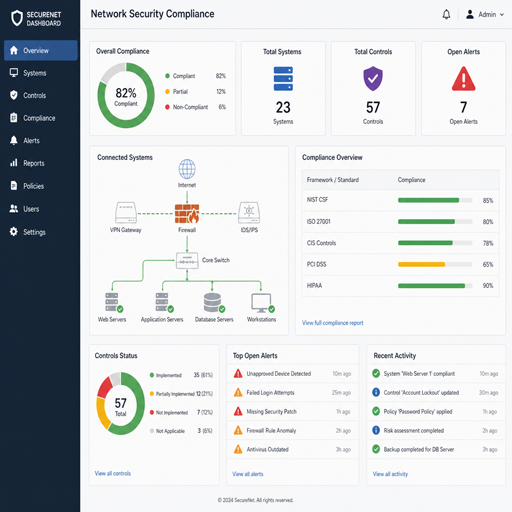
Regulatory compliance for network security is the process of aligning your network controls, policies, monitoring, and documentation with the laws, industry rules, and security standards that apply to your organization. It is not just a paperwork exercise. Done well, compliance helps reduce risk, improve visibility, and make security decisions easier to defend during audits, incidents, and business reviews.
For many teams, the challenge is that compliance language can feel separate from day-to-day network operations. Firewalls, access controls, encryption, logging, segmentation, vendor connections, and incident response all play a role. The goal is to turn regulatory guidelines into practical security habits that protect systems without slowing the business down.
What does regulatory compliance mean for network security?
Regulatory compliance means your network security program meets the specific requirements set by applicable laws, contracts, industry bodies, or internal governance rules. In practice, that means you can show how your network is protected, who has access, how activity is monitored, how incidents are handled, and how risks are reviewed over time.
This matters because most regulations do not only ask whether security tools exist. They also ask whether controls are appropriate, consistently managed, tested, documented, and improved. A company may have strong technology in place but still struggle with cybersecurity compliance if policies are outdated, evidence is missing, or responsibilities are unclear.
A strong compliance security approach connects technical controls with business accountability. Network teams, security leaders, legal teams, risk managers, and system owners need a shared understanding of what must be protected and why. When that alignment exists, compliance becomes less reactive and more useful.
Compliance starts with knowing your obligations
No organization should build a compliance program from guesswork. The first step is identifying which regulatory frameworks, security standards, contractual requirements, and internal policies apply to your environment. A healthcare provider, payment processor, software company, school, public agency, and manufacturer may all need different controls, even if they use similar network technologies.
Common obligations often relate to sensitive data, such as personal information, financial records, health data, intellectual property, or customer credentials. Other requirements may focus on service availability, audit trails, incident reporting, access management, or third-party risk. The important point is to map requirements to real network assets instead of treating them as abstract checklist items.
A practical obligation review should answer:
- What data moves across the network? Identify regulated, confidential, and business-critical data flows.
- Where is that data stored or processed? Include cloud platforms, on-premises systems, remote offices, and third-party services.
- Who can access it? Review employees, administrators, vendors, service accounts, and automated systems.
- Which rules apply? Connect each environment to relevant regulatory frameworks and contractual commitments.
- What evidence is required? Determine which logs, policies, reports, approvals, and test results must be retained.
This mapping exercise prevents wasted effort. Instead of applying every control everywhere with the same intensity, teams can prioritize the areas that create the greatest compliance and security risk.
Core network controls that support security compliance
Security compliance depends on controls that are both technically effective and provable. Auditors and assessors often need evidence, but the real value comes from building controls that reduce the likelihood and impact of unauthorized access, data exposure, malware movement, and service disruption.
Access control and identity management
Access control is one of the foundations of regulatory compliance network security. Users and systems should receive only the access they need, for only as long as they need it. That principle applies to network devices, administrative consoles, VPNs, cloud networks, databases, internal applications, and remote access tools.
Strong access management usually includes multi-factor authentication, role-based permissions, timely removal of inactive accounts, and extra protection for privileged users. Administrative access should be especially controlled because a compromised admin account can quickly become a network-wide incident. Regular access reviews help confirm that permissions still match job responsibilities and business needs.
Network segmentation
Segmentation limits how far an attacker, misconfiguration, or compromised account can move. Instead of allowing every system to communicate freely, organizations divide networks by function, sensitivity, or trust level. For example, guest Wi-Fi, production systems, administrative tools, development environments, and sensitive data stores should not all sit in the same unrestricted network zone.
From a compliance perspective, segmentation makes it easier to define control boundaries. If regulated data only lives in a protected segment, the organization can focus stronger controls and monitoring around that area. It can also reduce unnecessary exposure and simplify evidence collection.
Encryption and secure communication
Many regulatory guidelines expect sensitive data to be protected while it is transmitted. Encryption helps prevent unauthorized parties from reading data if traffic is intercepted or routed through untrusted networks. Secure protocols, well-managed certificates, and strong configuration standards all contribute to this goal.
Encryption should not be treated as a set-and-forget control. Teams need to know where encrypted communication is required, which systems terminate encrypted sessions, and how certificates and keys are managed. Weak legacy protocols or expired certificates can create both security and compliance problems.
Logging, monitoring, and alerting
A compliant network must be observable. Logs from firewalls, authentication systems, endpoint tools, cloud networks, intrusion detection systems, and critical servers help teams investigate suspicious activity and demonstrate control effectiveness. Without reliable logs, it is difficult to prove what happened during an incident or show that controls are operating as expected.
Monitoring should focus on meaningful events, such as failed login patterns, privilege changes, unusual outbound traffic, blocked connections, configuration changes, and access to sensitive systems. Alerts must be tuned so teams can respond to real issues rather than drown in noise. Log retention periods should also match applicable security standards and business requirements.
How do regulatory frameworks shape network security decisions?
Regulatory frameworks shape network security by defining what outcomes an organization must achieve, such as protecting sensitive data, controlling access, maintaining audit trails, managing risk, and responding to incidents. They rarely prescribe every technical detail, so teams must translate requirements into controls that fit their environment.
This is where compliance security becomes both strategic and practical. A framework may require access restrictions, but your organization must decide how to implement them across VPNs, cloud platforms, firewalls, directory services, and administrative tools. A framework may require monitoring, but your team must decide which logs matter, how alerts are handled, and who reviews them.
Useful translation often follows this pattern:
- Read the requirement in business terms. Identify the risk the rule is trying to reduce.
- Map it to network assets. Determine which systems, users, data flows, and devices are affected.
- Select appropriate controls. Choose technical, administrative, and procedural safeguards.
- Assign ownership. Make clear who configures, reviews, approves, and maintains each control.
- Collect evidence continuously. Avoid scrambling for screenshots and reports right before an audit.
- Review effectiveness. Test whether the control actually works, not just whether it exists.
The best programs do not treat regulatory frameworks as separate projects. They build a common control set that can satisfy multiple obligations at once. For example, a strong access review process may support several standards, contracts, and internal policies.
Documentation turns controls into evidence
Good documentation does not make a weak network secure, but poor documentation can make a strong network difficult to defend. Compliance depends on showing what controls exist, why they are appropriate, who owns them, when they were reviewed, and what happened when exceptions occurred.
Policies define intent. Procedures explain how work gets done. Standards set specific expectations, such as approved encryption protocols, password requirements, firewall rule review frequency, or logging configuration. Records and reports then prove that the organization followed those expectations.
Helpful documentation may include:
- Network diagrams showing key segments, trust boundaries, and data flows
- Firewall and access control review records
- User access review approvals and remediation notes
- Incident response plans and post-incident reports
- Vulnerability scan results and remediation tracking
- Change management records for network devices and security tools
- Vendor access agreements and third-party connection reviews
- Exceptions with business justification, compensating controls, and expiration dates
The key is to keep documentation close to the work. If diagrams, asset inventories, and policies are only updated before audits, they will quickly drift from reality. Living documentation helps operations teams as much as it helps auditors.
Common compliance gaps in network security
Many compliance problems are not caused by a complete lack of security. They happen because controls are inconsistent, undocumented, poorly owned, or no longer aligned with the environment. As networks evolve through cloud adoption, remote work, mergers, new vendors, and changing applications, yesterday’s control model may no longer be enough.
One common gap is excessive access. Users accumulate permissions over time, service accounts are forgotten, and vendor connections remain active after projects end. Another gap is unclear asset ownership. If no one knows who owns a system, no one can confidently approve access, patching windows, risk exceptions, or decommissioning.
Logging gaps are also frequent. Systems may generate logs, but those logs may not be centralized, retained, reviewed, or protected from alteration. Firewall rules can create similar issues when temporary exceptions become permanent or when rule descriptions do not explain the business purpose.
A useful internal review should look for warning signs such as:
- Unused accounts with active network access
- Shared administrator credentials
- Flat networks with limited separation between sensitive and general systems
- Firewall rules without owners, dates, or business justification
- Missing logs for critical systems
- Outdated network diagrams
- Inconsistent vulnerability remediation timelines
- Security exceptions with no expiration date
- Vendor access that is not monitored or periodically reviewed
Finding these issues early is valuable. It gives teams time to fix root causes rather than rushing through temporary audit responses.
Making compliance part of everyday operations
The most sustainable cybersecurity compliance programs are built into normal workflows. If compliance depends on heroic effort once a year, the process will be stressful and unreliable. If it is embedded into access requests, change management, vendor onboarding, vulnerability management, and incident response, it becomes much easier to maintain.
Change management is a good example. A network change request can include compliance prompts: Does this affect regulated data? Does it create a new external connection? Are logs enabled? Is the firewall rule time-bound? Has the system owner approved the change? These questions help teams catch risk before it becomes production exposure.
Automation can also help, especially for evidence collection and configuration monitoring. Automated checks can flag open ports, policy drift, expired certificates, disabled logging, or unapproved changes. However, automation should support human judgment, not replace it. Someone still needs to decide whether a risk is acceptable and whether a control meets the intent of the requirement.
What should a practical compliance roadmap include?
A practical roadmap should include obligation mapping, asset discovery, risk prioritization, control implementation, evidence collection, testing, and continuous improvement. It should be realistic enough for teams to follow and specific enough to show progress.
Start with the highest-risk systems and the clearest requirements. Trying to fix every network issue at once can create confusion and fatigue. Instead, build momentum with focused improvements that reduce real risk and strengthen audit readiness.
A simple roadmap might look like this:
- Define scope. Identify regulated systems, sensitive data, network zones, and business processes.
- Assess current controls. Compare existing practices against applicable regulatory guidelines and security standards.
- Prioritize risks. Focus first on gaps that could expose sensitive data, disrupt operations, or create audit failure.
- Remediate in phases. Assign owners, deadlines, and measurable outcomes for each improvement.
- Standardize evidence. Decide where reports, approvals, diagrams, and logs will be stored.
- Test controls. Use reviews, tabletop exercises, scans, and access checks to confirm controls work.
- Repeat regularly. Revisit scope and risks as the business, technology, and requirements change.
This approach keeps regulatory compliance network security manageable. It also helps leaders see compliance as an ongoing risk management discipline rather than a last-minute documentation project.
A stronger network makes compliance easier
Regulatory compliance and network security work best when they support each other. Compliance provides structure, accountability, and evidence. Security provides the technical and operational protection that makes those requirements meaningful.
The strongest programs begin with a clear view of obligations, assets, users, data flows, and risks. They translate regulatory frameworks into practical controls, keep documentation current, and build compliance checks into daily operations. Over time, this creates more than audit readiness. It creates a network security program that is easier to manage, easier to explain, and better prepared for change.
