
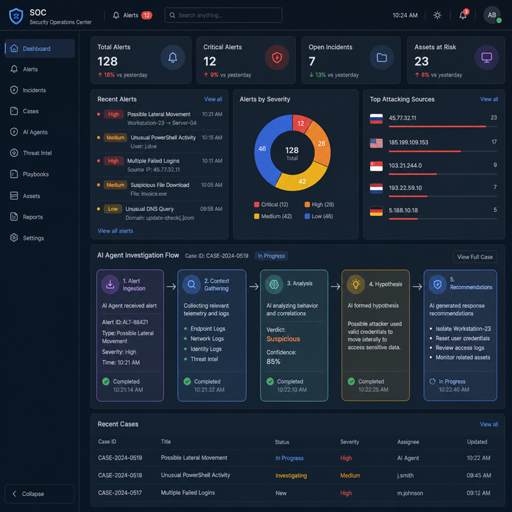
Autonomous Cyber Defense Agents are AI-enabled systems designed to detect, investigate, prioritize, and in some cases respond to cyber threats with limited human intervention. Their future is not simply “AI replacing analysts”; it is a shift toward machine-speed security operations where humans set policy, supervise risk, and handle judgment-heavy decisions while agents handle repetitive, time-sensitive work. The most successful organizations will treat these agents as governed teammates inside a broader security program, not as magic tools that can be dropped into a noisy environment and trusted blindly.
What are Autonomous Cyber Defense Agents?
Autonomous Cyber Defense Agents are software agents that use automation, analytics, and AI to perform security tasks across detection, triage, investigation, response, validation, and recovery. Unlike basic automated cybersecurity tools that follow static rules, these agents can combine context from multiple systems, reason through a sequence of actions, call tools, and adapt their next step based on what they find.
In practical terms, an autonomous agent might notice suspicious authentication behavior, pull identity and endpoint context, compare the activity against known attack patterns, check whether similar alerts are appearing elsewhere, draft an incident summary, and recommend or trigger a containment action. A more advanced agent could also open a ticket, query a SIEM, enrich indicators, isolate a device under approved conditions, or generate a detection rule for human review.
The word “autonomous” does not mean unrestricted. In mature environments, autonomy is bounded by policy, approval levels, audit logs, identity controls, and rollback options. The future of ai cyber defense will depend less on whether agents can act and more on whether organizations can define when they should act, how far they may go, and how their decisions are verified.
Key takeaways for security leaders
- Autonomous threat detection is moving from alert matching to context-driven reasoning. Agents will increasingly connect identity, endpoint, network, cloud, SaaS, code, and business context before deciding what matters.
- Human oversight remains essential. The best near-term model is supervised autonomy: agents handle speed and scale, while people govern intent, risk tolerance, exceptions, and high-impact actions.
- AI security agents introduce their own attack surface. Prompt injection, data poisoning, excessive permissions, tool misuse, and model leakage must be considered part of the security architecture.
- Governance will be a differentiator. NIST Cybersecurity Framework 2.0 is organized around Govern, Identify, Protect, Detect, Respond, and Recover, which provides a useful lens for deciding where agents fit in a risk program.
- The future is agentic, but not fully hands-off. Autonomous security solutions will be most valuable when they are measurable, constrained, observable, and aligned with business impact.
Why autonomous cyber defense is becoming necessary
Security teams are being asked to protect more systems, more identities, more software dependencies, and more cloud services than traditional manual workflows can reasonably cover. Attackers already use automation to scan, phish, exploit, move laterally, and adjust tactics quickly. Defense that depends entirely on human review of every signal becomes too slow when the environment is large, distributed, and constantly changing.
Autonomous security solutions address this imbalance by compressing time. They can inspect events continuously, correlate weak signals, retrieve context, and perform repetitive investigative steps before an analyst even opens the case. That does not eliminate the need for skilled defenders. It changes where those defenders spend their attention: from gathering evidence manually to validating conclusions, improving policy, hunting complex threats, and deciding how much risk the organization is willing to accept.
CISA’s AI Roadmap emphasizes both sides of this transformation: using AI to enhance cybersecurity capabilities and protecting AI systems from cyber-based threats. That balance is important because ai cyber defense is not only a defensive capability; it is also a new class of critical system that can be attacked, misled, or misconfigured.
The pressure points driving adoption
Autonomous Cyber Defense Agents are gaining attention because they map directly to recurring pain points in security operations:
- Alert overload: Agents can cluster related alerts, suppress duplicates, and enrich findings so analysts see fewer low-value cases.
- Skill scarcity: Junior analysts often spend time on repetitive triage. Agents can codify playbooks and make expert workflows more scalable.
- Cloud complexity: Modern infrastructure changes quickly. Agents can continuously inspect configurations, identities, permissions, and runtime behavior.
- Faster attacks: When credential abuse or automated exploitation unfolds in minutes, waiting for manual review may create unnecessary exposure.
- Tool fragmentation: Agents can act as connective tissue across SIEM, SOAR, EDR, IAM, vulnerability management, ticketing, and cloud platforms.
- Evidence quality: Well-designed agents can collect consistent evidence, preserve timelines, and reduce gaps in incident documentation.
The future belongs to teams that can combine automation with judgment. If an agent can handle the first 70% of a standard investigation reliably, the analyst can spend more time on the 30% that requires experience, skepticism, and business context.
The evolution from automated tools to AI security agents
Automated cybersecurity tools are not new. Firewalls block traffic, endpoint tools quarantine files, scanners identify vulnerabilities, and SOAR platforms run playbooks. What is changing is the degree to which AI security agents can decide what workflow to run, how to adapt it, and what evidence is needed next.
Traditional automation follows predefined logic: if this alert appears, then run this enrichment step, then notify this channel. Agentic systems are more flexible. They can break a goal into tasks, interact with tools, interpret results, and adjust their plan. That flexibility is useful in cybersecurity because incidents rarely unfold exactly like the playbook.
However, flexibility is also the source of risk. A deterministic automation may be brittle, but it is usually predictable. An AI agent may handle variation better, yet it can also misunderstand instructions, over-trust bad data, or take an unexpected path. The next generation of autonomous security solutions will therefore need both intelligence and restraint.
How cyber threat agents differ from conventional automation
|
Capability |
Conventional automation |
Autonomous cyber defense agents |
|---|---|---|
|
Trigger |
Static rule, alert, or schedule |
Goal, event, pattern, or analyst request |
|
Workflow |
Predefined playbook |
Dynamic plan with tool use and branching |
|
Context use |
Limited enrichment fields |
Multi-source reasoning across identity, asset, threat, and business data |
|
Adaptability |
Low to moderate |
Higher, depending on model and permissions |
|
Risk profile |
Predictable but rigid |
Powerful but needs stronger guardrails |
|
Human role |
Build and maintain rules |
Govern policy, supervise exceptions, validate outputs |
This shift is similar to moving from a conveyor belt to a junior analyst with access to tools. The junior analyst can reason, but they also need training, permissions, supervision, and escalation criteria. AI agents deserve the same discipline.
Where autonomous threat detection will have the biggest impact
Autonomous threat detection will be most useful where signal volume is high, context is distributed, and response speed matters. The strongest use cases are not necessarily the flashiest. They are the workflows where agents can reliably reduce time, remove manual toil, and make investigations more consistent.
Identity and access monitoring
Identity is one of the most important domains for ai cyber defense because compromised credentials can give attackers legitimate-looking access. Autonomous agents can monitor unusual login patterns, impossible travel, suspicious MFA behavior, privilege escalation, dormant account usage, and risky service account activity.
The agent’s value comes from context. A login from a new location may be harmless for a traveling executive but suspicious for a service account. A privilege change may be routine during a maintenance window but dangerous when paired with new device enrollment and unusual data access. Agents can join those dots quickly and present a richer assessment than a single alert can provide.
Endpoint investigation and containment
Endpoint agents already collect detailed telemetry. Autonomous Cyber Defense Agents can use that telemetry to reconstruct timelines, identify suspicious parent-child process relationships, check file reputation, compare activity against known behaviors, and recommend containment.
The future endpoint workflow may look less like “analyst opens alert and manually pivots through tabs” and more like “agent produces a case file with evidence, confidence, recommended action, and rollback path.” In lower-risk scenarios, the agent may isolate a device automatically under predefined policy. In higher-risk cases, it may request approval and explain the expected impact before acting.
Cloud posture and runtime defense
Cloud environments are dynamic, API-driven, and permission-heavy. Agents can continuously watch for risky configurations, exposed storage, excessive IAM permissions, unusual workload behavior, and deviations from approved baselines. They can also map a cloud alert to affected business services, recent deployments, and known vulnerabilities.
This is an area where autonomous security solutions can improve both speed and prioritization. A misconfiguration on an unused test asset is not the same as a misconfiguration on a public-facing production service with sensitive data access. Agents can help defenders focus on the issue that actually changes risk.
Vulnerability discovery and remediation support
DARPA’s AI Cyber Challenge highlighted the potential of autonomous systems to find and help fix vulnerabilities in software that supports critical infrastructure. The competition focused on cyber reasoning systems that could secure open-source software, and DARPA described quality patching as an important demonstration of combining AI with other cyber defense techniques.
In enterprise settings, this kind of capability could change vulnerability management from a periodic scanning function into a more continuous remediation loop. Agents may identify vulnerable code paths, rank exposure based on actual deployment, suggest patches, create pull requests, and verify whether fixes introduce regressions. Human engineers would still review the changes, but the expensive first pass could become faster and more consistent.
Phishing and business email compromise defense
Email attacks are rich in context: sender history, message content, links, attachments, identity relationships, financial workflows, and user behavior all matter. An agent can examine a suspicious message, inspect headers, detonate attachments in a sandbox, check whether similar messages reached other users, and recommend removal or user notification.
The more interesting future is not just faster phishing classification. It is autonomous investigation of downstream impact. If a user clicked a link, the agent can check authentication logs, session tokens, endpoint activity, and mailbox rules. That turns a phishing alert into a complete incident picture.
How will AI cyber defense change the security operations center?
AI cyber defense will change the SOC by turning analysts into supervisors of intelligent workflows rather than manual operators of every investigative step. The SOC will still need people, but the work will become more policy-driven, exception-driven, and evidence-driven. Analysts will ask better questions, review agent conclusions, tune risk thresholds, and focus on incidents where business judgment matters.
This change will not happen overnight. Many organizations will start with agent-assisted triage, then move to supervised response, and only later permit limited autonomous action. The SOC of the future will likely contain multiple specialized agents: one for identity, one for endpoint investigation, one for cloud posture, one for vulnerability remediation, one for threat intelligence, and one for reporting or case management.
A practical SOC operating model
A mature agent-enabled SOC needs clear lanes of responsibility:
- Tier 0 agentic triage: Agents collect context, deduplicate alerts, assign severity, and generate initial case summaries.
- Tier 1 supervised validation: Analysts review agent findings, confirm obvious true positives, and close well-supported false positives.
- Tier 2 investigation: Human responders handle complex attacks, ambiguous evidence, lateral movement, and high-impact containment.
- Tier 3 engineering and hunting: Specialists improve detections, test agent behavior, build playbooks, and search for stealthy threats.
- Governance and assurance: Security leaders define approval thresholds, audit agent actions, and measure risk reduction.
The key is not to remove humans from the loop entirely. The key is to place humans where they add the most value.
Metrics that will matter more
Traditional SOC metrics often emphasize volume: number of alerts, number of cases closed, time to acknowledge, and time to respond. Those still matter, but autonomous agents require additional measurements:
- Investigation accuracy: How often does the agent reach the same conclusion as a qualified analyst?
- Evidence completeness: Does the agent gather the right context before recommending action?
- Escalation quality: Does it escalate uncertain or high-risk cases instead of forcing a confident answer?
- Containment safety: Are automated actions reversible, proportionate, and aligned with policy?
- Drift detection: Does performance degrade when infrastructure, attacker behavior, or business processes change?
- Analyst trust: Do analysts understand why the agent made a recommendation?
Organizations that measure only speed may create fast but unsafe automation. The better goal is trustworthy acceleration.
The architecture of autonomous security solutions
Autonomous security solutions require more than a model connected to security tools. They need a carefully designed architecture that controls data, identity, permissions, memory, tool use, decision boundaries, and monitoring.
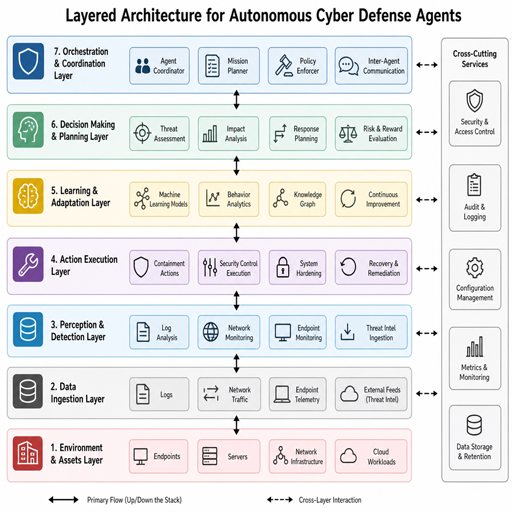
At a high level, an agentic cyber defense system includes five layers: sensing, reasoning, action, governance, and learning. Each layer must be secure by design. If any layer is weak, the agent can become unreliable or dangerous.
1. Sensing and data ingestion
Agents need access to logs, alerts, telemetry, asset inventories, identity data, cloud events, vulnerability findings, network flows, and threat intelligence. The quality of autonomous threat detection depends heavily on the quality of this data. Incomplete, stale, or poorly normalized data leads to weak conclusions.
This is why asset inventory and identity hygiene remain foundational. An agent cannot accurately judge risk if it does not know whether an asset is production or test, whether an account is privileged, or whether a workload handles sensitive data. AI can improve analysis, but it cannot magically fix a broken source of truth.
2. Reasoning and planning
The reasoning layer interprets the situation and decides what to do next. It may use machine learning, large language models, rules, statistical baselines, knowledge graphs, or a combination of techniques. For cyber threat agents, hybrid approaches are likely to remain common because cybersecurity requires both probabilistic judgment and strict policy enforcement.
For example, an LLM may summarize a case and propose investigative steps, while a rules engine enforces that production isolation requires approval. A graph model may show relationships between identities, devices, and cloud resources, while a detection engine identifies anomalous behavior. Strong architecture uses the right method for the right job.
3. Tool use and action execution
Agents become powerful when they can act through tools. They may query a SIEM, disable a token, quarantine a file, update a firewall rule, create a ticket, run a scanner, or open a pull request. Every tool connection increases both capability and risk.
Tool access should follow least privilege. An agent that only needs to read logs should not be able to disable accounts. An agent that can isolate endpoints should not be able to modify identity policies. Permissions should be scoped by task, environment, asset criticality, and confidence level.
4. Governance and policy controls
Governance defines what the agent is allowed to do. NIST’s AI Risk Management Framework is intended to help organizations manage risks associated with AI systems and incorporate trustworthiness considerations into AI design, development, use, and evaluation. NIST also identifies secure and resilient behavior as a key characteristic of AI trustworthiness.
For autonomous agents, governance should be operational, not theoretical. It should answer questions such as: Which actions require human approval? Which systems are off-limits? How is confidence calculated? What happens when evidence conflicts? Who reviews agent errors? How are changes tested before deployment?
5. Learning and continuous improvement
Cybersecurity changes constantly, so agents need feedback loops. Analysts should be able to mark conclusions as correct or incorrect, annotate missing evidence, improve playbooks, and update policy. The agent should not silently learn from every interaction without control; learning must be deliberate, testable, and auditable.
A strong learning loop includes evaluation datasets, regression tests, red-team exercises, and change management. Before an updated agent receives broader permissions, it should prove that it performs at least as safely as the previous version.
The risks and limitations of autonomous agents
The future of Autonomous Cyber Defense Agents is promising, but the risks are real. AI systems can be manipulated, overconfident, opaque, or misaligned with business priorities. When an agent has access to security tools, a mistake can disrupt operations just as surely as an attacker can.
NIST’s adversarial machine learning work describes risks such as poisoning, evasion, and privacy attacks, while MITRE ATLAS catalogs adversary tactics and techniques involving AI systems based on real-world observations and red-team demonstrations. These resources are useful reminders that AI security agents are both defenders and potential targets.
Prompt injection and instruction manipulation
If an agent uses a language model and reads external content, it may encounter malicious instructions hidden in emails, web pages, tickets, documents, or retrieved knowledge-base entries. OWASP identifies prompt injection as a major risk for LLM applications and also highlights excessive agency, where too much functionality, permission, or autonomy can enable damaging actions.
For security agents, this risk is especially serious. An attacker might craft content that attempts to make the agent ignore policy, reveal sensitive data, suppress an alert, or misuse a tool. Defenses include treating external content as untrusted data, separating instructions from evidence, limiting tool permissions, validating outputs, and requiring approval for sensitive actions.
Bad data and false confidence
Agents can only reason from the information they can access. If telemetry is missing, asset labels are wrong, or identity data is stale, the agent may produce a polished but incorrect conclusion. This is dangerous because fluent explanations can create unwarranted trust.
Security teams should design agents to express uncertainty clearly. A good agent does not simply say, “This is benign.” It says, “This appears benign because these five checks passed, but cloud audit logs were unavailable and the device has not reported endpoint telemetry in six hours.” That difference matters.
Over-automation and business disruption
The riskiest actions in cybersecurity are often not technically complex. Disabling an account, blocking an IP range, rotating a secret, or isolating a server may be simple to execute but disruptive if applied incorrectly. Autonomous security solutions need business-aware guardrails.
A containment action against a developer laptop is different from a containment action against a hospital system, trading platform, manufacturing controller, or executive account during a critical transaction. The agent should understand blast radius, maintenance windows, service ownership, and escalation paths before taking action.
Model and supply chain exposure
AI agents may depend on models, prompts, plugins, APIs, vector databases, third-party packages, and external knowledge sources. Each dependency can introduce supply chain risk. OWASP’s LLM guidance includes supply chain, data and model poisoning, sensitive information disclosure, vector and embedding weaknesses, and unbounded consumption among the risks organizations should consider for LLM and generative AI applications.
This means the security of an agent includes the security of its entire ecosystem. Teams should know which models are used, where data is processed, how prompts are managed, how retrieval sources are curated, and how third-party components are updated.
A governance model for safe autonomy
Safe autonomy starts by defining what the agent may decide, what it may recommend, and what it may execute. The central question is not “Can the agent do this?” but “Under what conditions should the agent be trusted to do this?”
A useful governance model separates actions into autonomy tiers. These tiers let organizations expand capability gradually while maintaining control.
Autonomy tiers for cyber defense agents
|
Tier |
Agent authority |
Example actions |
Oversight model |
|---|---|---|---|
|
Tier 1: Observe |
Read-only monitoring and summarization |
Enrich alerts, summarize logs, cluster incidents |
Periodic review |
|
Tier 2: Recommend |
Suggest actions but do not execute |
Recommend account reset, endpoint isolation, rule update |
Analyst approval required |
|
Tier 3: Execute low-risk actions |
Perform reversible actions within policy |
Close duplicate alerts, tag assets, open tickets, block known malicious hashes in test environments |
Audit and sampling |
|
Tier 4: Execute constrained response |
Take approved containment actions |
Isolate non-critical endpoint, revoke suspicious session, disable temporary token |
Approval for exceptions |
|
Tier 5: Adaptive response |
Coordinate multi-step response across systems |
Contain active intrusion across identity, endpoint, and cloud |
Strict governance, testing, and executive risk acceptance |
Most organizations should begin with Tier 1 and Tier 2. Higher tiers should be earned through evidence, testing, and trust over time.
Controls every agent should have
Before granting meaningful autonomy, security teams should implement a minimum control set:
- Strong identity for the agent: Every agent needs a unique identity, scoped permissions, and monitored credentials.
- Least-privilege tool access: Permissions should match the specific task, not the broad capability of the platform.
- Human approval gates: High-impact actions should require explicit approval until the organization has strong evidence of reliability.
- Complete audit trails: Prompts, inputs, tool calls, outputs, approvals, and actions should be logged for review.
- Policy-as-code: Guardrails should be enforceable by systems, not buried in documents.
- Rollback paths: Containment and remediation actions should be reversible when possible.
- Test environments: New playbooks and model updates should be tested before production use.
- Exception handling: The agent should escalate uncertainty instead of improvising beyond its authority.
Governance is not a brake on innovation. It is what allows autonomy to scale safely.
Building a roadmap for adoption
Organizations do not need to leap directly into fully autonomous response. A better roadmap starts with high-value, low-risk workflows and expands as trust improves. The best early projects are measurable, repetitive, and painful enough that analysts will welcome help.
Phase 1: Prepare the foundation
Start with visibility and data quality. Inventory assets, normalize logs, clean up identity data, map critical services, and define incident severity. If the environment is noisy and poorly labeled, autonomous threat detection will amplify confusion rather than reduce it.
During this phase, choose one or two narrow use cases. Good candidates include alert summarization, phishing triage, vulnerability prioritization, or identity anomaly enrichment. Avoid starting with high-impact automated containment before the organization understands how the agent behaves.
Phase 2: Deploy read-only and recommendation workflows
Read-only agents can produce value quickly. They can summarize cases, enrich indicators, map affected assets, identify missing evidence, and recommend next steps. Analysts can compare agent output with their own conclusions without risking business disruption.
This phase should include structured feedback. Analysts should rate accuracy, mark missing context, and record whether the recommendation was useful. That feedback becomes the basis for improving prompts, tools, policies, and evaluation tests.
Phase 3: Automate low-risk actions
Once the agent has proven useful, grant limited execution rights for reversible, low-risk tasks. Examples include creating tickets, tagging duplicate alerts, updating case fields, notifying service owners, or blocking known malicious indicators in non-production environments.
The goal is to build operational trust. Every action should be logged, sampled, and reviewed. If the agent makes mistakes, the team should treat them as design feedback rather than individual surprises.
Phase 4: Add constrained response
Constrained response is where autonomous security solutions begin to change incident outcomes. Agents may revoke suspicious sessions, isolate low-criticality endpoints, disable temporary credentials, or quarantine files under predefined conditions.
This phase requires stronger policy. Define asset classes, user groups, confidence thresholds, maintenance windows, and escalation paths. The agent should know when it is allowed to act, when it must ask, and when it must stop.
Phase 5: Continuous assurance
Autonomy is not a one-time deployment. It requires continuous assurance through testing, monitoring, red teaming, and governance review. The threat landscape changes, business systems change, and model behavior can drift.
Teams should regularly ask: Are agents reducing meaningful risk? Are analysts trusting them appropriately? Are they escalating the right cases? Are new attack techniques bypassing controls? Are permissions still appropriate?
How to evaluate AI security agents
Choosing among AI security agents requires more than a feature checklist. Many products can claim automation, correlation, or generative AI summaries. The better question is whether the agent improves real workflows safely and measurably.
Evaluation checklist
Use this checklist when assessing autonomous security solutions:
- Use-case clarity: What exact workflow does the agent improve?
- Data requirements: Which logs, tools, and context sources are required for reliable output?
- Permission model: Can access be scoped by action, asset, user group, and environment?
- Explainability: Does the agent show evidence, assumptions, uncertainty, and reasoning path?
- Approval controls: Can the organization define which actions require human approval?
- Auditability: Are prompts, inputs, tool calls, outputs, and actions retained for review?
- Testing support: Can the agent be evaluated against historical incidents or simulated attacks?
- Integration depth: Does it work with existing SIEM, SOAR, EDR, IAM, cloud, ticketing, and DevSecOps tools?
- Failure behavior: What does the agent do when data is missing, tools fail, or evidence conflicts?
- Security of the agent itself: How are prompts, models, memory, credentials, and retrieval sources protected?
- Vendor transparency: Are model choices, data handling, update practices, and limitations clearly documented?
- Operational fit: Will analysts actually use the output, or will it create another queue to monitor?
The strongest agents are not always the most autonomous. They are the ones whose autonomy matches the organization’s maturity and risk tolerance.
Best practices for implementation
A successful implementation begins with humility. Autonomous agents can be powerful, but cybersecurity is full of edge cases. The safest approach is to narrow the problem, define success, observe behavior, and expand authority only when the evidence supports it.
Start with analyst pain, not technology hype
Interview analysts before choosing a use case. Ask which tasks consume time, which alerts are repetitive, which evidence is hard to gather, and where delays create risk. The best first agent project often solves a boring workflow that happens hundreds of times per week.
For example, an agent that enriches identity alerts with device, location, privilege, and recent activity context may deliver more value than a broad “autonomous SOC” promise. Narrow wins build trust.
Keep humans responsible for risk decisions
Agents can recommend, but the organization owns the decision. A human leader must define acceptable risk, business impact, compliance expectations, and escalation thresholds. If a fully automated action disrupts operations, “the AI did it” is not an accountability model.
This is why policy should be explicit. Do not rely on vague prompts such as “act safely.” Define what safe means in operational terms.
Separate evidence from instructions
Security agents often read untrusted content. Emails, web pages, logs, tickets, documents, and chat messages may contain attacker-controlled text. The agent should treat these as evidence, not as instructions.
Architecturally, this means system instructions, developer instructions, policy rules, retrieved evidence, and user requests should be separated. Tool calls should be validated against policy, not executed simply because model output requested them.
Design for graceful failure
Agents will encounter missing logs, API failures, conflicting evidence, ambiguous alerts, and unfamiliar systems. A reliable agent knows when to stop and escalate. It should not fill gaps with confident guesses.
Graceful failure can be designed through uncertainty thresholds, fallback playbooks, safe defaults, and clear escalation messages. In cybersecurity, “I cannot determine this safely” is often a better answer than a false conclusion.
Red-team the agent
If an agent can influence security decisions, it should be tested like a security-critical system. Red teams should attempt prompt injection, data poisoning, tool misuse, privilege escalation, output manipulation, and denial-of-wallet scenarios. Results should feed into controls and regression tests.
This testing should include realistic workflows. A lab prompt injection test is useful, but the more important question is whether malicious content inside an email, ticket, code comment, or retrieved document can alter the agent’s behavior.
The future: multi-agent defense and autonomous resilience
The future of ai cyber defense is likely to involve networks of specialized agents rather than one all-purpose system. One agent may monitor identity behavior, another may investigate endpoints, another may inspect cloud posture, another may assist developers with secure code fixes, and another may coordinate incident communications.
This multi-agent model has advantages. Specialized agents can have narrower permissions, better evaluation criteria, and more domain-specific context. A coordinator agent can assemble their findings into a unified incident picture without giving every agent broad authority.
However, multi-agent systems also introduce complexity. Agents may disagree, duplicate work, or pass flawed assumptions to each other. Governance must define how conflicts are resolved, which agent has authority, and how shared memory is controlled.
From response to resilience
Today, much of cybersecurity focuses on detecting and responding to incidents. Future autonomous security solutions will also support resilience: anticipating weak points, validating controls, rehearsing response, and helping systems recover quickly.
An agent might continuously ask: Which critical assets lack coverage? Which controls are failing silently? Which vulnerabilities are exposed to the internet and tied to high-value services? Which recovery plans have not been tested? Which detections would fail if an attacker changed one step?
This is where autonomy becomes more strategic. The goal is not just to react faster. The goal is to make the environment harder to compromise and easier to restore.
The defender’s advantage
Attackers can use AI, but defenders have something attackers usually lack: legitimate access to internal context. Defenders can combine asset data, identity graphs, endpoint telemetry, source code, business ownership, change history, and recovery plans. Autonomous Cyber Defense Agents can turn that context into a durable advantage if it is accurate, governed, and available.
The organizations that benefit most will not be the ones that buy the most AI-branded tools. They will be the ones that prepare their data, clarify their policies, integrate their systems, and build a culture where analysts can challenge and improve agent behavior.
A practical readiness checklist
Before expanding autonomy, use this checklist to assess readiness:
- Security data is reliable: Logs, alerts, assets, identities, and cloud resources are reasonably complete and current.
- Critical assets are labeled: The agent can distinguish production, regulated, high-value, and low-risk systems.
- Use cases are specific: Each agent has a defined workflow, success metric, and escalation path.
- Permissions are scoped: Agent identities have least-privilege access and no unnecessary standing privileges.
- Human approval is defined: Sensitive actions require approval based on impact, confidence, and asset class.
- Auditing is complete: Every recommendation and action can be reconstructed after the fact.
- Testing is routine: Agents are evaluated with historical cases, simulations, and adversarial tests.
- Rollback is possible: Automated changes can be reversed where practical.
- Analysts are trained: Users understand what the agent can do, where it fails, and how to challenge it.
- Governance is active: Policies are reviewed as systems, models, threats, and business priorities change.
If several of these items are missing, start with recommendation-only workflows. Autonomy should expand with maturity, not ambition alone.
The road ahead
Autonomous Cyber Defense Agents will become a major part of modern security operations because they address a real imbalance: attackers move quickly, environments are complex, and defenders cannot manually inspect every signal. The strongest use cases will combine autonomous threat detection, contextual investigation, and carefully governed response.
The future is not a fully independent AI guardian that solves cybersecurity on its own. It is a disciplined operating model where AI security agents do the repetitive, high-speed work; analysts provide judgment and oversight; and leaders define the boundaries of acceptable action. Organizations that build those foundations now will be better prepared for the next generation of cyber threat agents, automated cybersecurity tools, and autonomous security solutions.
