

Explainable AI security analytics uses transparent, interpretable AI methods to help security teams understand not only what a system detected, but why it mattered. Instead of treating machine learning alerts as black-box scores, it connects suspicious activity to readable evidence, ranked signals, behavioral context, and risk reasoning. The result is faster triage, stronger trust in automated detection, and better decisions during security data analysis.
What does explainable AI mean in security analytics?
Explainable AI in security analytics means using AI models and workflows that can show the factors behind a security prediction, alert, anomaly, or recommendation. A system might flag a login attempt, but an explainable system also helps analysts see which signals influenced the decision: unusual location, impossible travel, rare device fingerprint, privileged account access, abnormal timing, or a sequence of events that differs from past behavior.
This matters because security work is rarely about a single data point. Analysts need to judge intent, urgency, impact, and uncertainty under pressure. If an AI model provides only a risk score, the analyst still has to reverse-engineer the reason. When the model provides evidence, confidence, and context, the analyst can move from “the tool says this is risky” to “these specific behaviors make this risky.”
Explainable machine learning is especially useful in environments where teams monitor large volumes of logs, endpoints, identities, cloud activity, network traffic, and application events. The model may detect subtle patterns, but interpretability in AI makes those patterns usable by people who must investigate, escalate, contain, or dismiss them.
Why black-box detection creates operational risk
Security teams already deal with noisy tools, incomplete telemetry, and alert fatigue. A black-box AI system can add another layer of uncertainty if it produces conclusions without showing the path behind them. Even when the model is technically accurate, analysts may hesitate to trust it if they cannot understand what changed, which assets are involved, or why one event is more important than another.
Poor explainability can create several practical problems:
- Slow triage: Analysts spend extra time gathering context the system could have provided.
- Missed escalation: A serious alert may be dismissed because the reasoning is unclear or looks arbitrary.
- Over-escalation: Low-value events may be treated as incidents because the model score appears severe without supporting evidence.
- Weak auditability: Security leaders may struggle to explain why an automated workflow isolated a host, locked an account, or prioritized one case over another.
- Reduced confidence: Teams may avoid using advanced AI features if they cannot validate model behavior.
Explainable ai security analytics reduces these risks by making model outputs inspectable. It does not guarantee perfect detection, and it should not replace expert judgment. Its value is that it gives security teams a clearer basis for action, challenge, and improvement.
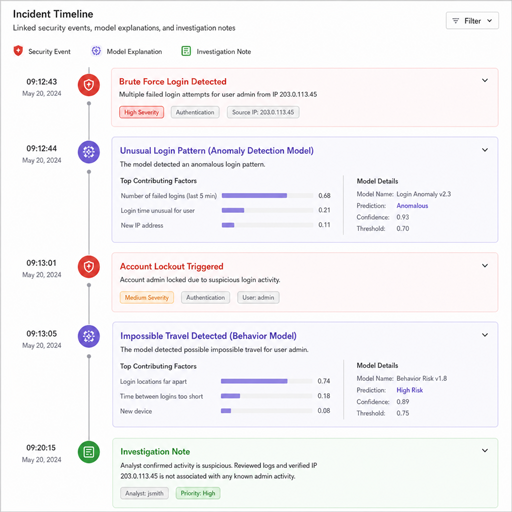
The core components of explainable security analytics
A strong explainable analytics program combines data quality, model design, user experience, and governance. The goal is not to overload analysts with every technical detail. The goal is to reveal the right evidence at the right moment.
Interpretable signals
Security models learn from signals such as frequency, rarity, sequence, proximity, deviation from baseline, and relationships between entities. For example, a user downloading files after hours may not be risky by itself. The pattern becomes more meaningful if the same user authenticates from a new country, accesses an unusual repository, and attempts to disable logging.
Explainable systems should identify which signals carried weight. This may include feature importance, rule contributions, anomaly drivers, peer-group comparison, or timeline evidence. The best explainable ai tools present this information in language analysts can use rather than raw mathematical output alone.
Context-rich scoring
A risk score is more useful when it comes with context. A score of 87 is hard to interpret without knowing whether it reflects asset sensitivity, credential behavior, malware indicators, privilege level, or correlation across multiple controls. Explainability turns scoring into a narrative of risk.
That narrative should also expose uncertainty. If data is missing, stale, or weak, the analyst should know. A transparent system may say, in effect, “This is high risk because of these three signals, but endpoint telemetry is incomplete.” That is far more useful than a confident-looking score with hidden limitations.
Human-readable reasoning
Security teams need explanations that support action. A good explanation should answer: what happened, who or what was involved, why the model considered it abnormal, what evidence supports the conclusion, and what the analyst should review next.
This does not mean every explanation must be long. In many cases, a concise summary with expandable evidence is ideal. Analysts can scan quickly, then drill into logs, entities, and contributing signals when needed.
Feedback loops
Explainable machine learning improves when analyst feedback is captured in a disciplined way. If analysts mark alerts as true positive, benign, expected change, duplicate, or insufficient evidence, that feedback can refine future prioritization and reveal blind spots.
Feedback should be structured, not just written in case notes. Over time, patterns in analyst decisions can show where the model is too sensitive, where data quality is weak, or where certain detections need more context.
How does explainability improve AI risk assessment?
Explainability improves ai risk assessment by turning model output into evidence-based judgment. Instead of asking whether a model score is high or low, teams can ask whether the supporting facts justify a response. That shift is critical because security risk depends on likelihood, impact, asset value, user role, business context, and threat behavior.
A model may identify an unusual cloud API call. Explainability helps determine whether the event is a harmless deployment action, a misconfigured automation script, or a sign of credential compromise. The same signal can mean different things depending on surrounding evidence.
Useful AI risk assessment should include:
- Entity context: Which user, device, workload, application, or service account is involved?
- Behavioral baseline: How does this activity compare with normal behavior for that entity and peer group?
- Asset sensitivity: Does the activity affect critical systems, regulated data, or privileged infrastructure?
- Threat relevance: Does the behavior align with known attack patterns such as lateral movement, persistence, exfiltration, or privilege escalation?
- Evidence strength: Are there multiple supporting signals, or is the model relying on one weak anomaly?
- Recommended next step: Should the analyst investigate, monitor, contain, enrich, or close?
This structure makes AI security insights more operational. It also helps leaders understand risk trends without needing to inspect every log line.
Practical use cases across the security workflow
Explainable AI is not limited to one tool category. It can support detection engineering, security operations, cloud security, identity protection, insider risk programs, and compliance-oriented investigations.
Alert triage and prioritization
The most common use case is helping analysts decide which alerts deserve attention first. An explainable model can rank alerts by severity and show the drivers behind the ranking. For example, it may prioritize an endpoint alert because the affected device belongs to an administrator, recently connected to a rare external destination, and generated credential-access behavior.
This helps reduce time spent on low-context alerts. It also makes prioritization easier to defend when teams are understaffed or handling a surge of activity.
User and entity behavior analytics
Behavior analytics depends heavily on baselines. Explainability helps analysts understand why a user, host, or service account diverged from expected behavior. Without that context, anomaly detection can feel noisy.
A readable explanation might highlight that the activity occurred outside the user’s normal hours, involved a new data source, and exceeded typical download volume. The analyst can then compare those factors with business events such as travel, role change, project deadlines, or approved maintenance.
Cloud and SaaS monitoring
Cloud environments produce fast-moving activity across identities, APIs, workloads, permissions, and storage. Explainable ai security analytics can help connect events that would otherwise appear separate. A suspicious cloud case might combine new access key creation, unusual API calls, permission changes, and access to sensitive storage.
Interpretability is especially valuable here because cloud incidents often involve legitimate tools used in illegitimate ways. The explanation should show the sequence and relationship between actions, not merely label each event as abnormal.
Incident investigation
During an investigation, analysts need timelines, hypotheses, and evidence. Explainable AI can help summarize likely attack paths, cluster related events, and identify the signals that link them. It can also help distinguish primary evidence from background noise.
The analyst still validates the case, but the system accelerates the first pass. Good explanations help answer what happened first, what changed next, which assets were touched, and where containment should focus.
Choosing and evaluating explainable AI tools
The right explainable ai tools should fit the team’s data, workflow, and risk tolerance. A feature labeled “AI explanation” is not enough. The explanation must be understandable, testable, and useful in real investigations.
When evaluating tools, consider this checklist:
- Data coverage: Does the tool ingest the logs and telemetry that matter most to your environment?
- Explanation quality: Does it show contributing signals, affected entities, confidence, and missing context?
- Analyst usability: Can security staff understand the output without data science support?
- Drill-down capability: Can users move from a summary into raw evidence, timelines, and related events?
- Customization: Can teams tune risk factors, thresholds, labels, and business context?
- Feedback capture: Does the platform learn from analyst dispositions and investigation outcomes?
- Governance support: Are decisions, model changes, and automated actions logged for review?
- Integration: Does it work with existing SIEM, SOAR, endpoint, identity, cloud, and ticketing workflows?
A useful evaluation exercise is to replay known incidents or high-quality historical cases through the tool. Compare the explanation with what analysts actually found. If the system highlights meaningful evidence and reduces manual reconstruction, it is likely adding value. If it produces generic explanations that repeat the alert title, it may not improve daily operations.
Best practices for implementation
Successful implementation starts with a clear scope. Teams should decide which use cases need explainability first, such as identity anomalies, endpoint triage, cloud risk, or executive reporting. Trying to apply AI everywhere at once can make validation and trust harder.
Start with high-value data sources and known pain points. If identity compromise is a major concern, focus on authentication logs, access patterns, privilege changes, device posture, and sensitive application activity. If cloud risk is the priority, emphasize API events, permissions, storage access, workload behavior, and configuration changes.
Security teams should also define what a good explanation looks like before deployment. For example, an acceptable explanation might include a plain-language summary, top contributing factors, timeline evidence, affected assets, confidence level, and recommended analyst action. This gives vendors, engineers, and security leaders a shared standard.
Finally, treat explainability as an ongoing process. Models drift, environments change, users adopt new tools, and attackers adapt. Regular reviews should examine false positives, false negatives, analyst feedback, and whether explanations still match operational reality.
Governance, trust, and responsible use
Explainable AI supports trust, but it does not remove the need for governance. Security teams should know where AI is used, what decisions it influences, which actions are automated, and how humans can override or review those actions. This is especially important when AI outputs affect account access, employee investigations, customer systems, or business-critical infrastructure.
Responsible use also means avoiding blind reliance on model explanations. Explanations can be incomplete, overly simplified, or influenced by poor data. Analysts should treat them as decision support, not unquestionable truth.
A practical governance model includes documented use cases, role-based access, audit logs, change management for model updates, periodic performance review, and clear escalation paths. These controls help teams gain the benefits of AI security insights while maintaining accountability.
Common pitfalls to avoid
Many organizations adopt AI-driven analytics before preparing the surrounding process. The technology may be powerful, but value depends on how well it fits human investigation.
Avoid these mistakes:
- Confusing explanation with accuracy: A clear explanation can still be wrong if the data or model is flawed.
- Showing too much detail: Analysts need relevant evidence, not every internal model calculation.
- Ignoring data quality: Missing, duplicated, or poorly normalized telemetry weakens both detection and explanation.
- Skipping analyst feedback: Without feedback, models may keep repeating the same low-value patterns.
- Automating too early: High-impact response actions should be tested and governed before automation expands.
- Using generic risk language: Explanations should reference specific behaviors, assets, and signals.
The strongest programs balance machine speed with human expertise. AI finds patterns at scale; analysts provide judgment, context, and accountability.
Building a more transparent security operation
Explainable AI security analytics helps security teams move beyond opaque alert scoring toward evidence-based investigation. By combining explainable machine learning, contextual security data analysis, and practical analyst workflows, organizations can make AI-driven detection easier to trust and easier to act on.
The goal is not to make every analyst a machine learning expert. The goal is to make AI outputs clear enough that security professionals can validate them, challenge them, and use them confidently. When explanations are specific, contextual, and connected to action, AI becomes more than a detection engine—it becomes a source of usable security intelligence.
