
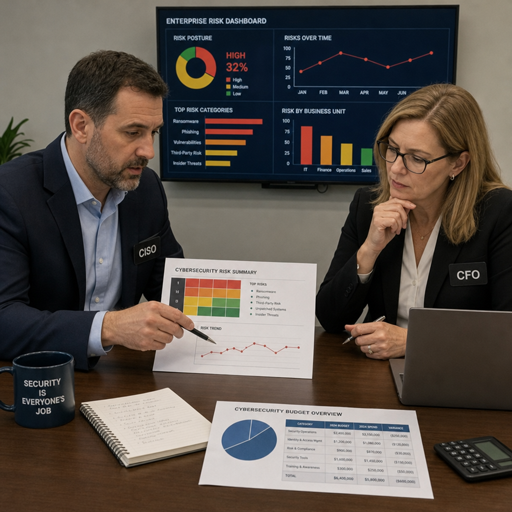
Cybersecurity success depends on more than strong tools, skilled analysts, and strict policies. It also depends on whether security leaders can connect cyber risk to financial priorities in a way the business can act on. A strong ciso-cfo relationship helps organizations make better investment decisions, reduce avoidable exposure, and turn cybersecurity from a technical cost center into a business resilience strategy.
Why does the CISO-CFO relationship matter so much?
The ciso-cfo relationship matters because cybersecurity decisions are also financial decisions. Every major security choice affects budget, risk tolerance, insurance, operational continuity, regulatory exposure, and long-term business value. When the CISO and CFO work closely together, the organization is more likely to fund the right controls, understand the cost of inaction, and prioritize cyber investments based on business impact instead of fear or technical complexity.
For many organizations, the CISO sees risk before the rest of the business feels it. The CFO, meanwhile, understands capital allocation, financial planning, cost control, and enterprise risk. When these perspectives stay separate, security conversations can become frustrating: the CISO may feel underfunded, while the CFO may feel asked to approve spending without a clear return.
A productive partnership changes that dynamic. The CISO brings clarity about threats, vulnerabilities, control gaps, and operational dependencies. The CFO brings discipline around value, affordability, forecasting, and trade-offs. Together, they can answer a better question: not “How much should we spend on cybersecurity?” but “What level of cyber risk can the business afford, and what investments reduce that risk most effectively?”
Cybersecurity is now a business risk conversation
Cyber incidents can interrupt revenue, delay operations, increase legal and regulatory costs, damage customer trust, and create unplanned recovery expenses. That means cybersecurity can no longer be treated as a purely technical function managed somewhere inside IT. It belongs in the same category as other enterprise risks that affect financial performance and strategic execution.
This shift requires a shared language. A CFO does not need a deep explanation of every vulnerability scanner, identity protocol, or endpoint control. They need to understand how security weaknesses could affect cash flow, productivity, contractual obligations, insurance premiums, customer retention, and future growth. The CISO’s role is to translate technical exposure into business terms without oversimplifying the risk.
That translation is where trust begins. When the CISO presents cyber risk in financial and operational context, the CFO can compare security investments against competing priorities. When the CFO engages seriously with cyber risk, the CISO gains a more realistic view of business constraints. The result is not unlimited security spending; it is better-aligned spending.
The CFO needs decision-ready cyber information
A CFO is often asked to make funding decisions under pressure, especially when the security team identifies urgent gaps. But urgency alone is not a strategy. To support smarter decisions, CISOs should present information in a format that helps finance leaders evaluate risk, cost, timing, and expected benefit.
Helpful cybersecurity information for the CFO often includes:
- Business impact: What systems, revenue streams, customers, or operations could be affected if the risk materializes?
- Financial exposure: What types of costs could arise, such as downtime, response support, legal review, penalties, lost productivity, or customer churn?
- Likelihood and severity: How probable is the scenario, and how damaging would it be if it happened?
- Control effectiveness: What existing safeguards are working, and where are the most important gaps?
- Investment options: What can be done now, what can wait, and what are the trade-offs of each path?
- Residual risk: After the investment, what risk remains, and is it acceptable to the business?
This approach gives the CFO more than a list of tools to approve. It creates a decision framework. A request for funding becomes easier to evaluate when it is tied to a clear risk scenario, a defined business outcome, and a realistic explanation of what the investment will and will not solve.
How can CISOs make the financial case for cybersecurity?
CISOs can make the financial case for cybersecurity by framing investments around risk reduction, operational resilience, and business enablement. Instead of leading with technical detail, they should explain what the organization is protecting, what could happen if protection fails, and how a proposed investment changes the risk profile. This makes the conversation more concrete for finance leaders and more useful for executive decision-making.
One practical method is to build proposals around scenarios. For example, rather than saying the organization needs stronger identity controls, the CISO might explain how compromised credentials could give an attacker access to critical systems, disrupt operations, and require costly remediation. The proposed investment can then be positioned as a way to reduce the likelihood or impact of that scenario.
CISOs should also be clear about uncertainty. Cybersecurity does not offer perfect guarantees, and overpromising can damage credibility. A stronger message is: “This investment reduces these specific risks, improves our ability to detect or recover, and supports these business priorities.” That kind of explanation respects both the complexity of cyber risk and the CFO’s responsibility to allocate resources carefully.
A stronger business case includes context
A persuasive cyber budget request should not stand alone. It should connect to broader business conditions, such as digital transformation, cloud migration, merger activity, third-party reliance, regulatory obligations, or expansion into new markets. These changes often increase the organization’s attack surface and can make existing controls less sufficient.
The CISO can also show how security supports revenue-generating work. Stronger controls may help satisfy customer due diligence, speed vendor assessments, support compliance needs, or reduce friction in sales conversations involving sensitive data. In that sense, cybersecurity is not only a defensive investment. It can also protect the organization’s ability to operate, compete, and grow.
The CISO helps the CFO see beyond cost control
Finance leaders naturally watch costs, and that discipline is valuable. But cybersecurity cannot be managed only as a cost to minimize. Underinvestment can create hidden liabilities that surface later as incidents, downtime, regulatory findings, or emergency spending. The CISO helps the CFO understand when a lower upfront cost may create a higher long-term risk.
This does not mean every security request deserves approval. It means the conversation should include the cost of delay, not just the cost of action. For example, postponing improvements to backup resilience, privileged access, or incident response readiness may save money this quarter while increasing the organization’s exposure to disruption. The right decision depends on business priorities, risk appetite, and timing.
A mature ciso-cfo relationship also helps prevent reactive spending. Organizations that only invest after a near miss or incident often pay a premium in urgency, disruption, and limited options. Regular planning allows cyber investments to be sequenced, budgeted, and integrated with other technology and risk initiatives.
The CFO helps the CISO sharpen priorities
The partnership is not one-directional. The CFO can help the CISO become a more effective business leader by asking hard but useful questions. Which risks are most material? Which controls produce the greatest reduction in exposure? What is the implementation timeline? What operating costs follow the initial purchase? What alternatives were considered?
These questions help security teams move from broad concern to focused execution. They also encourage CISOs to distinguish between essential controls, nice-to-have tools, and investments that may be important but not urgent. In many organizations, cybersecurity teams face more possible work than they can realistically complete. Financial discipline can help turn that complexity into a prioritized roadmap.
The CFO can also help integrate cybersecurity into enterprise planning. When security is part of budgeting cycles, strategic initiatives, procurement reviews, and risk discussions, it becomes easier to avoid last-minute surprises. This gives the CISO more visibility and gives the CFO more confidence that security spending is intentional.
Building a stronger CISO-CFO partnership
A strong partnership does not happen through one annual budget meeting. It develops through regular communication, shared expectations, and a willingness to understand each other’s pressures. The goal is not for the CFO to become a security expert or for the CISO to become a finance executive. The goal is for both leaders to make better decisions together.
Practical ways to strengthen the relationship include:
- Create a shared risk vocabulary. Agree on how cyber risks will be described, ranked, and escalated so conversations stay consistent.
- Meet outside budget season. Regular check-ins reduce surprises and allow both leaders to discuss emerging risks before they become urgent requests.
- Tie security metrics to business outcomes. Report on resilience, response readiness, control coverage, and risk reduction rather than only technical activity.
- Discuss trade-offs openly. If funding is limited, clarify what risk the business is accepting by delaying or reducing investment.
- Plan for incident costs before an incident. Review response retainers, insurance considerations, recovery assumptions, and decision-making authority in advance.
- Align on risk appetite. Make sure security priorities reflect what the organization is willing to tolerate, not just what the security team wants to improve.
These habits make cybersecurity governance more practical. They also help both leaders avoid talking past each other. The CISO gains a clearer path to support, and the CFO gains a clearer view of cyber risk as part of overall business risk.
What happens when the relationship is weak?
When the relationship is weak, cybersecurity decisions often become reactive, fragmented, or misunderstood. The CISO may present urgent technical needs without enough financial context, while the CFO may delay or reject requests because the business case is unclear. Over time, this can leave critical risks unresolved and create tension between security goals and financial priorities.
Weak alignment can also cause inconsistent funding. One year, the organization may approve a major tool purchase after an incident or audit finding. The next year, it may cut operating support needed to maintain that tool effectively. This creates the appearance of investment without the full benefit of sustained execution.
Another common problem is risk ownership. If cybersecurity is seen as only the CISO’s problem, business leaders may not understand the implications of accepting risk. The CFO can help correct this by ensuring cyber risk is discussed alongside other enterprise risks, where financial exposure, accountability, and business impact are more visible.
Cybersecurity success depends on shared accountability
The best cybersecurity programs are not built by security teams alone. They require support from finance, operations, legal, compliance, procurement, human resources, and executive leadership. Among these relationships, the CISO and CFO connection is especially important because it links technical risk to financial decision-making.
When the CISO and CFO operate as partners, cybersecurity becomes easier to prioritize and explain. Investments are more likely to be tied to business value. Risks are more likely to be accepted consciously rather than accidentally. Budget conversations become less about fear and more about resilience, continuity, and responsible growth.
The takeaway is simple: a strong ciso-cfo relationship helps organizations make smarter cybersecurity decisions. It brings financial discipline to security planning and business context to technical risk. In a world where cyber threats can affect nearly every part of the organization, that partnership is not optional. It is one of the foundations of lasting cybersecurity success.
