
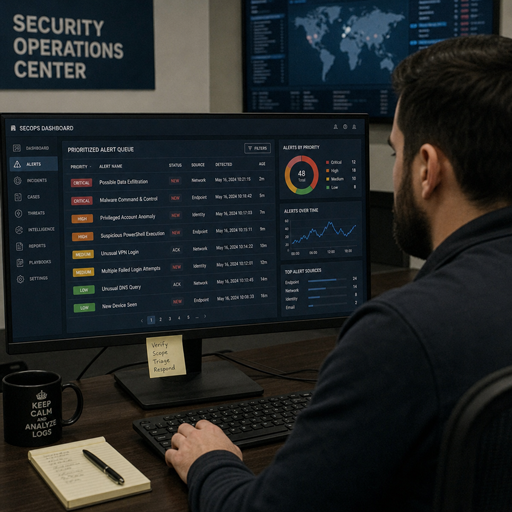
Alert triage is the discipline of separating urgent, credible security signals from the constant stream of routine, duplicate, low-risk, or poorly tuned alerts. A strong triage process helps teams reduce noise, prioritize real threats, and move faster during incident response without burning out analysts. This guide explains how effective alert triage works, what to prioritize, and how alert management can improve with better context, automation, and repeatable decision-making.
What does effective alert triage actually mean?
Effective alert triage means evaluating each alert quickly and consistently so the team can decide whether to dismiss it, enrich it, escalate it, or begin incident response. It is not simply “checking alerts”; it is a structured process for understanding severity, confidence, business impact, and the next best action. Done well, incident triage turns noisy monitoring data into a manageable workflow that supports faster, more accurate security decisions.
In many environments, alert volume grows faster than analyst capacity. Endpoint tools, identity platforms, cloud services, email security gateways, firewalls, and SIEM rules may all generate signals. Some are high-value warnings. Others are false positives, duplicates, or low-priority events that lack enough context to act on.
The purpose of effective alert triage is to prevent two common failures: treating every alert as urgent, and treating too many alerts as harmless. The first creates fatigue and slows response. The second allows real threats to hide in the background. A mature triage process creates a middle path: alerts are reviewed according to risk, enriched with relevant context, and routed to the right outcome.
The cost of alert noise
Alert noise is more than an inconvenience. It weakens the security function by making important signals harder to recognize. When analysts spend too much time closing repetitive or low-quality alerts, they have less time for investigation, threat hunting, process improvement, and containment planning.
Noise also affects judgment. A queue filled with routine warnings trains teams to expect false positives, which can make subtle signs of compromise easier to overlook. Over time, this can create inconsistent handling, delayed escalation, and unnecessary friction between security operations and the rest of the business.
Common sources of noisy alert management include:
- Overly broad detection rules that trigger on normal user or system behavior.
- Duplicate alerts from multiple tools reporting the same event.
- Missing asset context, making it hard to know whether a system is sensitive or routine.
- Weak severity mapping, where low-risk activity appears beside business-critical threats.
- Unclear ownership, causing alerts to bounce between teams instead of moving forward.
- Manual enrichment, forcing analysts to gather the same information repeatedly.
Reducing noise does not mean suppressing everything inconvenient. It means improving the signal-to-action ratio so alerts become useful inputs for decisions.
Core principles of a strong triage process
A reliable triage process is built on consistency. Analysts should not have to reinvent the decision path every time an alert appears. The process should define what matters, what information is required, who owns the next step, and when escalation is necessary.
Context comes before conclusion
An alert alone rarely tells the whole story. A failed login, suspicious process, unusual data transfer, or blocked connection may be harmless in one context and dangerous in another. The triage process should bring in supporting details before an analyst makes a decision.
Useful context may include the affected user, asset criticality, known vulnerabilities, recent authentication patterns, geographic anomalies, endpoint telemetry, cloud activity, and whether similar alerts have appeared elsewhere. The more relevant context available at the point of review, the less time analysts spend switching tools and guessing.
Severity and priority are not the same
Severity describes the potential seriousness of an alert. Priority describes how soon the team should act. A high-severity issue on an isolated test asset may need attention, but it may not outrank a medium-severity alert involving a privileged account or production system.
Effective alert prioritization combines technical severity with business impact. That distinction helps teams avoid overreacting to dramatic-looking alerts while underreacting to quieter risks that affect sensitive systems.
Every alert needs a defined outcome
A triage process should lead to one of several clear outcomes. For example, an alert may be closed as benign, marked as a false positive, escalated for investigation, linked to an existing incident, or converted into an incident response workflow. If analysts do not have defined outcomes, queues become inconsistent and reporting becomes unreliable.
Clear outcomes also help teams improve detection quality. If many alerts are repeatedly closed for the same reason, that pattern becomes evidence for tuning rules, improving asset data, or changing escalation criteria.
How should teams prioritize alerts?
Teams should prioritize alerts by combining likelihood, impact, confidence, and urgency into a simple decision model. The best alert prioritization approach is practical enough for daily use but structured enough to prevent personal judgment from becoming the only standard. The goal is not to create a perfect scoring system; it is to make risk visible and response decisions repeatable.
A useful prioritization model can consider five questions:
- What happened? Identify the triggering behavior, such as suspicious authentication, malware detection, privilege change, lateral movement, or unusual network activity.
- Where did it happen? Determine whether the asset, account, application, or environment is business-critical.
- Who or what is involved? Check for privileged users, service accounts, sensitive data stores, exposed systems, or known vulnerable assets.
- How confident is the signal? Evaluate whether the detection is supported by multiple sources or based on a weak indicator.
- What could happen next? Consider whether the alert suggests early reconnaissance, active compromise, data exposure, or containment urgency.
This approach keeps triage grounded in risk. For example, a single failed login may be low priority. Repeated failures followed by a successful login from an unusual location for an administrator account should move higher. The event type matters, but the surrounding pattern matters more.
A simple alert priority framework
|
Priority |
Typical characteristics |
Recommended action |
|---|---|---|
|
Critical |
Strong evidence of compromise, sensitive asset involved, active impact possible |
Escalate immediately and begin incident response |
|
High |
Credible threat behavior, privileged account, production asset, or multiple correlated signals |
Investigate promptly and assign clear ownership |
|
Medium |
Suspicious activity with limited context or lower business impact |
Enrich, validate, and monitor for related activity |
|
Low |
Expected behavior, weak signal, known benign pattern, or isolated event |
Close, tune, or document as appropriate |
The framework should be adapted to the organization’s environment. What counts as “critical” for one team may be “medium” for another if the asset, exposure, or business process is different.
Building an efficient incident triage workflow
Incident triage becomes easier when the workflow follows a predictable path. The steps do not need to be complex, but they should be visible, documented, and supported by the tools analysts use every day.
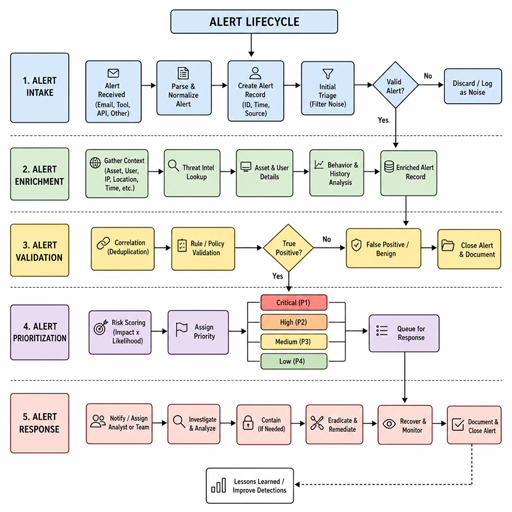
Step 1: Intake and normalization
Alerts should enter a shared workflow with consistent fields. At minimum, analysts need the source tool, timestamp, alert type, affected entity, severity, description, and related evidence. Normalization makes it easier to compare alerts across systems and prevents important details from being buried in vendor-specific formats.
This is also where duplicate detection can help. If three tools report the same suspicious login, the triage process should connect those signals rather than forcing analysts to handle them separately.
Step 2: Enrichment
Enrichment adds the context required to decide what matters. This may include identity data, asset owner, department, device posture, vulnerability status, recent changes, threat intelligence, and historical activity. Enrichment is one of the highest-value improvements in alert management because it directly reduces manual research.
Automation can play a major role here. Trychitter automation tools for effective alert triage and management, or similar workflow automation approaches, can help collect repeatable context, route alerts, and reduce analyst time spent on low-value lookups. The key is to automate support for decisions, not to remove human judgment from complex investigations.
Step 3: Validation
Validation determines whether the alert reflects expected behavior, suspicious activity, or likely compromise. Analysts may check related logs, compare activity to baselines, review recent administrative changes, or confirm whether the user performed the action.
A good validation step should be fast but not careless. The team should know which checks are required for common alert types and which signals justify escalation.
Step 4: Classification and prioritization
After validation, the alert should be classified. Categories might include benign activity, false positive, policy violation, suspicious event, confirmed incident, or duplicate. Priority should then be assigned based on risk and impact.
This stage is where structured alert prioritization prevents inconsistent decisions. Instead of relying only on analyst instinct, the team applies agreed criteria and documents why an alert was handled a certain way.
Step 5: Escalation, closure, or response
Every triaged alert should move somewhere. If it is benign, close it with a useful reason. If it is noisy, flag it for tuning. If it needs deeper investigation, escalate it with the evidence already gathered. If it is confirmed or highly likely to be malicious, start the incident response process.
The handoff matters. Escalations should include enough context for the next responder to act without repeating the same investigation.
Automation makes triage faster when the process is clear
Automation works best when it supports a well-defined triage process. If the workflow is unclear, automation can simply move confusion faster. Before automating, teams should understand which decisions are repetitive, which data sources are reliable, and where human review is still necessary.
Automation can help with:
- Alert enrichment, such as adding asset criticality, user role, geolocation, or vulnerability context.
- Deduplication and correlation, so related alerts are grouped into a single investigation.
- Routing, ensuring the right team or analyst receives the alert.
- Suppression of known benign patterns, when supported by careful review and expiration dates.
- Evidence collection, including logs, recent activity, and related events.
- Case creation, so high-priority alerts become trackable investigations.
- Notification and escalation, especially for critical events that need immediate attention.
However, automation should not become a black box. Teams need to understand why an alert was suppressed, escalated, or reclassified. Automated actions should be documented, reviewable, and tuned over time.
Practical ways to reduce alert noise
Noise reduction is an ongoing practice, not a one-time cleanup. The best results usually come from combining rule tuning, better context, analyst feedback, and clearer ownership.
Tune detections based on real outcomes
Closed alerts are a valuable data source. If analysts repeatedly close the same alert as benign, investigate why it fires. The rule may need a threshold change, exclusion, asset filter, or additional condition.
Avoid tuning only to reduce volume. A rule that fires too often may still detect something important. The goal is to improve precision while preserving coverage for meaningful threats.
Use asset and identity context
Alert severity is much easier to judge when the team knows what is affected. A suspicious action involving a privileged identity, domain controller, payment system, customer database, or internet-facing server deserves different treatment than the same action on a low-risk test machine.
Maintaining accurate asset and identity context is not glamorous, but it is central to effective alert triage. Without it, analysts waste time trying to determine impact during every review.
Group related alerts into cases
Attack activity often appears as a sequence of smaller signals. A login anomaly, endpoint alert, privilege change, and unusual network connection may look moderate in isolation but serious together. Correlation helps analysts see the bigger picture.
Grouping related alerts also reduces queue fatigue. Instead of investigating ten separate alerts, the team investigates one case with ten pieces of evidence.
Create feedback loops with detection engineering
Triage findings should influence detection quality. Analysts know which alerts are useful, which are noisy, and which lack context. Detection engineers, security architects, or tool owners can use that feedback to improve rules and integrations.
A simple review rhythm can help: identify top noisy alerts, review closure reasons, decide what to tune, measure whether the change helped, and repeat.
Metrics that show whether triage is improving
Metrics should help the team understand whether alert management is becoming faster, more accurate, and more useful. They should not encourage analysts to close alerts quickly at the expense of quality.
Useful metrics include:
- Alert volume by source and type: Shows where noise originates.
- False positive rate: Highlights detections that may need tuning.
- Duplicate alert rate: Reveals opportunities for correlation.
- Mean time to acknowledge: Measures how quickly alerts enter active review.
- Mean time to triage: Shows how long it takes to reach a decision.
- Escalation rate: Indicates how often alerts become deeper investigations.
- Closure reasons: Explains why alerts are dismissed or resolved.
- Reopened or misclassified alerts: Helps detect quality issues in triage decisions.
Metrics are most useful when reviewed with context. A lower alert volume is not automatically better if important detections were removed. A higher escalation rate is not automatically worse if it reflects better identification of real threats.
Common mistakes that weaken alert triage
Even capable teams can struggle when the triage process is informal or overloaded. Recognizing common mistakes makes it easier to correct them before they become habits.
One common mistake is treating vendor severity as the final answer. Tool-generated severity can be useful, but it may not reflect the organization’s asset value, exposure, or business priorities. Internal context should adjust priority.
Another mistake is closing alerts without meaningful reasons. “False positive” is often too vague unless the team knows why it was false and whether the detection needs tuning. Better closure notes support future improvements and reduce repeated work.
Teams also run into problems when escalation criteria are unclear. If analysts are unsure when to involve incident response, high-risk alerts may sit too long or be escalated inconsistently. Clear triggers, such as privileged account compromise indicators or confirmed malware execution, make decisions faster.
Finally, some teams automate suppression too aggressively. Suppression can reduce noise, but it should be reviewed regularly. A pattern that was benign last month may become risky after an environment change, new exposure, or different threat behavior.
A practical checklist for better alert management
Use this checklist to assess and improve the triage process:
- Define standard alert outcomes, such as closed benign, false positive, duplicate, escalated, or incident.
- Document severity and priority criteria so analysts use the same decision model.
- Add asset, identity, and business context to alerts before analysts review them.
- Correlate related alerts into cases whenever possible.
- Track closure reasons and review the most common noisy detections.
- Automate repetitive enrichment and routing tasks.
- Keep human review for ambiguous, high-impact, or novel activity.
- Create escalation triggers for high-risk scenarios.
- Review suppressed alerts and tuning decisions on a recurring basis.
- Use metrics to improve quality, not just to increase closure speed.
This checklist is intentionally practical. A team does not need a perfect security operations program to improve triage. It needs clear decisions, better context, and a habit of learning from the queue.
Turning triage into better incident response
Alert triage and incident response are closely connected. Triage identifies which signals deserve action; incident response handles the investigation, containment, eradication, and recovery when a real threat is present. If triage is slow or inconsistent, response starts late. If triage is accurate and well-documented, responders begin with stronger evidence and less confusion.
The best triage workflows preserve the story of an alert: what happened, what context was reviewed, why it was prioritized, and what action was taken. That history helps responders understand the situation quickly and helps leaders see how security decisions were made.
Effective alert triage is ultimately about focus. By reducing noise, improving alert prioritization, and strengthening the triage process, teams can spend less time fighting queues and more time finding real threats. Whether supported by Trychitter automation tools for effective alert triage and management or another automation approach, the goal remains the same: make every alert easier to understand, easier to act on, and less likely to hide the signals that matter most.
