
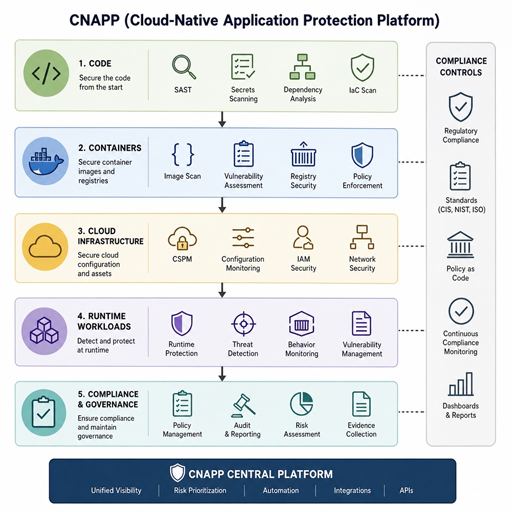
CNAPP security helps organizations protect cloud-native applications from development through runtime. Instead of treating cloud security, application security, container security, identity, and cloud compliance as separate problems, a Cloud Native Application Protection CNAPP approach brings them into one coordinated program. The result is better visibility, faster risk reduction, and security that fits the way modern teams build and operate software.
What does CNAPP security actually protect?
CNAPP security protects the full cloud-native application lifecycle: the code being written, the infrastructure being defined, the containers being built, the cloud services being configured, and the workloads running in production. A CNAPP does not replace every security practice, but it helps connect them so teams can see how a weakness in one layer creates risk in another.
In a traditional environment, security controls often focus on the network perimeter or on individual systems. Cloud-native environments are different. Applications may run across containers, Kubernetes clusters, serverless functions, managed databases, APIs, and multiple cloud accounts. Infrastructure can change every day through code, and development teams may ship updates continuously.
That speed is powerful, but it also creates blind spots. A misconfigured storage bucket, an over-permissioned identity, a vulnerable container image, and an exposed workload may each look like separate findings. CNAPP solutions help connect those dots and prioritize what matters most.
Common CNAPP protection areas include:
- Cloud configuration security: identifying risky settings across cloud accounts, services, networks, and workloads.
- Container security: scanning images, registries, Kubernetes settings, and runtime behavior for weaknesses.
- Application security: detecting vulnerable dependencies, insecure code patterns, exposed secrets, and risky build artifacts.
- Infrastructure-as-code security: finding misconfigurations before cloud resources are deployed.
- Identity and permissions risk: spotting excessive access, unused privileges, and risky combinations of permissions.
- Runtime threat detection: monitoring active workloads for suspicious behavior and potential compromise.
- Cloud compliance support: mapping controls, policies, and findings to regulatory or internal requirements.
CNAPP unifies cloud security and application security
The importance of CNAPP comes from its ability to bridge teams and tools that often operate separately. Cloud security teams may focus on misconfigurations and account posture, while application security teams focus on code, dependencies, and build pipelines. Operations teams may manage Kubernetes and runtime reliability, while compliance teams need proof that controls are working.
When these groups use disconnected tools, risk becomes harder to understand. A vulnerability scanner may flag hundreds of issues, but it may not know whether the affected package is running in production. A cloud posture tool may detect public exposure, but it may not understand whether the exposed workload contains a critical application. A compliance dashboard may show failed controls, but not the engineering context needed to fix them.
CNAPP solutions create a shared view. They combine signals from development pipelines, cloud environments, workload inventories, identities, and runtime activity. This makes it easier to answer practical questions: Which risks are exploitable? Which assets are exposed? Which findings affect production? Which team owns the fix?
That context matters because modern security teams rarely suffer from too little data. More often, they struggle with too many alerts and too little prioritization. CNAPP helps turn scattered findings into a clearer risk picture.
Why CNAPP matters in modern cloud environments
Cloud-native systems are built for flexibility, scale, and fast release cycles. Security must support that model instead of slowing it down. CNAPP matters because it helps organizations shift security earlier, maintain visibility in dynamic environments, and protect applications after deployment.
Cloud environments change constantly
In cloud-native environments, resources are often created and modified automatically. A developer can update infrastructure-as-code, a pipeline can build a new container image, and an orchestration platform can replace running workloads without manual intervention. This makes static security reviews insufficient.
CNAPP gives teams continuous assessment. Instead of checking security only at a release gate or audit milestone, teams can evaluate risk throughout the lifecycle. That continuous model is especially useful for organizations using containers, Kubernetes, microservices, and multi-cloud architectures.
Attack paths often cross multiple layers
Real-world risk rarely stays inside one category. An attacker may exploit a vulnerable application dependency, reach a container, abuse an overly permissive identity, and access sensitive cloud data. Each step may involve a different layer of the environment.
A CNAPP approach helps reveal these relationships. Rather than treating every issue as equal, it can help teams prioritize combinations of exposure, vulnerability, permissions, and asset sensitivity. This supports faster decisions and more efficient remediation.
Compliance requires evidence, not assumptions
Cloud compliance is not only about passing an audit. It is about proving that controls are defined, monitored, and corrected when they fail. In cloud-native environments, that proof can be difficult if evidence is spread across multiple platforms.
CNAPP can support compliance by centralizing policy checks, control mappings, configuration history, and remediation status. This does not remove the need for governance, documentation, or human review, but it can reduce manual effort and improve consistency.
How do CNAPP solutions strengthen DevSecOps?
CNAPP solutions strengthen DevSecOps by making security part of the same workflows developers and operations teams already use. Instead of discovering every issue after deployment, CNAPP can surface risks in code repositories, build pipelines, container registries, and cloud environments before they become production incidents.
DevSecOps works best when security feedback is timely, specific, and actionable. A vague policy failure rarely helps a developer move quickly. A clear finding that explains the risky line of infrastructure-as-code, the affected container image, the severity, and the suggested fix is much more useful.
CNAPP also helps security teams avoid acting as a final approval bottleneck. By embedding policy checks into CI/CD pipelines and developer workflows, organizations can make secure choices easier by default. Teams can block critical issues when needed, warn on lower-risk items, and track remediation without relying only on manual reviews.
Useful DevSecOps integrations often include:
- Repository scanning to identify secrets, vulnerable dependencies, and insecure configuration patterns.
- Infrastructure-as-code checks to prevent risky cloud settings before deployment.
- Container image scanning to detect operating system packages, libraries, and build-time risks.
- CI/CD policy gates to stop high-risk releases based on agreed rules.
- Ticketing and workflow integration so findings reach the right owners with context.
- Runtime feedback loops so production insights improve development priorities.
The goal is not to overwhelm developers with security alerts. The goal is to give them the right information early enough to act.
Core capabilities to look for in a CNAPP program
A CNAPP program is broader than a single feature. Some organizations begin with cloud posture management, while others start with container security or application security. The strongest approach is to choose capabilities that match the organization’s architecture, maturity, and risk profile.
Visibility across assets and ownership
Security teams need to know what exists before they can protect it. A useful CNAPP should discover cloud accounts, workloads, containers, clusters, serverless functions, images, repositories, identities, and exposed services. It should also help connect assets to owners, applications, environments, and business context.
Ownership is especially important for remediation. If a tool finds a serious risk but no one knows who owns the resource, the issue may sit unresolved. Clear ownership turns visibility into action.
Risk-based prioritization
Not every finding deserves the same urgency. A low-severity issue on an isolated test asset may matter less than a medium-severity issue on an internet-facing production workload with sensitive permissions. CNAPP solutions should help rank risk based on context.
Good prioritization considers factors such as exposure, exploitability, asset importance, vulnerability severity, permissions, data sensitivity, and runtime activity. This helps teams focus on the issues most likely to cause harm.
Policy and compliance alignment
CNAPP should support internal security standards and external cloud compliance requirements. This may include policy templates, custom rules, reporting, evidence collection, and remediation tracking. The best value comes when compliance checks are tied to practical engineering fixes.
A compliance report is useful, but a clear remediation path is better. Teams should be able to understand what failed, why it matters, and how to correct it.
Runtime protection and threat awareness
Prevention is important, but production environments still need monitoring. Runtime capability helps detect suspicious activity, unexpected network behavior, privilege abuse, container drift, and workload anomalies. This is where CNAPP connects preventive controls with active defense.
Runtime insight also improves prioritization. If a vulnerable image is not running, it may be less urgent than a vulnerable container exposed to the internet and showing unusual behavior.
CNAPP compared with traditional point tools
Point tools can still be valuable, especially when they solve a specialized problem well. The limitation is that they often create fragmented visibility. CNAPP is designed to bring related security functions together so teams can understand risk across the full environment.
|
Security need |
Point-tool approach |
CNAPP approach |
|---|---|---|
|
Cloud posture |
Checks configurations in cloud accounts |
Connects misconfigurations to workloads, identities, exposure, and compliance |
|
Container security |
Scans images or registries |
Links image risk to Kubernetes, runtime usage, and deployment context |
|
Application security |
Finds code and dependency issues |
Connects code findings to deployed cloud assets and production exposure |
|
Compliance |
Produces separate control reports |
Maps controls to live cloud posture and remediation status |
|
Prioritization |
Often based on severity alone |
Uses context across cloud, app, identity, and runtime layers |
The practical benefit is fewer isolated findings and a stronger understanding of cause, impact, and ownership.
Building a practical CNAPP adoption plan
Adopting CNAPP should be intentional. Buying a platform without clear goals can lead to another dashboard that teams ignore. A better approach is to start with the risks that matter most and expand from there.
Use this checklist to guide adoption:
- Define the scope: identify cloud providers, accounts, clusters, repositories, pipelines, and application teams.
- Prioritize use cases: start with high-value goals such as reducing public exposure, improving container security, or supporting cloud compliance.
- Connect workflows: integrate findings with CI/CD, ticketing, chat, and ownership systems.
- Tune policies: align rules to your environment so teams are not buried in low-value alerts.
- Set remediation expectations: define severity levels, response timelines, and escalation paths.
- Measure improvement: track risk reduction, recurring misconfigurations, remediation speed, and policy exceptions.
CNAPP adoption is not only a tooling project. It is a process change that requires collaboration among security, development, operations, and compliance teams. The technology helps, but the operating model determines whether findings turn into fixes.
Common mistakes to avoid
One common mistake is treating CNAPP as a magic replacement for security strategy. A platform can reveal risk, but teams still need policies, ownership, training, and executive support. Without those foundations, alerts may increase without improving outcomes.
Another mistake is enabling every possible rule on day one. This can create alert fatigue and resistance from engineering teams. Start with the most important policies, validate accuracy, and expand as teams build trust in the system.
Organizations should also avoid focusing only on pre-deployment scanning. Shift-left controls are valuable, but runtime context is essential. Production behavior often reveals which risks are truly active and which assets require immediate attention.
The strategic value of CNAPP security
CNAPP security is important because cloud-native applications are too interconnected for isolated security controls. A weakness in code can become a cloud risk, a container issue can become a compliance concern, and an identity problem can turn a small exposure into a serious incident.
By unifying cloud security, application security, container security, DevSecOps tools, and cloud compliance workflows, CNAPP gives organizations a more complete way to manage risk. It helps teams move faster without losing visibility, prioritize the issues that matter, and build security into the full application lifecycle.
For organizations building or running modern cloud-native systems, CNAPP is not just another security category. It is a practical framework for protecting applications in the way they are actually developed, deployed, and operated today.
