
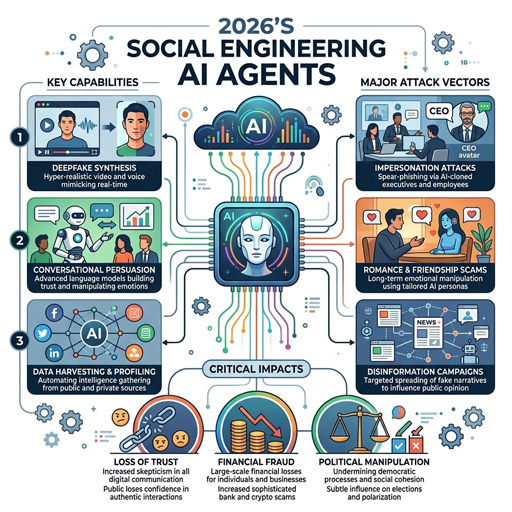
Business email compromise is no longer just a suspicious email from a spoofed executive. In 2026, social engineering AI agents are pushing BEC into a faster, more believable, and more automated phase where attackers can research targets, draft messages, mimic tone, and coordinate follow-ups across channels. The result is a fraud problem that still depends on human trust, but now operates with machine-scale patience and personalization.
The FBI has described BEC as a scam that uses compromised or impersonated business communications to redirect funds or sensitive information, and IC3 reported more than $55 billion in exposed global losses from October 2013 through December 2023. AI does not replace that playbook; it makes the playbook easier to run, harder to recognize, and more adaptable.
Why are social engineering AI agents changing BEC?
Social engineering AI agents are changing BEC because they can automate the parts of fraud that used to require time, language skill, and manual research. Instead of sending one clumsy phishing email, an attacker can use AI to summarize a company’s public footprint, infer reporting lines, generate convincing pretexts, and maintain a conversation until the victim takes action.
Traditional BEC often relied on urgency: “Pay this invoice today” or “Send the wire before close of business.” AI social engineering can be more subtle. It can warm up a target through a calendar invite, a vendor-style question, a fake recruiter message, or a voice note that sounds familiar enough to lower suspicion. That makes the first risky click or approval feel like part of normal work.
This is why the conversation has shifted from “Can employees spot phishing?” to “Can the organization verify intent, identity, and payment changes under pressure?” The strongest defense is no longer awareness training alone. It is a combination of process design, AI threat detection, payment controls, and a culture where verification is normal rather than awkward.
The shift from fake emails to agent-led deception
BEC used to be closely associated with email, but modern attacks move across the same channels employees use every day. A fraudulent request may begin in email, continue in a business messaging app, escalate through a synthetic voice call, and end with a payment portal update. FBI and CISA warnings about phishing against commercial messaging applications show how attackers increasingly target trusted communication spaces, not just inboxes.
The “agent” part matters. An AI agent can be instructed to pursue a goal, such as getting an invoice paid or persuading an employee to reset credentials. Depending on the tools available to it, the agent may draft messages, adjust tone after each reply, translate content, create summaries for the attacker, or suggest the next step.
That does not mean every criminal has a fully autonomous system. Many attacks are still human-directed. But even partially automated social engineering tools can reduce the effort needed to personalize outreach, making smaller companies, regional teams, and busy finance departments more attractive targets.
Where AI-powered BEC pressure appears inside the business
The highest-risk moments are usually ordinary business processes with money, access, or sensitive data attached. AI security risks grow when those processes depend on informal trust, fast approvals, or one-person decision making.
Common exposure points include:
- Accounts payable and vendor management: Fake bank-detail changes, invoice substitutions, and “urgent” payment exceptions can look routine when written in a familiar vendor tone.
- Executive support and finance teams: Assistants, controllers, and finance managers may receive messages that appear to come from leadership, especially around travel, deals, or quarter-end activity.
- Human resources: HR teams handle personal data, payroll changes, tax documents, and employee verification requests, making them attractive targets for impersonation.
- IT and help desk workflows: Password resets, MFA changes, device enrollment, and account recovery can be abused when a convincing caller sounds calm, prepared, and legitimate.
- Sales and customer success: Attackers may impersonate customers, partners, or prospects to request documents, change contacts, or insert malicious links into ongoing conversations.
The practical lesson is simple: if a workflow can move money, change identity data, or expand access, it needs a verification path that does not rely on the same channel where the request arrived.
What makes AI social engineering harder to spot?
AI social engineering is harder to spot because it removes many of the warning signs people were trained to notice. Poor grammar, odd phrasing, wrong time zones, and generic greetings are less reliable indicators when a model can write fluent messages in a specific tone for a specific role.
Personalization at scale
Attackers can use public websites, social profiles, press releases, job posts, and breach data to build a believable context. A message that mentions a real project, vendor, executive, or hiring process feels less suspicious because it reflects details the recipient recognizes. The danger is not that every detail is correct; it is that enough details are correct to keep the conversation moving.
Multichannel trust building
A single email may raise suspicion. A short email followed by a chat message, a calendar invite, and a voice call can create the illusion of legitimacy. This is especially powerful when teams are distributed and rarely verify requests face to face.
Better emotional timing
Social engineering tactics work because they exploit pressure, helpfulness, fear, curiosity, and professional obligation. AI can help attackers test softer language, reduce obvious urgency, and respond politely when challenged. Instead of sounding like a scammer, the exchange may sound like a busy colleague trying to solve a small problem.
Defensive signals security teams should prioritize
AI threat detection should focus less on whether a message “sounds like AI” and more on whether the request creates unusual risk. A perfectly written message can still be fraudulent if it asks for a payment change, credential action, or data transfer outside normal patterns.
Useful signals include:
- New or changed payment instructions combined with urgency, secrecy, or executive pressure.
- Requests that move channels, such as email to personal phone, chat app, or external meeting link.
- Identity recovery events involving executives, finance staff, administrators, or recently hired employees.
- Vendor communication anomalies, including new domains, slightly altered sender names, or unexpected contact changes.
- Unusual approval patterns, such as one approver bypassing a dual-control process.
- Language that discourages verification, including “do not call,” “I am in a meeting,” or “handle this quietly.”
These signals work best when connected. Email security, identity logs, finance workflows, endpoint data, and collaboration platforms each show part of the story. The goal is to detect risky sequences, not just risky messages.
How organizations can reduce AI security risks
Reducing AI security risks starts with accepting that employees cannot be the only control. People should be trained, but the system should not fail just because one person is busy, distracted, or trying to be helpful.
A practical prevention model includes:
- Create out-of-band verification rules. Any payment change, payroll update, credential reset, or sensitive data request should be verified through a known, trusted contact method already on file.
- Use dual approval for financial changes. Require separate approval for new vendors, bank-account updates, and high-risk transfers. Do not allow the requestor to define the verification method.
- Protect executive and finance identities. Apply phishing-resistant MFA where possible, monitor risky sign-ins, and limit mailbox rules that forward or hide messages.
- Train for behavior, not just phishing clues. Employees should learn to pause when a request changes money, access, identity, or urgency, even if the message looks polished.
- Run tabletop exercises. Simulate an AI-assisted vendor fraud scenario and test who verifies, who approves, who escalates, and who can stop the payment.
- Document exception handling. Attackers love exceptions. If the normal process cannot be followed, define who can approve an exception and how it must be recorded.
NIST’s AI Risk Management Framework emphasizes mapping, measuring, managing, and governing AI risks, while its generative AI profile addresses risks specific to generative systems. For security teams, that means AI governance should cover not only internal AI use but also external AI-enabled threats that target people and processes.
Cybersecurity AI agents should be part of the response
Cybersecurity AI agents can help defenders keep pace, but they should be deployed with clear boundaries. Used well, they can summarize suspicious conversation threads, correlate identity events, flag risky payment changes, and help analysts prioritize alerts. Used carelessly, they can create their own problems, such as over-automation, false confidence, or exposure of sensitive data.
The best use cases are assistive rather than blindly autonomous. A defensive agent might gather context from approved systems, highlight anomalies, and recommend next steps, while a human analyst decides whether to block, verify, or escalate. This keeps speed without handing full judgment to a model.
Organizations should also test how their own AI tools could be abused. If employees use internal chatbots, workflow automations, or customer-facing assistants, those systems need access controls, logging, prompt-injection safeguards, and clear escalation paths. AI defense is not just buying another tool; it is redesigning trust for an environment where synthetic communication is normal.
A 2026 readiness checklist
Use this checklist to evaluate whether your organization is prepared for social engineering AI agents and the next wave of BEC-style fraud:
- [ ] Payment changes require out-of-band confirmation using trusted contact records.
- [ ] Vendor master data changes are logged, reviewed, and separated from payment approval.
- [ ] Finance, HR, IT, and executive support teams receive role-specific social engineering training.
- [ ] Employees are allowed and encouraged to challenge unusual requests without fear of slowing work.
- [ ] Security tools monitor collaboration apps, identity systems, and email together where possible.
- [ ] High-risk accounts use strong MFA and conditional access controls.
- [ ] Help desk teams follow strict identity verification for resets and device enrollment.
- [ ] Incident response plans include wire fraud, deepfake calls, and compromised vendor scenarios.
- [ ] AI tools used internally have governance, logging, and data-handling rules.
- [ ] Leadership practices the same verification rules expected of everyone else.
This checklist is not about eliminating trust. It is about making trust verifiable. When verification is built into the workflow, attackers lose the advantage of urgency and charm.
The takeaway for security and business leaders
Social engineering AI agents are becoming the new BEC because they combine believable communication with automation, persistence, and context. They do not need to hack every system if they can persuade one person to approve the wrong action.
The most resilient organizations in 2026 will treat AI social engineering as a business-process risk, not only a cybersecurity issue. Strong controls, trained teams, useful cybersecurity AI agents, and clear verification habits can make even sophisticated deception much harder to monetize.
