
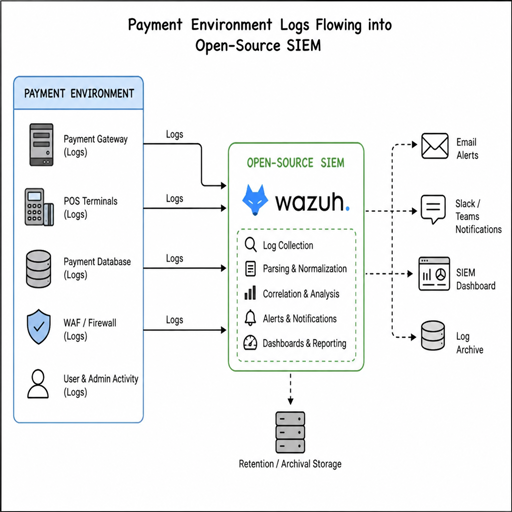
PCI-DSS compliance using open-source SIEM is about turning raw security logs into evidence, alerts, and repeatable processes that support payment-card protection. An open-source SIEM can help centralize monitoring, correlate suspicious activity, and document control operation, but it does not make an organization compliant by itself. This guide explains where SIEM fits, how to map it to PCI DSS requirements, and what to include in a practical pci dss checklist for secure payment processing.
How does an open-source SIEM support PCI-DSS compliance?
An open-source SIEM supports PCI-DSS compliance by collecting security events from in-scope systems, normalizing them, detecting anomalies, alerting responsible teams, and preserving evidence for review. In PCI DSS v4.0.1, Requirement 10 focuses on logging and monitoring access to system components and cardholder data, including the review of logs to identify suspicious activity.
The SIEM is the operating layer, not the whole compliance program. It helps prove that monitoring controls are working, but the organization still needs scope definition, policies, risk analysis, access control, vulnerability management, incident response, vendor oversight, and management sign-off. That is why strong SIEM design starts with the cardholder data environment, not with dashboards.
Open-source platforms can be attractive because they reduce license dependency, allow customization, and make detection logic more transparent. Tools such as Wazuh include PCI DSS-oriented dashboards, while OpenSearch Security Analytics provides detectors, findings, alerts, correlation rules, and Sigma-based detection options.
PCI DSS requirements that intersect with SIEM
PCI DSS contains more than logging, but SIEM is most visible where monitoring, evidence, and incident detection matter. PCI SSC published PCI DSS v4.0.1 in June 2024 as a limited revision to clarify and update the standard, and the future-dated PCI DSS v4.x requirements became effective on March 31, 2025.
A SIEM usually contributes to these areas:
- Requirement 10: Log and monitor access. This is the clearest SIEM use case: ingest logs, protect them, alert on suspicious patterns, and support review.
- Requirement 11: Test security regularly. SIEM alerts can enrich vulnerability, intrusion-detection, file-integrity, and network-monitoring activities, but they do not replace required scans or tests.
- Requirement 12: Support security governance. SIEM procedures, ownership, escalation paths, and evidence-retention practices help show that monitoring is assigned, repeatable, and understood.
- Requirements 7 and 8: Access control and authentication. SIEM rules can detect privilege misuse, failed logins, shared-account behavior, or unexpected administrative actions.
- Requirement 6: Secure development and change control. SIEM events can help monitor changes to payment applications, scripts, or sensitive configurations when integrated with deployment and file-integrity sources.
For data security compliance, the important point is traceability. Each SIEM alert, dashboard, and report should map back to a PCI DSS control objective, an owner, a review cadence, and a remediation workflow.
The open-source SIEM architecture for payment security
A compliance-ready SIEM architecture is built around scope. Start by identifying every system that stores, processes, or transmits cardholder data, then include connected systems that can affect the security of that environment. If the SIEM receives logs from both in-scope and out-of-scope systems, separate access, retention, and reporting so PCI evidence remains clear.
Log sources to prioritize
Payment environments usually need more than firewall logs. A useful SIEM implementation collects evidence from the layers attackers actually touch:
- Payment applications, APIs, gateways, and web servers
- Authentication systems, identity providers, MFA services, and directory services
- Firewalls, routers, VPNs, WAFs, IDS/IPS, and cloud security groups
- Databases that store or query payment-related records
- Endpoint agents on servers and administrator workstations
- File-integrity monitoring sources for critical configuration and application files
- Vulnerability scanners, EDR tools, container platforms, and cloud audit logs
- Change-management, ticketing, and incident-response systems when available
The goal is not to ingest everything blindly. High-volume logs without context can create storage cost, review fatigue, and weak evidence. A better approach is to define the PCI DSS requirement, identify the event that proves or challenges the control, then collect the log source needed to answer that question.
Normalization and correlation
Open-source SIEM projects often rely on parsers, rules, and mappings to make unlike systems searchable together. Normalization lets a failed login, privilege change, or firewall deny event use common fields, even when the original products format logs differently. Correlation then connects events across systems, such as a new privileged account followed by database access outside normal hours.
OpenSearch Security Analytics, for example, works with detectors, findings, alerts, and correlation rules to analyze ingested log data and identify events of interest. That pattern matters for PCI because auditors and internal reviewers need more than a screenshot; they need a defensible chain from source event to alert, review, ticket, and resolution.
A practical PCI DSS checklist for SIEM implementation
A pci dss checklist for SIEM should cover design, operation, review, and evidence. Use it as a working checklist, not a substitute for the official PCI DSS requirements or pci dss compliance consulting when your environment is complex.
- Define PCI scope first. Document systems in the cardholder data environment, connected systems, service providers, cloud accounts, administrator endpoints, and network segments.
- Map log sources to PCI DSS requirements. For each required control, identify the system of record, log type, event category, alert condition, and review owner.
- Protect SIEM access. Use unique accounts, least privilege, MFA where applicable, role-based access, and separation between SIEM administration and ordinary alert review.
- Synchronize time. Consistent timestamps are essential for incident timelines, forensic review, and event correlation.
- Create detection rules for high-risk activity. Include suspicious authentication, privilege escalation, disabled logging, policy changes, malware signals, payment application changes, and access to cardholder data.
- Set review cadences. Define what is reviewed continuously, daily, weekly, monthly, quarterly, and during incidents. Make ownership explicit.
- Retain evidence. Preserve logs, alerts, review notes, tickets, and remediation records according to your compliance obligations and business risk decisions.
- Test alert paths. Confirm alerts reach the right people, tickets are created, escalations work, and false positives are tuned without hiding real risk.
- Document exceptions. If a source cannot log a required event, record the limitation, compensating control, remediation plan, and approval.
- Review after change. Re-test SIEM coverage when payment flows, cloud services, applications, processors, or network architecture changes.
This checklist should be revisited throughout the year. PCI-DSS compliance is easier when evidence is created as part of normal operations instead of reconstructed right before assessment.
What should your SIEM alerts detect?
Your SIEM alerts should detect activity that could expose cardholder data, weaken security controls, or indicate an active compromise. The most useful alerts are specific enough to prompt action and mapped clearly enough to support compliance evidence.
Start with administrative and authentication risks. Alert when privileged users are created, disabled users authenticate, MFA settings change, service accounts behave interactively, or repeated failed logins appear across multiple systems. These alerts support access governance while helping security teams catch early-stage attacks.
Then add cardholder-data and application risks. Alert on unusual database queries, unexpected access to payment application directories, changes to payment pages, disabled file-integrity monitoring, webshell-like activity, suspicious API errors, and outbound connections from systems that should not initiate them. Secure payment processing depends on knowing when the environment changes in ways the business did not approve.
Finally, include control-failure alerts. A SIEM should notice when logging stops, an agent goes offline, a network device stops forwarding events, storage nears capacity, or parsing fails. A silent SIEM can create a compliance gap even if the underlying security tools are still running.
Open-source SIEM options and selection factors
Open-source SIEM selection should be based on control coverage, operational fit, and evidence quality. Wazuh provides compliance-oriented dashboards and explicitly notes that its capabilities can support technical controls, while also warning that deployment alone does not certify or guarantee compliance. Security Onion is another open platform used for defensive monitoring, network intrusion detection alerts, hunting, cases, and observables.
When comparing tools, look beyond the demo dashboard:
|
Selection factor |
Why it matters for PCI DSS |
|---|---|
|
Log-source coverage |
Determines whether in-scope systems can produce usable evidence |
|
Rule transparency |
Helps reviewers understand why alerts fire and how they map to controls |
|
Retention and search performance |
Supports investigations and assessment evidence requests |
|
Access control |
Protects sensitive logs and limits who can change rules or delete data |
|
Reporting |
Makes periodic review, management sign-off, and audit preparation easier |
|
Community and maintenance |
Reduces the risk of stale parsers, unsupported agents, or unpatched components |
|
Integration options |
Connects alerts to ticketing, incident response, cloud logs, and vulnerability tools |
A smaller merchant may value simplicity and prebuilt compliance views. A service provider or larger enterprise may need distributed collection, custom parsing, high availability, formal change control, and deeper integration with SOC workflows.
Evidence auditors and assessors expect to see
Assessors usually want to know whether controls exist, operate consistently, and are reviewed by accountable people. For SIEM, that means evidence should show configuration, activity, review, and response.
Strong evidence packages often include:
- A current log-source inventory with in-scope systems identified
- Data-flow diagrams showing how payment-related systems send logs to the SIEM
- Screenshots or exports of key rule configurations and alert thresholds
- Samples of daily or periodic log reviews with reviewer name, date, and outcome
- Tickets showing investigation, escalation, remediation, and closure
- Access-control reviews for SIEM users and administrators
- Retention settings and proof that logs are protected from unauthorized modification
- Test results showing that critical alerts fire as expected
- Change records for SIEM rules, parsers, dashboards, and integrations
Evidence should be boring in the best way: consistent, dated, traceable, and easy to explain. If your team cannot describe why an alert exists or what action it triggers, it may not be a mature compliance control.
Common mistakes that weaken compliance
The biggest mistake is treating SIEM deployment as the finish line. A dashboard full of PCI labels is not the same as reviewed alerts, tuned rules, protected logs, and documented response.
Another common issue is collecting logs without assigning ownership. If nobody reviews failed administrator logins, agent outages, firewall changes, or payment application modifications, the organization has visibility without accountability. PCI evidence needs people, process, and technology working together.
Teams also underinvest in tuning. Excessive false positives cause reviewers to skim, while overly broad suppression rules can hide real incidents. Tuning should be documented so the organization can explain why noisy events were adjusted and how detection quality was preserved.
Finally, many organizations forget that compliance frameworks overlap. If your roadmap includes Discover Financial Services, SOC 2, ISO 27001, PCI DSS compliance, or broader data security compliance, build shared monitoring controls where possible. One well-governed SIEM process can support several frameworks, but each framework still has its own scope, terminology, and evidence expectations.
When to use PCI DSS compliance consulting
PCI DSS compliance consulting is worth considering when scope is unclear, payment flows are complex, or internal teams are new to PCI DSS v4.0.1. Consultants and Qualified Security Assessors can help interpret applicability, validate evidence, test compensating controls, and identify gaps before formal assessment.
Consulting is especially useful for organizations with multiple payment channels, cloud-native architectures, third-party processors, marketplace models, or service-provider obligations. The SIEM team may understand logs, but PCI scope and responsibility matrices can be more nuanced than the technology suggests.
A good consultant should not simply hand over generic templates. They should help your team map actual payment flows, align SIEM evidence to the right pci dss requirements, and build a program that survives day-to-day operations.
Building a sustainable SIEM compliance program
The best SIEM programs treat compliance as continuous operations. Build a monthly rhythm for reviewing log-source health, alert quality, user access, rule changes, evidence completeness, and unresolved risks. Use quarterly reviews to confirm that business changes have not expanded PCI scope without monitoring coverage.
Keep the program practical. Start with the highest-risk payment systems, prove that alerts generate useful action, then expand coverage in stages. Document decisions as you go, including what you collect, what you do not collect, why each choice was made, and who approved it.
Open-source SIEM can be a strong foundation for PCI-DSS compliance when it is scoped correctly, operated consistently, and tied to real security outcomes. It gives teams visibility and flexibility, but compliance comes from disciplined control ownership, evidence, review, and response.
