
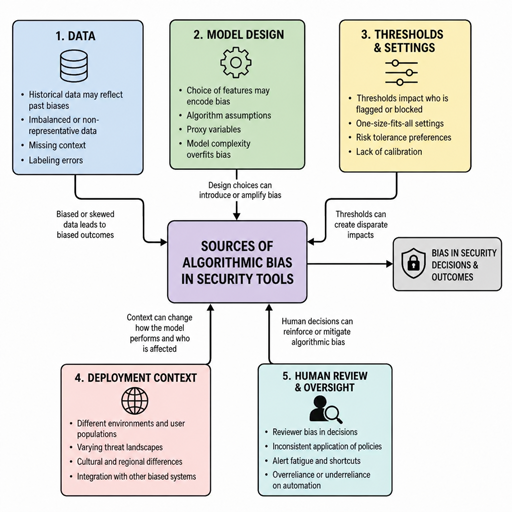
Security tools increasingly use machine learning, rules engines, scoring models, biometrics, behavioral analytics, and generative AI to decide what looks risky. Algorithmic bias in security happens when those systems produce unfair, unreliable, or uneven outcomes for different people, groups, devices, locations, languages, or behaviors. This guide explains how biased algorithms appear in security environments, why they create operational and ethical risk, and how teams can evaluate algorithm fairness without weakening protection.
What does algorithmic bias in security tools mean?
Algorithmic bias in security tools means a model or automated decision process systematically performs differently across groups or contexts in a way that can cause unfair treatment, missed threats, false accusations, privacy harm, or weaker protection. It is not limited to intentional discrimination. Bias can come from data, design assumptions, operational thresholds, historical patterns, human labels, or the way a tool is deployed.
In practice, algorithmic bias in security may show up as a fraud model that flags certain neighborhoods more often, a facial recognition system with uneven match performance, an insider-risk tool that misreads accessibility software as suspicious behavior, or a phishing detector that works well in English but poorly in another language. The harm may be direct, such as a person being denied access, or indirect, such as a security team spending most of its time investigating low-value alerts from one employee group while missing real threats elsewhere.
NIST’s AI Risk Management Framework treats fairness with harmful bias managed as one characteristic of trustworthy AI, alongside qualities such as validity, reliability, security, resilience, explainability, interpretability, privacy, accountability, and transparency. That framing matters for security because a tool can be technically sophisticated and still be untrustworthy if it is unfair, opaque, or difficult to challenge.
NIST Special Publication 1270 also emphasizes that AI bias is not only a statistical problem. It describes bias through broader lenses that include systemic, human, and statistical or computational sources, which is especially relevant in security domains where historical enforcement patterns, analyst judgment, and incomplete telemetry can all shape model behavior.
Algorithmic discrimination turns technical errors into real-world harm
Algorithmic discrimination occurs when automated systems contribute to unequal or unlawful treatment of people. In security, this may happen through access decisions, identity checks, fraud scoring, workplace monitoring, law enforcement support tools, or risk models that affect whether someone is trusted, investigated, delayed, or excluded.
The important point is that security teams do not get a special exemption from fairness just because their objective is protection. U.S. agencies including the FTC, DOJ, CFPB, and EEOC have warned that automated systems can still violate existing civil rights, consumer protection, fair competition, and equal opportunity laws when they produce discriminatory outcomes.
For security leaders, that means algorithm fairness is not a “soft” concern separate from risk management. It is part of model quality, legal exposure, operational effectiveness, user trust, and incident response. A biased tool can generate more work, create blind spots, damage morale, and make enforcement decisions harder to defend.
Bias can be hidden behind neutral labels
Security systems often use labels that sound objective: risky login, suspicious transaction, anomalous user, high-risk account, likely bot, possible insider, positive match. Those labels can hide subjective or uneven inputs. If past investigations were concentrated in one location, if reports came from managers with inconsistent standards, or if fraud labels were based on who was caught rather than who offended, the model may learn a distorted picture of risk.
A security model may also use proxies. It may not use a protected attribute directly, but it may rely on variables that correlate with that attribute, such as geography, device affordability, shift schedule, language patterns, network type, job role, or account age. Proxy bias is difficult because each feature may look defensible in isolation while the combined model produces unfair outcomes.
Security consequences are often asymmetric
Bias does not affect all error types equally. A false positive may lock out a legitimate user, delay a payment, trigger an investigation, or expose someone to suspicion. A false negative may allow an attacker, fraudster, or compromised account to pass. In some contexts, the same biased model can do both: over-police one group and under-protect another.
This is why algorithmic bias in security is not simply a matter of reducing alert volume. Teams need to know which errors are rising, who or what is affected, and what happens after the alert. A low average error rate can still conceal unacceptable disparities for smaller populations, edge cases, or high-impact decisions.
Where biased algorithms appear across the security stack
Security technology is now broad enough that bias can appear almost anywhere. Some tools make decisions about people; others make decisions about devices, networks, content, or behavior. Even when a system is not obviously “about” humans, its outputs may affect employees, customers, travelers, patients, students, tenants, or account holders.
Identity verification and biometrics
Biometric security tools can support account recovery, border control, workplace access, device unlocking, and customer onboarding. They may compare a live image to an identity document, search a watchlist, or verify that the same person is present over time. These uses can be convenient, but they are also sensitive because errors can immediately affect a person’s ability to move, work, transact, or access services.
NIST’s work on face recognition demographic effects found that performance varies by algorithm, application, and data, and that many face recognition algorithms show demographic differentials. NIST also notes that false negatives can be strongly dependent on image quality, which means deployment conditions such as lighting, camera placement, compression, and capture instructions can influence fairness.
The lesson is not that every biometric system is unusable. The lesson is that teams must test the exact use case, population, image pipeline, threshold, fallback process, and human review workflow. A vendor accuracy claim from a general benchmark is not enough to prove fair performance in a specific security environment.
Fraud detection and transaction monitoring
Fraud tools often score transactions, accounts, claims, applications, returns, chargebacks, or payment behavior. They may use device fingerprints, velocity rules, geolocation, behavioral biometrics, merchant patterns, identity signals, and historical fraud labels. These systems can create algorithmic discrimination when they treat legitimate users as suspicious because their behavior differs from the majority population in the training data.
Examples include users who share devices, use VPNs for privacy, travel often, rely on prepaid instruments, have limited credit history, use assistive technologies, live in multi-family households, or access services from regions with weak infrastructure. A model may classify these patterns as risky because they resemble some fraud cases, even when many legitimate users behave the same way.
Fair fraud prevention requires layered controls. Instead of turning a score into an automatic denial, teams can use step-up verification, clearer appeal channels, risk-based review, and separate monitoring for false positives. The goal is to stop abuse without making ordinary access unnecessarily difficult for specific communities.
Insider threat and employee monitoring
Insider-risk systems look for unusual activity: large downloads, odd working hours, access to sensitive repositories, changes in communication patterns, or deviations from peer behavior. These tools can be biased when “normal” is defined around a narrow group. Remote employees, disabled workers, night-shift staff, caregivers, multilingual teams, contractors, union organizers, or employees in different regions may be flagged more often because their work patterns differ.
The risks are not only technical. Workplace security tools can create chilling effects if employees believe ordinary behavior is being interpreted suspiciously. A biased insider-risk program may damage trust, discourage legitimate reporting, and push people to work around controls.
Strong governance is essential here. Organizations should define which behaviors are security-relevant, prohibit monitoring for unrelated purposes, require human review before adverse action, and document why each signal is proportionate. Fairness in employee security monitoring depends as much on policy boundaries as on model calibration.
Threat detection, endpoint security, and anomaly analytics
Threat detection tools may seem less connected to fairness because they classify files, processes, domains, network flows, or authentication patterns. Still, bias can appear as uneven protection. A malware model trained heavily on threats common to large enterprises may perform poorly for small organizations, regional industries, or non-English environments. An anomaly detector trained on headquarters behavior may misclassify branch offices as risky.
This kind of bias creates security inequality rather than classic discrimination. Some users are overloaded with false alerts, while others receive less accurate protection. If alert fatigue is concentrated in certain environments, analysts may begin ignoring signals from those sources, compounding the risk.
Security teams should evaluate model performance by environment, business unit, geography, operating system, device type, language, and user role where those categories are relevant and lawful to use for testing. Fairness analysis is not only about demographic groups; it is also about whether security protection is consistent across the organization’s real operating conditions.
Generative AI security assistants and autonomous agents
Generative AI tools now help summarize alerts, write detection rules, investigate incidents, classify phishing reports, answer policy questions, and operate security workflows. These systems introduce a different form of bias: they may produce confident but incomplete reasoning, reflect training-data stereotypes, over-prioritize familiar attack patterns, or recommend actions that work for one environment but not another.
OWASP’s 2025 guidance for large language model applications highlights risks such as excessive agency, misinformation, sensitive information disclosure, prompt injection, data and model poisoning, and vector or embedding weaknesses. These risks are relevant to security tools because an AI assistant with too much autonomy, poor validation, or biased retrieval can escalate flawed recommendations into real operational changes.
A fair and safe AI security assistant should not be treated as an independent authority. It should cite evidence, preserve analyst judgment, separate facts from guesses, and require approval for actions that affect users, systems, access, or investigations.
The root causes of algorithmic bias in security
Biased algorithms rarely come from one mistake. They usually emerge from a chain of decisions: what problem the tool is built to solve, what data is collected, which labels are used, what threshold is selected, how humans interpret outputs, and what consequences follow.
Historical data reflects historical enforcement
Security data is not a neutral record of all harmful activity. It is a record of what was observed, logged, reported, investigated, confirmed, and retained. If an organization historically monitored one group more closely than another, the resulting dataset may overrepresent incidents in that group. A model trained on that dataset can reproduce the pattern and send even more scrutiny to the same place.
This creates a feedback loop. More alerts lead to more investigations; more investigations create more labels; more labels teach the model that the group is riskier. Without intervention, algorithmic discrimination can grow stronger over time while appearing data-driven.
Labels can encode human judgment
Many security labels are created by analysts, investigators, managers, fraud reviewers, or automated rules. A “true positive” may mean the team found enough evidence under time pressure, not that the event was objectively malicious. A “false positive” may mean no one had enough information to confirm it. A “policy violation” may reflect a manager’s interpretation rather than a consistent standard.
Label quality matters because supervised models learn from those outcomes. If human decisions were inconsistent, the model may scale inconsistency. If reviewers were stricter with certain users, the model may learn that strictness as if it were ground truth.
Missing data can look like suspicious data
Security systems often penalize uncertainty. A new device, limited history, missing geolocation, sparse profile, privacy-preserving browser, or unusual login pattern may all increase risk scores. That can be reasonable in moderation, but it can become unfair when missingness is unevenly distributed.
For example, new immigrants, younger users, low-income customers, small businesses, privacy-conscious individuals, and people in regions with shared devices may have less conventional data. If a model treats thin data as dangerous data, it can exclude legitimate users precisely because they are less visible to the system.
Optimization targets can conflict with fairness
A model optimized only to reduce aggregate fraud loss, alert volume, or investigation time may discover shortcuts. Those shortcuts can increase harm for smaller groups if the overall metric improves. Aggregate performance is useful, but it is not enough.
Security teams need group-level and context-level evaluation. They should ask whether a performance gain is broadly shared or achieved by shifting burden to a subset of users. This is the heart of algorithm fairness: not every person will receive the same outcome, but differences should be justified, measured, proportionate, and contestable.
How can teams evaluate algorithm fairness in security tools?
Teams can evaluate algorithm fairness by defining the decision being made, identifying who or what may be affected, measuring error patterns across relevant groups and contexts, testing the workflow around the model, and documenting whether the remaining risk is acceptable. Fairness evaluation should happen before deployment, after material changes, and continuously during operation because data, attackers, users, and business processes all drift.
A practical fairness review is not a one-time ethics meeting. It is a repeatable control inside the security lifecycle. It should include security engineering, legal, privacy, compliance, data science, accessibility, affected business owners, and the analysts or reviewers who will use the tool.
A practical fairness testing checklist
Use this checklist to turn broad concerns about biased algorithms into concrete review steps:
- Define the decision. Specify whether the tool recommends, flags, scores, blocks, verifies, denies, escalates, or automatically acts. Fairness risk rises when the tool directly affects access, employment, identity, money, movement, or investigation.
- Map affected populations and assets. Identify which user groups, regions, devices, languages, work patterns, account types, or customer segments may experience different outcomes. Use lawful and privacy-preserving methods for analysis.
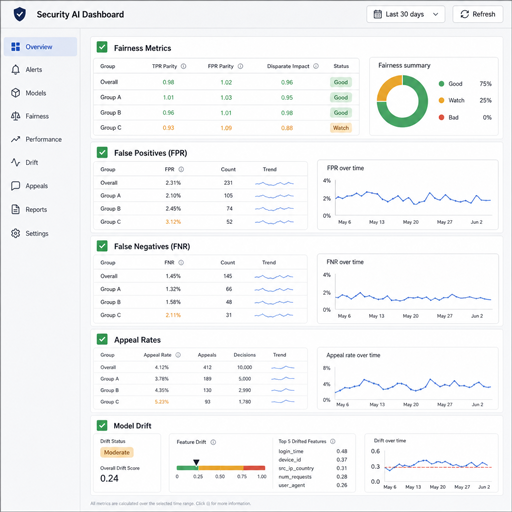
- Separate error types. Measure false positives, false negatives, inconclusive results, manual review rates, appeal outcomes, and time-to-resolution. A single accuracy number can hide the most harmful disparities.
- Test thresholds. Evaluate whether the same risk threshold creates uneven burden across groups or contexts. Sometimes fairness improves through threshold changes, additional verification options, or different escalation paths.
- Review training labels. Ask who created labels, under what rules, with what review process, and whether labels reflect confirmed harm or merely suspected activity.
- Check proxy features. Examine whether variables such as location, device type, language, schedule, account age, or network attributes may indirectly stand in for sensitive characteristics.
- Evaluate deployment conditions. Test real camera quality, network latency, browser environments, accessibility tools, mobile devices, and regional workflows. Lab performance may not reflect production use.
- Inspect the human workflow. Determine whether analysts understand model limitations, can challenge outputs, and have enough context to avoid automation bias.
- Document decisions. Record fairness metrics, known limitations, accepted risks, mitigation steps, and ownership for monitoring.
- Create appeal and correction paths. Users need a way to recover from incorrect security decisions, especially when the output affects access, identity, money, or employment.
Useful metrics, with caution
Fairness metrics can include differences in false positive rates, false negative rates, precision, recall, review rates, denial rates, pass rates, and outcome reversal rates after appeal. For biometric systems, teams may examine false match and false non-match rates. For fraud systems, they may compare step-up challenge rates and successful challenge completion rates. For detection systems, they may compare alert quality and analyst actionability across environments.
No single metric proves fairness. Equalizing one metric may worsen another. A high-risk security decision also requires context: the severity of harm, the availability of alternatives, the reliability of human review, and the ability to contest the result. Metrics should start the conversation, not end it.
Red teaming should include fairness abuse cases
Security red teaming usually asks, “How could an attacker exploit this system?” Fairness-aware red teaming also asks, “Who is the system likely to misunderstand, exclude, over-scrutinize, or under-protect?” Both questions belong together.
For AI and LLM-enabled applications, OWASP recommends treating the whole system as the attack surface, including the model, prompts, retrieval pipeline, tools, and permissions. That approach is useful for fairness as well because bias may live in the retrieval source, the tool permission model, the generated recommendation, or the downstream workflow rather than in the model alone.
Governance makes fairness operational
Algorithm fairness improves when organizations treat it as an operating discipline. Policies should define what automated security tools may do, what they may not do, who approves high-impact uses, how performance is monitored, and when a system must be paused or changed.
NIST’s AI RMF is organized around governance and risk management functions that help organizations map, measure, manage, and govern AI risks. For security teams, that means fairness should be connected to existing controls such as vendor risk management, change management, access governance, incident response, model monitoring, privacy review, and audit evidence.
Assign clear ownership
A common failure mode is assuming fairness belongs to someone else. Data scientists may focus on model performance, security teams on threat reduction, legal teams on compliance, and procurement teams on vendor claims. Bias falls through the cracks when no one owns the full decision chain.
A better model assigns owners for each layer:
- Business owner: defines the security purpose and acceptable use.
- Technical owner: validates data, model behavior, thresholds, and monitoring.
- Security owner: evaluates adversarial risk and operational impact.
- Privacy and legal reviewers: assess rights, notice, data use, and discrimination risk.
- Human workflow owner: ensures reviewers are trained and decisions are contestable.
- Executive sponsor: accepts residual risk and funds remediation.
Require documentation before deployment
Documentation does not need to be bureaucratic to be useful. A concise model or system card can describe intended use, prohibited use, data sources, known limitations, performance by relevant subgroup, human review requirements, escalation paths, and monitoring cadence. The point is to make assumptions visible before the tool is embedded into everyday operations.
Documentation is especially important when using vendor tools. A vendor may not disclose proprietary model details, but customers can still ask for evaluation summaries, demographic or contextual performance testing where relevant, data governance practices, model update procedures, explainability options, audit logs, and incident notification processes.
Monitor drift after launch
Fairness can degrade after deployment. User behavior changes, attackers adapt, new regions come online, policies shift, fraud patterns evolve, and vendors update models. A system that looked acceptable at launch may later produce biased outcomes.
Monitoring should track both security performance and fairness indicators. If false positives rise after a policy change, if appeals increase in one language group, if one office receives disproportionate insider alerts, or if a biometric system fails more often under certain lighting conditions, the team should investigate quickly. Waiting for a complaint may mean the harm has already scaled.
Regulatory and standards pressure is increasing
Organizations should avoid treating AI fairness as optional, especially when security tools affect people. The regulatory direction is clear: governments and standards bodies are paying closer attention to automated decisions, biometric systems, transparency, discrimination, and accountability.
In the European Union, the AI Act regulates AI through risk categories and includes restrictions or prohibitions for certain uses involving biometric categorization, emotion recognition, predictive policing, and real-time remote biometric identification in public spaces for law enforcement, subject to specific exceptions. EU guidance also addresses transparency obligations for certain AI systems, including informing people when they are exposed to emotion recognition or biometric categorization systems.
For U.S. organizations, the most practical takeaway is not to wait for one single AI law to cover every security tool. Existing discrimination, consumer protection, employment, privacy, and sector-specific rules may already apply depending on the use case. The joint statement from U.S. enforcement agencies makes clear that using automated systems is not a defense if the resulting conduct violates existing law.
Security teams should work with counsel for specific legal advice, but they do not need to wait for legal certainty to improve practice. Better testing, documentation, transparency, human review, and appeal mechanisms reduce both operational and compliance risk.
How should organizations choose and deploy fairer security tools?
Organizations should choose and deploy fairer security tools by evaluating the vendor, the model, the data, the workflow, and the consequences together. A tool is not fair simply because the vendor says it uses AI responsibly, and it is not unsafe simply because it uses machine learning. The deciding factor is whether the organization can understand, test, control, monitor, and correct the system in its real environment.
Procurement is one of the strongest moments to reduce algorithmic bias in security. Once a tool is deeply integrated into identity, fraud, endpoint, or investigation workflows, replacing it becomes harder. Ask fairness questions before the contract is signed, not after the first harmful incident.
Vendor questions that reveal fairness maturity
Ask vendors questions that require evidence rather than slogans:
- What is the tool’s intended use, and what uses are explicitly unsupported?
- What data sources were used for development and evaluation at a high level?
- Which performance metrics are available by relevant subgroup or operating condition?
- How does the system perform under low-quality, sparse, noisy, or atypical input conditions?
- What features or signals are most influential in risk scoring or classification?
- Can customers adjust thresholds, escalation paths, and automated actions?
- What human review is recommended before adverse action?
- How are model updates tested, documented, and communicated?
- What audit logs are available for investigations, appeals, and compliance reviews?
- How can users correct errors or recover from false positives?
A vendor that cannot answer every question may still be usable for low-impact contexts. But for high-impact decisions, weak transparency should raise concern. If the organization cannot explain or challenge the system, it may struggle to defend the outcomes.
Deployment patterns that reduce harm
Fairness is often improved by workflow design, not only by model design. Security teams can reduce harm by using automation to prioritize review rather than to make final decisions, by offering multiple verification methods, by limiting the duration of restrictions, and by preventing one signal from becoming the sole basis for adverse action.
For example, a high fraud score might trigger step-up authentication rather than account closure. A biometric mismatch might route to document review rather than denial. An insider-risk alert might require corroborating evidence before an investigation. A generative AI recommendation might require analyst approval before any system change.
When not to automate
Some security decisions should remain human-led or should not be performed at all with a given technology. Automation is risky when the data is weak, the consequences are severe, the affected person cannot appeal, the model cannot be meaningfully evaluated, or the tool is being used outside its intended purpose.
A good rule is simple: the higher the consequence, the stronger the evidence and review process must be. If a tool can affect employment, legal exposure, access to essential services, identity status, or law enforcement attention, “the model said so” is not enough.
A response plan for suspected algorithmic bias
Even mature programs can discover bias after deployment. What matters is whether the organization responds quickly, transparently, and proportionately.
Start by preserving evidence. Capture model version, thresholds, input data, logs, analyst notes, affected users or systems, decision timestamps, and any downstream actions. If a vendor model is involved, notify the vendor and request update history or known issue information.
Next, contain harm. Depending on severity, that may mean pausing automated decisions, raising thresholds, switching to manual review, restoring access, reversing account restrictions, or notifying affected stakeholders. Do not wait for a perfect root-cause analysis if people are actively being harmed.
Then investigate the decision chain:
- Input: Was the data missing, low quality, skewed, or incorrectly processed?
- Model: Did the model weight proxy features, drift, or fail for a subgroup?
- Threshold: Did the cut-off create uneven error rates or excessive burden?
- Workflow: Did human reviewers over-trust the score or lack context?
- Policy: Was the tool used beyond its approved purpose?
- Remedy: Were affected people able to appeal, correct records, or regain access?
Finally, document corrective action. Update testing, thresholds, training, vendor requirements, user notices, appeal procedures, and monitoring dashboards. A bias incident should feed the same improvement cycle as a security incident: identify root causes, fix control gaps, and verify that the fix works.
Key takeaways for security leaders
Algorithmic bias in security is not a niche AI ethics problem. It is a practical risk that can weaken detection, overload analysts, unfairly burden users, and expose organizations to legal and reputational consequences.
Keep these principles in view:
- Fairness is part of security quality. A tool that works unevenly is less reliable than its average accuracy suggests.
- Bias can enter anywhere. Data, labels, features, thresholds, deployment conditions, and human workflows all matter.
- Measure the right errors. False positives, false negatives, inconclusive outcomes, appeal reversals, and review delays may affect groups differently.
- Avoid fully automatic high-impact decisions. Human review, corroborating evidence, and appeal rights are essential when consequences are serious.
- Demand vendor evidence. Responsible AI claims should be backed by testing, documentation, logs, and update controls.
- Monitor continuously. Algorithm fairness can drift as users, attackers, policies, and models change.
Building security systems people can trust
The best security programs do not treat fairness as a constraint that competes with protection. They treat it as a requirement for reliable protection. A biased system wastes analyst time, damages trust, and may miss the threats that do not fit its assumptions.
Reducing algorithmic bias in security requires technical testing, careful deployment, clear governance, and humility about what automated systems can know. Teams should ask hard questions before launch, monitor outcomes after launch, and give people meaningful ways to challenge mistakes.
Security tools should help organizations make better decisions, not hide weak decisions behind mathematical authority. When algorithm fairness is built into procurement, engineering, operations, and incident response, security becomes more accurate, more accountable, and more resilient.
