
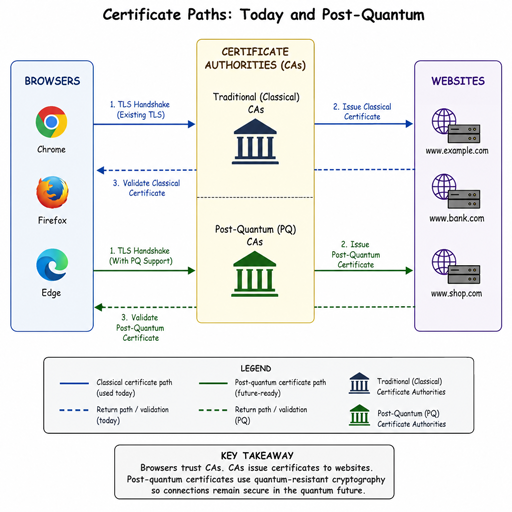
Cloudflare’s move toward a public Certificate Authority is a signal that post-quantum security is moving from theory into web infrastructure. The announcement matters because certificates sit at the center of web cryptography: they help prove a site is genuine and enable encrypted HTTPS connections. Cloudflare says its planned CA will support both today’s certificate model and post-quantum Merkle Tree Certificates, creating a bridge toward a quantum-safe internet without forcing website owners into an abrupt rebuild.
What did Cloudflare announce?
Cloudflare announced its intent to become a public Certificate Authority, meaning it plans to issue the digital certificates websites use to encrypt traffic and prove identity to browsers and visitors. The company also said the CA is being designed for both conventional TLS certificates and next-generation Merkle Tree Certificates, or MTCs, which are intended to support the post-quantum web. Cloudflare has applied for inclusion in major root programs, including Chrome, Apple, Microsoft, and Mozilla, and says it has agreed to acquire established publicly trusted Root CA key material from GlobalSign to improve compatibility across the existing Web PKI ecosystem.
That combination is the important part. A brand-new root can take years to become widely trusted across browsers, operating systems, phones, embedded devices, and older hardware. By pursuing both root program inclusion and an established root, Cloudflare is trying to make its certificates usable across newer clients and legacy devices while preparing for the cybersecurity evolution required by quantum computing impact.
The role of a Certificate Authority in web trust
A Certificate Authority, or CA, is one of the organizations trusted to validate that a domain and a public key belong together. When a browser connects to a website over HTTPS, the site presents a certificate chain that helps the browser decide whether the site is legitimate and whether an encrypted session should proceed. This system is often called Web PKI, and it is foundational to modern web cryptography.
For most users, certificates are invisible unless something goes wrong. A certificate warning, an expired certificate, or a misissued certificate can block access or create serious trust problems. For website operators, certificates are operational infrastructure: they must be issued, renewed, monitored, and replaced quickly when policies or security needs change.
Cloudflare’s announcement is therefore not just about adding another certificate issuer. It is about adding a high-scale, automated issuer to a trust ecosystem that Cloudflare argues benefits from redundancy, transparency, and a practical migration path toward post-quantum security. Cloudflare says it plans to make the CA ACME-first, using the widely adopted Automated Certificate Management Environment protocol so operators already using automated certificates can switch by changing a directory URL rather than re-architecting their tooling.
Why does post-quantum security matter for websites?
Post-quantum security matters because a sufficiently powerful quantum computer could eventually undermine widely used public-key cryptography, including the algorithms that help protect website authentication and key exchange today. NIST describes post-quantum cryptography as an effort to secure electronic information against quantum computers that may be years or decades away but could break many current cryptographic systems. NIST released its first three principal post-quantum cryptography standards in 2024 and says organizations should begin migrating systems to quantum-resistant cryptography.
The risk is not limited to a future day when a quantum computer suddenly exists. Security teams also worry about “harvest now, decrypt later” scenarios, where attackers collect encrypted traffic today in hopes of decrypting it when future capabilities improve. That threat is one reason the industry has prioritized post-quantum key agreement, which protects the exchange used to establish encrypted sessions.
Website authentication is another layer. Even if encrypted session setup becomes quantum-resistant, browsers still need a trustworthy way to know they are connected to the right site. That is where post-quantum certificates and MTCs enter the discussion. A quantum-safe internet needs both encrypted communication and resilient authentication.
Post-quantum does not mean “quantum encryption” in the everyday sense
The phrase quantum encryption is often used loosely in marketing and media. In this context, the more precise term is post-quantum cryptography: classical cryptographic algorithms designed to resist attacks from future quantum computers. It is different from quantum key distribution, which uses quantum physics to exchange keys and is not how ordinary HTTPS works.
For the public web, the near-term path is not replacing the internet with exotic quantum networks. It is updating TLS, certificates, cryptographic libraries, browsers, and operational processes so the existing web can remain fast, compatible, and secure as cryptographic assumptions change.
How Merkle Tree Certificates fit the post-quantum web
Merkle Tree Certificates are designed to make post-quantum website authentication practical at web scale. Cloudflare says MTCs are a more compact way to deliver publicly trusted certificates in a post-quantum world where traditional certificate chains could grow large enough to strain TLS handshakes. The company says it plans to issue production MTCs in the first quarter of 2027 and to support both classical certificates and MTCs under one CA so customers can adopt at a pace that fits their environment.
The core challenge is size and performance. Post-quantum signatures can be larger than the classical signatures used in today’s certificate chains. If every connection had to carry much larger certificate data, page loads, mobile performance, latency-sensitive applications, and constrained networks could feel the impact.
MTCs approach the problem differently. Instead of relying on a conventional certificate chain structure for every authentication event, they use Merkle tree techniques to provide compact proofs that a certificate belongs within a transparent, signed structure. Cloudflare says MTCs emerged as the path forward after industry support and experimentation, and it is targeting early 2027 inclusion in Chrome’s Quantum-resistant Root Store.
The practical goal: stronger authentication without heavier handshakes
For website owners, the best security migration is one that does not require every team to become a cryptography research group. The value of MTCs is that they aim to preserve the user experience people expect from HTTPS while changing the trust mechanism underneath. If the system works as intended, a site can move toward quantum-resistant authentication while browsers continue to load pages efficiently.
That is also why Cloudflare’s CA strategy pairs old and new. Classical certificates will remain necessary for many devices and clients for years. MTCs can grow as browser support and operational maturity improve. A mixed environment is not a weakness; it is how large infrastructure transitions usually succeed.
Key benefits and tradeoffs for website operators
Cloudflare’s announcement is relevant to security teams, platform engineers, SaaS companies, publishers, ecommerce brands, and anyone responsible for HTTPS at scale. The benefits are not only cryptographic. They are also operational.
Potential benefits include:
- A second high-scale free certificate option. Cloudflare says the automated, free certificate model now carries much of the encrypted web and that another public CA can add redundancy to the ecosystem.
- Automation-first issuance. ACME-first issuance can reduce manual certificate handling, renewal errors, and migration friction.
- A post-quantum upgrade path. Supporting both classical certificates and MTCs gives teams a bridge instead of a cliff.
- Better fit for mixed client environments. Older clients may still need conventional certificate compatibility, while newer browsers can move toward quantum-resistant methods.
- More transparency expectations. Cloudflare says it intends to publish reproducible builds of signing software, attest hardware security modules, and run public dashboards for issuance health and incidents.
The tradeoffs are equally important:
- This is not fully live yet. Cloudflare stated that it was not issuing certificates at the time of its announcement, and first MTC issuance is planned for early 2027.
- Browser and root program support still matters. A certificate is only useful when clients trust the issuing path.
- Post-quantum migration is layered. Certificates, key agreement, libraries, monitoring, and policy all need attention.
- Compatibility must be tested. Cloudflare’s own documentation notes that derivative browsers can lag upstream support or disable post-quantum features by policy, so teams should verify actual client behavior.
How this affects different audiences
Security leaders
For CISOs and security architects, the announcement reinforces that post-quantum readiness should be treated as a roadmap item, not a distant research topic. NIST says organizations need to identify where vulnerable algorithms are used and plan to replace or update them, with quantum-vulnerable algorithms eventually deprecated and removed from its standards timeline.
That does not mean every organization needs to replace every certificate workflow immediately. It does mean teams should inventory cryptography, understand vendor support, and avoid systems that make algorithm changes painful. Crypto-agility is becoming a practical control.
Web and platform teams
For platform teams, the most immediate takeaway is automation. If certificates are still renewed manually, stored inconsistently, or scattered across teams, post-quantum migration will be harder than it needs to be. Moving toward ACME-based workflows, short renewal cycles, clear ownership, and monitoring creates a cleaner path for future certificate changes.
Teams should also watch how browsers adopt post-quantum authentication. Cloudflare’s support documentation shows that key agreement support is already available by default in several major browser families, while certificate signatures are still a developing area, with Chrome planning MTCs rather than standard X.509 post-quantum certificates in the public Chrome Root Store.
Business and product owners
For business owners, this shift is mostly about continuity and trust. Customers expect the lock icon, fast load times, and no certificate warnings. The post-quantum web should ideally arrive without visible friction for users, but that outcome depends on early infrastructure work by browser vendors, CAs, hosting platforms, CDNs, and software providers.
If your business depends on secure logins, payments, APIs, healthcare data, legal records, financial information, or long-lived confidential data, the quantum computing impact is more than theoretical. The longer sensitive data must remain private, the more urgent post-quantum planning becomes.
A practical post-quantum readiness checklist
Use this checklist to turn the announcement into action without overreacting or buying unnecessary complexity:
- Inventory certificate sources. Identify which CAs issue your public certificates, how renewals happen, and which systems depend on them.
- Confirm automation. Prefer automated issuance and renewal over manual processes wherever possible.
- Map cryptographic dependencies. Include TLS endpoints, APIs, VPNs, internal PKI, code signing, device certificates, and third-party services.
- Track browser and library support. Verify the actual versions your customers, employees, and systems use rather than assuming upstream support applies everywhere.
- Ask vendors about crypto-agility. Look for clear answers on post-quantum key agreement, certificate plans, algorithm updates, and rollback procedures.
- Plan for coexistence. Expect classical and post-quantum mechanisms to run side by side during a long transition.
- Monitor Cloudflare CA milestones. Watch for root program progress, public issuance availability, MTC production timelines, and operational documentation.
The bigger meaning for cybersecurity evolution
Cloudflare’s planned public CA is part of a broader shift: post-quantum security is becoming infrastructure policy. NIST standards provide algorithms and migration guidance. Browsers are experimenting with and planning new trust models. Certificate authorities are preparing issuance systems that can support the next era of web cryptography.
The web cannot become quantum-safe through a single product launch. It requires coordination among standards bodies, browser vendors, certificate authorities, CDNs, software libraries, enterprises, and site owners. That coordination is difficult because the web includes everything from fully managed cloud platforms to forgotten legacy devices.
Cloudflare’s approach acknowledges that reality. By planning one CA that supports both traditional certificates and Merkle Tree Certificates, the company is positioning the migration as an evolution rather than a forced replacement. For most organizations, that is the right mindset: prepare early, automate heavily, test carefully, and adopt post-quantum capabilities as they become stable and broadly supported.
The post-quantum web will not arrive all at once. It will arrive through layered changes that make secure defaults stronger while preserving the speed and reliability users expect. Cloudflare’s announcement is one more sign that the quantum-safe internet is moving from a future concern into the operating model of the modern web.
