
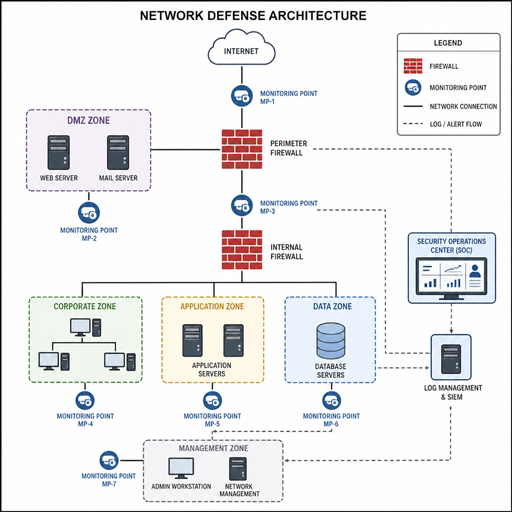
Network defense in 2026 is less about building a single strong perimeter and more about managing risk across users, devices, cloud services, remote access, applications, suppliers, and data flows. The strongest programs combine clear governance, hardened architecture, continuous monitoring, tested response, and practical security policy guidelines that people can actually follow. This guide explains the network defense best practices 2026 teams should prioritize, with a focus on durable controls rather than short-lived security trends.
What does effective network defense mean in 2026?
Effective network defense means knowing what is connected, limiting what each asset can do, watching for abnormal behavior, and responding quickly when something goes wrong. It also means aligning technical controls with business risk, not treating cybersecurity as a tool-buying exercise. NIST’s Cybersecurity Framework 2.0 organizes cybersecurity outcomes around Govern, Identify, Protect, Detect, Respond, and Recover, which is a useful model for building defense strategies that cover leadership, operations, and resilience together.
In practical terms, a mature network defense program answers five questions every day: What do we own? What is exposed? Who has access? What changed? What would we do if this failed? If those answers are unclear, even expensive security tools will leave gaps. If those answers are current, the organization can make better decisions about segmentation, monitoring, vulnerability management, and incident response.
A risk-first foundation keeps controls focused
Strong defense starts with risk management strategies that rank the systems, identities, and services most important to the organization. A public-facing payment application, a domain controller, a production database, and a backup repository do not carry the same risk as a test workstation. Treating all assets equally usually leads to shallow protection everywhere.
A risk-first approach should include:
- Asset inventory: Track endpoints, servers, network devices, cloud workloads, SaaS platforms, APIs, and unmanaged devices where possible.
- Data classification: Identify where sensitive, regulated, confidential, or operationally critical data lives.
- Exposure mapping: Document internet-facing systems, remote access paths, open ports, third-party connections, and cloud security groups.
- Business impact ranking: Prioritize systems that would cause operational, legal, financial, or reputational harm if disrupted.
- Control ownership: Assign accountable owners for patching, access reviews, logging, backups, firewall rules, and exceptions.
This foundation prevents security teams from chasing every alert with equal urgency. It also helps leadership understand why certain investments, such as identity protection or network segmentation, reduce more risk than broad but unfocused spending.
Security policy guidelines that shape daily behavior
Security policy guidelines should be short enough to use and specific enough to enforce. A policy that says “protect company data” is not operational. A policy that defines approved remote access methods, minimum logging requirements, privileged access rules, encryption expectations, and exception approval steps gives teams a workable standard.
Useful network security policies usually cover:
- Access control: Require least privilege, role-based access, regular access reviews, and stronger controls for administrators.
- Authentication: Use multifactor authentication, with phishing-resistant options prioritized for privileged and high-risk access where feasible. CISA’s Cybersecurity Performance Goals emphasize practices intended to meaningfully reduce risk, including stronger authentication and response-oriented controls.
- Change management: Require review and documentation for firewall changes, routing changes, VPN configuration, identity provider settings, and cloud network rules.
- Logging and retention: Define what must be logged, where logs are stored, who reviews them, and how long they are retained.
- Remote access: Restrict unmanaged devices, require secure connectivity, and monitor unusual login patterns.
- Exceptions: Set expiration dates and business justification requirements so temporary risk does not become permanent risk.
Policies should be reviewed whenever the network changes materially, not just once a year. Cloud migration, new business units, new suppliers, mergers, and remote workforce changes can all make old assumptions unsafe.
Modern architecture reduces blast radius
Traditional flat networks make lateral movement easier once an attacker gets inside. Modern network defense assumes compromise is possible and limits what any user, device, workload, or application can reach. This does not require rebuilding everything at once; it requires gradually separating high-risk paths and enforcing stronger identity-aware controls.
Segment critical systems
Segmentation divides the environment into zones based on sensitivity, function, or trust level. For example, user workstations should not have broad access to domain controllers, production databases, backup management consoles, or industrial systems. Administrative interfaces should be reachable only from approved management networks or secure access platforms.
The goal is not complexity for its own sake. The goal is to make unauthorized movement noisy, difficult, and easier to contain. Start with the most valuable assets, then expand segmentation as visibility improves.
Harden network infrastructure
Routers, switches, firewalls, wireless controllers, and VPN appliances are high-value assets. CIS Control 12 focuses on network infrastructure management, including secure configuration and controlled management of network devices. Administrative access should use secure protocols, restricted source networks, unique accounts, centralized logging, and timely updates.
Teams should also remove unused rules, disable legacy protocols where possible, and document rule purpose. A firewall rule with no owner, no expiration, and no business justification is technical debt with security consequences.
Apply zero trust principles practically
Zero trust is most useful when treated as a design principle: verify explicitly, limit access, and assume breach. In practice, that means combining identity, device health, location, behavior, and data sensitivity before granting access. It also means continuously evaluating access instead of relying on one successful login.
For many organizations, practical first steps include MFA for remote and privileged access, device compliance checks, conditional access policies, tighter service account controls, and removing standing administrator privileges.
How should intrusion detection systems fit into the defense stack?
Intrusion detection systems should help teams detect suspicious activity that preventive controls miss, especially unusual traffic, command-and-control behavior, policy violations, and signs of lateral movement. They are not a replacement for patching, segmentation, endpoint security, or identity controls. Their value depends on sensor placement, tuning, context, and the team’s ability to investigate alerts.
Network-based IDS can monitor traffic at key choke points, such as internet gateways, data center segments, cloud ingress and egress paths, and connections to critical environments. Host-based detection can add visibility into endpoint and server behavior. For many teams, the best approach is layered detection: network telemetry, endpoint detection, identity logs, DNS logs, cloud logs, and application logs feeding into a central analysis workflow.
To get more value from intrusion detection systems:
- Place sensors where important traffic actually passes.
- Tune alerts to reduce noise without hiding meaningful events.
- Integrate alerts with asset criticality and identity context.
- Create investigation playbooks for common alert types.
- Test detection with safe simulations and tabletop exercises.
- Review missed detections after incidents or near misses.
Detection should produce action, not just dashboards. If alerts are ignored because they are too noisy or unclear, the organization has a process problem as much as a tooling problem.
Continuous vulnerability management closes known gaps
Attackers often exploit known weaknesses before organizations finish prioritizing them. Continuous vulnerability management turns scanning into a repeatable operating process: discover, prioritize, remediate, verify, and report. CIS includes Continuous Vulnerability Management as a core control, alongside audit log management and other operational safeguards.
The key is prioritization. Not every vulnerability has the same urgency. Internet-facing systems, actively exploited weaknesses, critical identity infrastructure, remote access services, and systems holding sensitive data should move to the front of the queue. Internal-only findings still matter, but exposure and business impact should guide remediation order.
A practical workflow looks like this:
- Scan regularly across internal, external, cloud, and authenticated environments.
- Correlate findings with asset importance, exploitability, and exposure.
- Assign owners with clear remediation expectations.
- Track exceptions with compensating controls and expiration dates.
- Verify fixes rather than assuming a ticket closure means risk is gone.
- Report trends to leadership in business terms, not just counts.
Patching is only one remediation path. Configuration changes, access restrictions, virtual patching, service retirement, compensating monitoring, or segmentation may be appropriate depending on the system and operational constraints.
Logging, monitoring, and response must work together
Logs are only useful if they are complete enough, protected enough, and reviewed in time. At minimum, security teams should collect authentication events, administrative actions, DNS queries, VPN activity, firewall events, endpoint alerts, cloud control-plane activity, and critical application logs. The exact mix depends on the environment, but the principle is consistent: collect the events needed to investigate likely attack paths.
Monitoring should focus on behaviors that matter, such as impossible travel, repeated failed logins, new administrator accounts, unusual data transfers, suspicious PowerShell or script activity, unexpected firewall changes, rare destination domains, and access to sensitive systems outside normal patterns.
Incident response then turns detection into containment. A good response plan defines severity levels, decision authority, communication paths, evidence handling, legal escalation, customer or regulator notification considerations, and recovery steps. The plan should be tested through tabletop exercises and updated after real events.
Resilience depends on recovery, not prevention alone
Even strong defenses can fail. Ransomware, destructive attacks, cloud misconfiguration, insider activity, and supplier compromise can disrupt operations despite preventive controls. That is why cybersecurity best practices must include backup, recovery, and continuity planning.
Backups should be protected from the same identities and networks used in daily administration. They should be encrypted, monitored, tested, and separated enough that an attacker cannot easily delete or corrupt them. Recovery plans should identify which systems must return first, what dependencies exist, who approves restoration, and how the organization communicates during downtime.
Resilience also includes lessons learned. After incidents, near misses, or major control failures, teams should update architecture, policies, playbooks, training, and monitoring logic. Recovery is not just returning to normal; it is returning stronger.
A practical 2026 network defense checklist
Use this checklist to assess whether core defense strategies are in place:
- Maintain a current inventory of assets, owners, software, and exposure.
- Enforce MFA for remote, privileged, and high-risk access.
- Segment critical systems from user networks and lower-trust zones.
- Restrict and monitor administrative interfaces.
- Remove unused firewall rules, accounts, services, and VPN access.
- Centralize logs from identity, endpoint, network, cloud, and critical applications.
- Tune intrusion detection systems around real investigation workflows.
- Prioritize vulnerabilities by exploitability, exposure, and business impact.
- Protect backups with separation, monitoring, and restoration testing.
- Review third-party and supplier access regularly.
- Keep incident response playbooks current and tested.
- Report risk trends to leadership in plain business language.
Turning network security tips into an operating rhythm
The best network security tips are only valuable when they become habits. Weekly vulnerability review, monthly access review, quarterly tabletop exercises, routine firewall cleanup, and regular backup restoration tests create a rhythm that keeps defenses from decaying. Security is not a one-time architecture diagram; it is a system of decisions, reviews, and improvements.
For 2026, the priority is integration. Governance should guide architecture. Architecture should support detection. Detection should feed response. Response should improve recovery. When those pieces reinforce each other, network defense becomes more than a collection of tools; it becomes a practical, risk-aware capability that helps the organization operate with confidence.
