
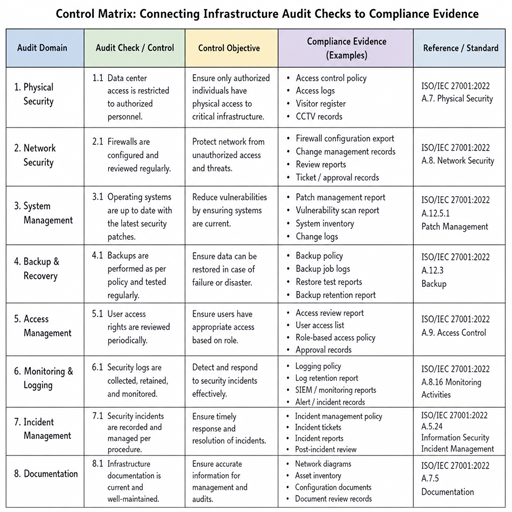
Open source infrastructure auditing is the practice of using transparent, community-accessible tools and methods to review servers, cloud resources, containers, networks, identities, and configuration for risk. It helps teams find security gaps, compliance drift, misconfigurations, and operational weaknesses before they become incidents. This guide explains how open source auditing works, which areas to examine, how to build an audit workflow, and how to choose open source tools without turning the process into tool sprawl.
What does open source infrastructure auditing mean?
Open source infrastructure auditing means using open source security and compliance tooling to inspect how infrastructure is configured, protected, monitored, and governed. The goal is not simply to run a scanner; it is to create a repeatable way to audit infrastructure across cloud accounts, Kubernetes clusters, virtual machines, networks, identity systems, code repositories, and deployment pipelines.
In practical terms, an audit looks for differences between what your infrastructure should be and what it actually is. A storage bucket may be public when policy says it should be private. A container image may include known vulnerable packages. A firewall rule may expose an administrative port to the internet. An identity role may have far more permissions than the service needs. Open source infrastructure auditing gives teams a way to detect those issues using inspectable, adaptable tooling.
The “open source” part matters because teams can see how tools evaluate risk, extend checks for internal policies, and avoid depending entirely on closed black-box systems. That transparency is valuable for infrastructure security, especially when auditors, platform engineers, and security teams need to understand why a finding appeared and how to fix it.
Why infrastructure audits matter for security and compliance
Infrastructure changes constantly. New services are deployed, permissions are updated, containers are rebuilt, and network paths shift as teams ship software. Without regular auditing, small changes can accumulate into serious risk: overexposed assets, outdated packages, weak secrets handling, inconsistent logging, or controls that exist on paper but not in production.
Open source auditing helps create a shared source of truth. Security teams gain visibility into risk. Operations teams get practical remediation tasks. Compliance owners can show evidence that controls are being checked repeatedly rather than reviewed only before an external audit. Developers receive earlier feedback when infrastructure-as-code introduces a risky configuration.
Strong audits also reduce ambiguity. Instead of asking whether “the cloud environment is secure,” teams can ask sharper questions: Which resources are internet-facing? Which identities have administrator-level access? Which images contain high-risk vulnerabilities? Which systems lack encryption, backups, or logging? Better questions lead to better action.
The main areas to audit
A useful infrastructure audit covers layers, not just individual machines. Modern environments are interconnected, so a weakness in one area can amplify risk elsewhere. The following areas form a practical baseline for open source infrastructure auditing.
Cloud and platform configuration
Cloud infrastructure should be reviewed for public exposure, encryption settings, logging, backup posture, access controls, and resource inventory. Misconfigured object storage, overly permissive security groups, missing audit logs, and unmanaged assets are common examples of findings. For teams using infrastructure-as-code, audit checks should run both against deployed environments and against proposed changes before they are merged.
Identity and access management
Identity is often the highest-impact audit area because excessive permissions can turn a minor compromise into a major incident. Review users, service accounts, API keys, roles, groups, and trust relationships. Look for stale accounts, broad wildcard permissions, missing multi-factor authentication, long-lived credentials, and roles that are no longer tied to an active workload.
Networks and exposure
Network auditing identifies what can communicate, what is reachable from the internet, and whether segmentation matches business intent. Open ports, unrestricted inbound rules, unmanaged VPN access, weak administrative interfaces, and unclear egress paths deserve close attention. The objective is not to close every connection, but to ensure every allowed path has a reason.
Hosts, containers, and Kubernetes
Servers, containers, and orchestration platforms require checks for vulnerabilities, hardening, runtime configuration, privilege boundaries, and patch status. Container audits should include base images, package versions, exposed secrets, root users, capabilities, and image provenance. Kubernetes audits should examine RBAC, pod security settings, admission policies, secrets handling, network policies, and cluster component exposure.
Logging, monitoring, and evidence
Auditing is weaker when teams cannot prove what happened. Review whether important systems emit logs, whether logs are retained long enough, and whether alerts cover meaningful events. Infrastructure compliance depends heavily on evidence, so audit outputs should be stored, reviewed, and tied to remediation records where possible.
How do open source tools fit into the audit process?
Open source tools fit best as part of a defined audit workflow, not as isolated scanners. They can inventory assets, inspect configurations, test infrastructure-as-code, scan container images, evaluate compliance rules, detect secrets, and produce evidence, but the team still needs ownership, prioritization, and remediation discipline.
Different open source tools solve different problems. Some focus on cloud security posture. Others inspect Terraform, Kubernetes manifests, container images, host benchmarks, network exposure, or software dependencies. A mature program combines tools carefully so each has a clear purpose and findings do not overwhelm the team.
A simple way to think about tooling is by audit stage:
|
Audit stage |
What it answers |
Example capability |
|---|---|---|
|
Inventory |
What do we have? |
Discover cloud assets, hosts, services, and workloads |
|
Configuration review |
Is it set up safely? |
Check policies, encryption, exposure, and permissions |
|
Vulnerability detection |
What is known to be weak? |
Scan packages, images, hosts, and dependencies |
|
Compliance mapping |
Which controls are covered? |
Map findings to internal or regulatory requirements |
|
Evidence and reporting |
What changed and what was fixed? |
Export findings, track remediation, preserve audit history |
Open source tools are especially helpful when teams need flexibility. You can run checks in CI, schedule scans, customize policies, integrate results into tickets, and inspect the logic behind a rule. However, that flexibility comes with responsibility. Someone must maintain the tooling, tune noisy checks, update policies, and verify that results are accurate.
A practical open source infrastructure audit workflow
A strong audit process is repeatable, scoped, and tied to action. The following workflow works for many teams whether they are auditing a small environment or a larger platform.
- Define the audit scope. Decide which accounts, clusters, networks, repositories, environments, and teams are included. Separate production from development where needed, but avoid ignoring non-production entirely because attackers often use weaker environments as entry points.
- Set the baseline. Document the policies you expect infrastructure to follow. This may include encryption requirements, allowed ports, identity standards, logging expectations, tagging rules, backup coverage, and container hardening requirements.
- Create an asset inventory. Before you can audit infrastructure, you need to know what exists. Include active resources, abandoned resources, external endpoints, service accounts, images, and deployment pipelines.
- Run automated checks. Use open source tools to scan configurations, infrastructure-as-code, containers, hosts, secrets, and access policies. Run checks in read-only mode where possible to reduce operational risk.
- Validate and prioritize findings. Not every finding has equal urgency. Prioritize based on exposure, privilege, data sensitivity, exploitability, and business impact. Remove duplicates and tune rules that generate repeated false positives.
- Assign remediation ownership. Every meaningful finding should have an owner, a target action, and a tracked status. If ownership is unclear, the same issue will likely return in the next audit.
- Retest and preserve evidence. After fixes are applied, rerun the relevant checks. Save reports, logs, policy versions, and remediation notes so the audit creates a useful historical record.
- Shift checks earlier. Once a problem is understood, move detection into CI, code review, or deployment gates so the same issue is caught before it reaches production.
This workflow turns open source infrastructure auditing into an operating habit. The first audit may reveal a large backlog, but repeated audits should become faster, clearer, and more preventive.
Choosing the right open source tools
Tool selection should begin with your infrastructure, not with a popularity list. A cloud-heavy team needs cloud configuration and identity checks. A Kubernetes-heavy team needs cluster, manifest, and container visibility. A regulated organization needs stronger evidence, control mapping, and change history.
Use this checklist when evaluating open source tools:
- Coverage: Does the tool audit the systems you actually run, such as AWS, Azure, Google Cloud, Kubernetes, Linux hosts, Terraform, containers, or CI pipelines?
- Policy flexibility: Can you customize rules to match your internal standards, or are you limited to predefined checks?
- Output quality: Are findings clear enough for engineers to fix without extensive interpretation?
- Automation support: Can the tool run in CI/CD, scheduled jobs, or read-only production scans?
- Evidence handling: Can reports be exported in formats that support infrastructure compliance reviews?
- Maintenance health: Is the project actively maintained, documented, and compatible with your current platforms?
- Noise control: Can you suppress accepted risks, tune severity, and avoid overwhelming teams with low-value alerts?
- Security of the tool itself: Does it require sensitive permissions, and can those permissions be limited?
The best open source tools are the ones your team can operate consistently. A focused set of well-integrated tools usually produces better outcomes than a crowded stack that nobody tunes or reviews.
Common audit findings and what they usually mean
Infrastructure audits often uncover patterns rather than isolated mistakes. Recognizing those patterns helps teams fix root causes instead of closing tickets one by one.
Overly broad permissions usually indicate that teams optimized for speed during deployment but never returned to least privilege. The fix is not only to reduce permissions, but also to improve role design and review access during change management.
Publicly exposed services may show gaps in network review, default settings, or asset ownership. Some services need to be public, but administrative interfaces, databases, internal dashboards, and storage endpoints should be treated with caution.
Missing logging or monitoring suggests that detection was not built into the infrastructure lifecycle. If a system handles sensitive data or controls access, it should produce useful security and operational signals.
Outdated images and packages often point to weak rebuild processes. Teams should ensure base images, dependencies, and host packages are updated through a predictable pipeline rather than waiting for emergency patching.
Secrets in code or configuration reveal process issues around credential handling. Remediation should include rotating exposed secrets, removing them from history where feasible, and giving developers safer ways to use secret stores.
Making audits useful for compliance
Infrastructure compliance is easier when audit checks are mapped to specific control expectations. Instead of producing a generic list of issues, connect findings to requirements such as access control, change management, encryption, logging, backup, vulnerability management, and incident readiness.
This mapping does not need to be overly complex at first. A practical control matrix can include the control area, the audit check, the tool or method used, the evidence location, the owner, and the remediation status. Over time, this becomes a living compliance asset rather than a rushed spreadsheet prepared at the last minute.
For best results, treat compliance as an outcome of good operations. If checks run regularly, evidence is retained, and remediation is tracked, formal reviews become easier. If audits happen only once a year, teams spend more time reconstructing history than improving security.
Best practices for sustainable auditing
Open source infrastructure auditing works best when it is built into normal engineering routines. Start with the highest-risk areas, such as internet exposure, privileged identities, production cloud accounts, and container images used in critical services. Avoid trying to solve every problem in the first audit cycle.
Keep policies readable and version-controlled. Engineers are more likely to trust audit results when they can understand the rule, propose improvements, and see changes over time. When a finding is accepted as a risk, document the reason and review it later rather than suppressing it forever.
A sustainable program should also separate signal from noise. High-severity, exploitable, internet-facing issues deserve fast attention. Low-risk formatting or tagging problems may matter for governance, but they should not distract from infrastructure security fundamentals. Good prioritization keeps teams engaged because audit results feel useful instead of punitive.
Turning audit results into better infrastructure
The real value of open source infrastructure auditing is not the report; it is the improvement loop that follows. Findings should lead to better templates, safer defaults, stronger identity patterns, clearer ownership, and earlier checks in development. Over time, the audit should find fewer repeated mistakes because the platform itself makes risky choices harder.
Begin with a scoped audit, choose open source tools that match your environment, and create a consistent path from finding to fix. Then make the process continuous: audit infrastructure before deployment, after major changes, and on a regular schedule. When auditing becomes part of how infrastructure is built and operated, security and compliance become easier to maintain rather than harder to prove.
