
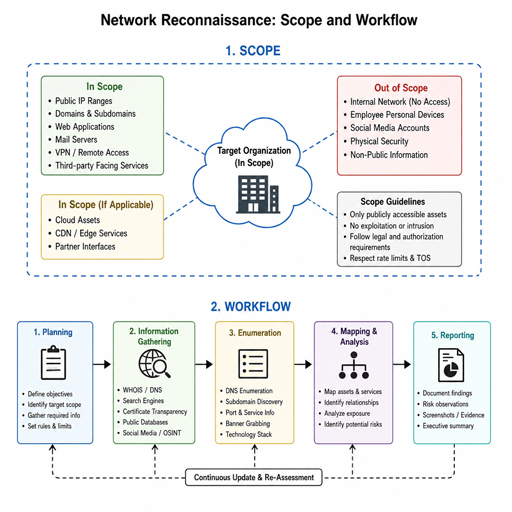
Network reconnaissance is the disciplined process of learning what exists in an environment before making security decisions. Done well, it helps teams understand assets, exposure, dependencies, and risk without creating unnecessary disruption. This guide explains practical, defensive network reconnaissance best practices, including how to plan scope, choose information gathering tools, apply reconnaissance techniques safely, and turn findings into useful security assessment methods.
What is network reconnaissance, and why does it matter?
Network reconnaissance is the collection and analysis of information about systems, services, users, domains, network paths, and external exposure. In a defensive context, it gives security, IT, and compliance teams a clearer picture of what they are responsible for protecting, where weak points may exist, and which risks should be addressed first.
Reconnaissance matters because most organizations cannot secure what they cannot see. Unknown cloud services, forgotten test servers, unmanaged devices, exposed administrative interfaces, and outdated DNS records can all create risk. A structured reconnaissance process turns scattered technical clues into a usable map of the environment.
It is also the first step in many security assessment methods. Vulnerability assessments, penetration tests, incident response investigations, attack surface reviews, and architecture reviews all depend on accurate information gathering. If the reconnaissance phase is rushed or incomplete, later conclusions may be misleading.
Reconnaissance begins with authorization and scope
The most important network reconnaissance best practices are not technical; they are procedural. Before any scan, lookup, inventory review, or validation activity begins, the team should define what is authorized, what is excluded, who is informed, and how findings will be handled.
A clear scope prevents confusion and reduces the chance of disrupting business systems. It also protects the assessment team by creating a shared understanding of purpose and boundaries. Even passive activities can raise questions if they are performed without context, and active probing can affect fragile systems if it is not planned carefully.
A practical scope should identify:
- Approved targets: IP ranges, domains, cloud accounts, applications, office locations, subsidiaries, or business units included in the assessment.
- Excluded systems: Sensitive production systems, third-party-managed assets, medical devices, industrial control systems, or any environment that requires special handling.
- Permitted techniques: Passive research, authenticated inventory review, port scanning, service enumeration, configuration review, or other allowed methods.
- Timing limits: Approved scan windows, maintenance periods, blackout dates, and business hours to avoid.
- Points of contact: Technical owners, escalation contacts, security leads, and anyone who should be notified before testing.
- Data handling rules: Where results are stored, who can access them, retention expectations, and how sensitive findings are reported.
Scope should be written in plain language. A long technical document that no one reads is less useful than a short, explicit agreement that defines the work clearly.
Passive reconnaissance builds context with minimal touch
Passive reconnaissance gathers information without directly interacting with target systems in a way that resembles scanning or probing. It is often the safest starting point because it can reveal a great deal about an organization’s public presence, technology footprint, and external dependencies before any active assessment begins.
Common passive sources include public DNS records, domain registration data, certificate transparency logs, public code repositories, job postings, vendor documentation, security headers visible from public websites, archived web content, and publicly indexed subdomains. Internally, passive sources may include asset management systems, CMDB records, cloud inventories, firewall rules, DHCP logs, identity provider records, and endpoint management platforms.
The goal is not to collect every possible data point. The goal is to build enough context to guide safer and more accurate follow-up. For example, discovering that a domain points to a cloud load balancer can help the team determine whether the asset is owned internally, managed by a vendor, or part of a legacy deployment that needs review.
Useful passive information to collect
A strong passive reconnaissance phase usually captures several categories of information:
- Domain and DNS data Identify primary domains, subdomains, mail records, name servers, SPF records, DKIM records, DMARC status, and legacy hostnames. DNS often reveals forgotten environments, old naming conventions, and third-party dependencies.
- Public certificate data Certificates can expose subdomains, alternate names, development hosts, and services that may not be linked from public websites. Reviewing certificate history can also show how an organization’s public footprint has changed over time.
- Cloud and SaaS indicators Public hostnames, redirects, login portals, and email records may indicate use of cloud platforms or SaaS providers. This helps determine where shared responsibility boundaries may exist.
- Technology clues Website headers, visible frameworks, content delivery networks, analytics scripts, and authentication flows can help identify likely technology stacks. These clues should be treated as leads, not proof, until verified.
- Organizational context Business units, acquisitions, regional offices, brands, and product lines may each have their own infrastructure. Reconnaissance should account for how the organization actually operates, not just its main website.
Active reconnaissance verifies what is actually reachable
Active reconnaissance involves direct interaction with systems to confirm what is live, reachable, and exposed. This can include host discovery, port scanning, service identification, banner review, authenticated inventory checks, and safe validation of observed services.
Because active reconnaissance sends traffic to systems, it requires more care than passive collection. The team should understand expected traffic volume, scan timing, rate limits, fragile systems, and monitoring implications. In mature environments, active reconnaissance is coordinated with security operations so alerts can be interpreted correctly rather than ignored or escalated unnecessarily.
Active techniques should answer practical questions: Which hosts are reachable? Which services are listening? Are management ports exposed? Are there unexpected protocols? Are internal-only systems reachable from places they should not be? Are asset records consistent with what the network shows?
Keep active probing safe and proportionate
Safe active reconnaissance favors accuracy and stability over speed. Aggressive scanning may finish quickly, but it can also produce noisy results, miss intermittent systems, or create avoidable operational issues. A best-practice approach uses conservative settings first, then increases detail only when the environment and authorization allow it.
Good practices include:
- Start with known asset inventories before scanning unknown ranges.
- Notify system owners when scanning critical business areas.
- Use approved scanner sources so traffic is recognizable.
- Avoid high-intensity probing against fragile or legacy systems.
- Separate external, internal, cloud, and remote-access assessments.
- Record scan time, source, method, and target range for auditability.
- Validate important findings manually or through trusted system records.
Active reconnaissance should never be treated as a one-click exercise. The results need interpretation. A listening service may be intentional, temporary, misconfigured, or incorrectly attributed to the wrong owner. The assessment team’s job is to separate signal from noise.
Information gathering tools should support the method, not replace judgment
Information gathering tools are useful only when they are matched to a clear objective. A tool can collect DNS records, map ports, identify services, enumerate cloud assets, or visualize dependencies, but it cannot decide what the organization should care about most. Human judgment is needed to interpret business context, ownership, exposure, and risk.
Tool selection should begin with the question being asked. If the goal is to understand public attack surface, external asset discovery and DNS analysis may be the right starting point. If the goal is to validate internal segmentation, network path analysis and controlled internal scanning may be more relevant. If the goal is incident response, logs and endpoint telemetry may matter more than broad discovery.
Common categories of reconnaissance tools
|
Tool category |
What it helps with |
Defensive use case |
|---|---|---|
|
Asset inventory platforms |
Known devices, owners, software, and lifecycle data |
Comparing expected assets with observed network activity |
|
DNS and domain tools |
Domains, subdomains, records, and name servers |
Finding forgotten hostnames or misaligned email security records |
|
Certificate analysis tools |
Public certificates and alternate names |
Discovering exposed services tied to organizational domains |
|
Network scanners |
Live hosts, ports, and services |
Verifying what is reachable from approved network locations |
|
Cloud inventory tools |
Cloud resources, identities, storage, and network paths |
Checking whether cloud exposure matches policy |
|
Log and telemetry platforms |
Connections, authentication, endpoint events, and traffic patterns |
Confirming whether an asset is active and who uses it |
|
Attack surface management tools |
External-facing assets and exposure trends |
Monitoring internet-facing change over time |
|
Diagramming and documentation tools |
Relationships, dependencies, and ownership |
Turning raw findings into maps that teams can maintain |
The best toolset is usually a combination of sources. A scanner might show an open service, a configuration platform might show who owns the server, and logs might show whether the service is actually used. When these sources disagree, the discrepancy itself becomes a finding worth investigating.
Reconnaissance techniques that produce reliable results
Reliable reconnaissance techniques combine breadth, depth, and validation. Breadth helps teams avoid missing assets. Depth helps them understand what those assets are doing. Validation keeps conclusions from being based on stale, incomplete, or misleading data.
A balanced process usually moves from low-impact discovery to targeted verification. It should be repeatable enough to compare results over time, but flexible enough to adapt to unusual environments such as mergers, hybrid cloud networks, remote sites, or vendor-managed platforms.
Start with asset correlation
Asset correlation means comparing multiple sources of truth instead of trusting one list. For example, a CMDB may show approved servers, cloud inventory may show running instances, DNS may show public hostnames, and network telemetry may show active connections. Each source can be incomplete on its own.
Correlating these views helps reveal gaps. A device seen in network logs but absent from inventory may be unmanaged. A DNS record pointing to an old address may indicate stale configuration. A server listed as retired but still reachable may need decommissioning.
Distinguish exposure from vulnerability
Reconnaissance identifies what exists and what is reachable. It does not automatically prove that something is exploitable. An exposed service may be properly secured, while a non-public system may still create internal risk if it is misconfigured.
This distinction matters for reporting. If reconnaissance findings are labeled too aggressively, teams may become defensive or dismissive. Better language is specific: “Administrative interface reachable from external network” is clearer than “critical system compromised.” The former describes an observable condition and invites action.
Validate ownership early
Many reconnaissance programs fail because findings cannot be assigned to the right owner. Ownership should be investigated as soon as assets are identified, not at the end of the assessment. Without ownership, remediation stalls.
Useful ownership clues include naming conventions, cloud tags, endpoint management records, application catalogs, change tickets, certificate request history, and business unit documentation. If ownership is unknown, create an “unassigned asset” category and track it as its own risk.
Preserve evidence without overcollecting
Evidence should be sufficient to support the finding, reproduce the observation, and help the owner take action. That usually means timestamps, target identifiers, observed services, source of discovery, screenshots when appropriate, and links to internal records.
Avoid collecting sensitive data unnecessarily. Reconnaissance is not an excuse to copy customer data, secrets, private files, or credentials. If sensitive information is accidentally encountered, follow the organization’s handling process and limit access immediately.
How do you choose the right security assessment methods?
The right security assessment methods depend on the question you need to answer, the maturity of the environment, and the level of assurance required. A small external exposure review may only need passive research and light validation, while a segmentation assessment may require coordinated internal testing, architecture review, and log analysis.
Different methods serve different purposes. A vulnerability assessment looks for known weaknesses across assets. A penetration test evaluates whether specific objectives can be achieved under controlled conditions. An attack surface review focuses on internet-facing exposure. A configuration review checks whether systems match expected security standards. A tabletop or incident review may use reconnaissance findings to test response readiness.
Match method to objective
Use this simple decision model:
- If the goal is visibility: Start with asset discovery, passive reconnaissance, and inventory reconciliation.
- If the goal is exposure reduction: Focus on external attack surface mapping, DNS review, cloud exposure checks, and service validation.
- If the goal is control assurance: Use configuration review, authenticated scanning, segmentation validation, and evidence sampling.
- If the goal is resilience: Combine reconnaissance with incident response exercises, detection review, and escalation testing.
- If the goal is remediation planning: Prioritize findings by business impact, ownership, exploitability indicators, and ease of correction.
The method should also reflect risk tolerance. Critical infrastructure, healthcare systems, financial platforms, and operational technology may require slower, more controlled approaches than standard office networks. In these cases, architecture review and passive telemetry may come before any direct probing.
A practical reconnaissance workflow
A repeatable workflow keeps reconnaissance from becoming a pile of disconnected observations. It also makes results easier to compare from one assessment to the next. The workflow below can be adapted for external, internal, cloud, or hybrid environments.
1. Define the assessment purpose
Start by writing a one-sentence purpose statement. For example: “Identify internet-facing assets associated with approved domains and determine whether exposure matches policy.” This prevents scope creep and helps the team decide which data sources matter.
The purpose should connect to a business need. Common drivers include preparing for an audit, reducing external exposure, validating a migration, improving incident response readiness, or establishing a baseline before a deeper assessment.
2. Gather existing records
Before scanning, collect what the organization already knows. This may include asset inventories, domain lists, cloud accounts, network diagrams, firewall rules, application catalogs, certificate records, and previous assessment reports.
Existing records save time and reduce unnecessary probing. They also reveal process gaps. If different teams maintain conflicting asset lists, reconnaissance can help identify which records need cleanup.
3. Perform passive discovery
Use passive sources to expand the initial asset list and identify areas for validation. Look for subdomains, certificates, third-party platforms, public login portals, exposed storage references, and technology indicators.
Document uncertainty. A public hostname may appear related to the organization but belong to a vendor, former subsidiary, or unrelated entity. Mark assumptions clearly until ownership is confirmed.
4. Conduct controlled active validation
Once the passive picture is understood, perform active validation within the approved scope. Confirm which hosts are reachable, which services respond, and whether observed exposure aligns with expectations.
Keep validation proportional to the assessment purpose. If the purpose is asset discovery, broad but light probing may be enough. If the purpose is configuration assurance, deeper authenticated checks may be needed with system owner approval.
5. Correlate and enrich findings
Combine scan results with inventory data, cloud metadata, ownership records, logs, and business context. Group related observations so owners receive actionable findings rather than isolated technical fragments.
For example, several exposed services may all belong to the same application environment. Reporting them together can help the owner understand the pattern and fix the root cause instead of closing issues one by one.
6. Prioritize by risk and actionability
Prioritization should consider exposure, sensitivity, business importance, control gaps, and remediation complexity. A low-severity service on a highly sensitive system may deserve more attention than a noisy finding on a disposable test host.
Actionability matters. A finding should tell the owner what was observed, why it matters, how to verify it, and what kind of remediation path is expected. Avoid vague recommendations such as “secure this system” without explaining the specific condition.
7. Report, remediate, and recheck
Reconnaissance creates value only when it leads to decisions. Share results with the right owners, track remediation, and recheck important changes. Retesting confirms whether exposure has changed and prevents the same issues from recurring unnoticed.
Over time, the workflow should become part of normal security operations. Continuous or periodic reconnaissance is more effective than occasional one-time discovery, especially in environments where cloud resources, remote access, and SaaS usage change frequently.
Common mistakes that weaken reconnaissance
Even experienced teams can produce poor reconnaissance results if the process is rushed or poorly governed. The most common mistakes are usually avoidable with planning and disciplined documentation.
Treating tools as the strategy
Tools are accelerators, not strategy. Running a scanner without a question often creates long lists of results that no one owns. Start with the decision the organization needs to make, then choose tools that support that decision.
Ignoring business context
A port, domain, or service has different meaning depending on what it supports. Business context helps determine whether something is expected, sensitive, temporary, or risky. Technical findings without context are harder to prioritize.
Overlooking third parties
Vendors, managed service providers, agencies, and SaaS platforms can all create visible infrastructure tied to an organization. Reconnaissance should identify these relationships without assuming direct control. Ownership and contractual boundaries matter.
Failing to track change
A single assessment is a snapshot. Networks change as teams deploy systems, retire services, migrate workloads, and adopt new tools. Without recurring review, old findings return and new exposure goes unnoticed.
Reporting without remediation paths
A report that lists problems but does not help teams fix them is incomplete. Findings should include clear observations, affected assets, likely owners, risk explanation, and recommended next steps. The goal is not to prove that issues exist; it is to help reduce risk.
A defensive reconnaissance checklist
Use this checklist to keep assessments consistent and practical:
- [ ] Confirm written authorization and approved scope.
- [ ] Identify excluded systems and sensitive environments.
- [ ] Notify relevant monitoring and operations teams.
- [ ] Collect existing inventories, diagrams, domain lists, and cloud records.
- [ ] Perform passive discovery before active probing.
- [ ] Validate ownership for newly discovered assets.
- [ ] Use controlled active reconnaissance only within scope.
- [ ] Record source, timestamp, target, and method for key observations.
- [ ] Correlate findings across multiple data sources.
- [ ] Separate confirmed facts from assumptions.
- [ ] Prioritize by exposure, sensitivity, business impact, and fixability.
- [ ] Share findings with accountable owners.
- [ ] Retest important remediation actions.
- [ ] Update inventories and diagrams after the assessment.
Turning reconnaissance into long-term security improvement
The strongest reconnaissance programs do more than support one assessment. They improve the organization’s ability to understand itself. Each assessment should leave behind cleaner inventories, better ownership records, more accurate diagrams, and clearer exposure standards.
This is where network reconnaissance best practices become operational habits. Security teams can use recurring discovery to detect unexpected change, validate decommissioning, monitor public-facing assets, and support risk reviews. IT teams can use the same insights to clean up naming, tagging, documentation, and lifecycle processes.
Metrics can help, but they should be simple and meaningful. Track items such as unknown assets found, externally exposed services reviewed, stale DNS records removed, assets assigned to owners, and critical findings remediated. Avoid vanity metrics that count raw discoveries without showing whether risk decreased.
Governance also matters. Decide who maintains asset records, who approves new external exposure, who reviews cloud changes, and how exceptions are documented. Reconnaissance findings often reveal process weaknesses, not just technical issues. Fixing those processes prevents repeated exposure.
Final takeaways
Network reconnaissance is most effective when it is authorized, scoped, methodical, and tied to real security decisions. Passive research builds context, active validation confirms what is reachable, and thoughtful analysis turns raw data into action.
The best results come from combining information gathering tools with disciplined reconnaissance techniques and well-chosen security assessment methods. Treat reconnaissance as an ongoing defensive practice, not a one-time scan, and it becomes a reliable foundation for reducing exposure, improving asset visibility, and strengthening security operations.
