
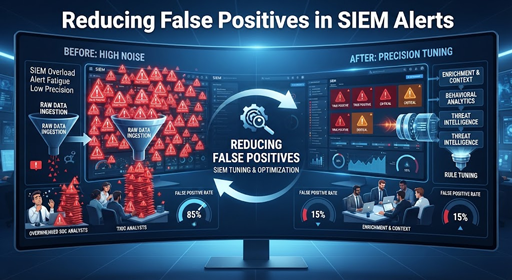
False positives in SIEM alerts can drain analyst time, slow incident response, and make real threats easier to miss. This FAQ explains how to improve SIEM tuning, sharpen threat detection, and make security monitoring more reliable without suppressing the signals your team depends on. Use it as a practical guide for reviewing noisy rules, improving log analysis, and building a cleaner alert workflow.
SIEM alert fundamentals
What are SIEM false positives?
SIEM false positives are alerts that look suspicious according to a detection rule but do not represent a real security incident. For example, a rule may flag a user logging in from a new location, even though the login came from an approved business trip or a known VPN endpoint. The SIEM alert is technically triggered correctly, but the security context is incomplete.
False positives happen because security monitoring tools rely on patterns, thresholds, correlations, and assumptions. Those inputs are useful, but they do not automatically understand every business process, user role, cloud workflow, or administrative exception. Reducing noise means improving that context so alerts better match actual risk.
Why do false positives matter in threat detection?
False positives matter because they compete with real threats for analyst attention. If a security team receives too many low-value SIEM alerts, investigation quality drops and urgent events may wait behind routine activity. Over time, alert fatigue can make analysts less responsive, even when an alert deserves immediate action.
The practical impact is bigger than inconvenience. Excessive noise can delay containment, inflate incident response workload, and make performance reporting misleading. A noisy SIEM may appear active and comprehensive, but activity is not the same as effective threat detection.
What usually causes noisy SIEM alerts?
Noisy SIEM alerts usually come from rules that are too broad, logs that lack context, thresholds that do not match the environment, or assets that have not been categorized by risk. A detection that works well in one organization may be too sensitive in another because normal behavior is different.
Common causes include:
- Generic vendor rules deployed without tuning for local systems, users, and workflows.
- Missing asset context, such as whether a server is internet-facing, critical, test-only, or decommissioned.
- Unnormalized log data that causes duplicate, inconsistent, or misleading events.
- Thresholds set too low, such as alerting on every failed login instead of meaningful patterns.
- Known administrative activity that is not documented or allowlisted carefully.
- Overlapping rules that create multiple alerts for the same event chain.
The root problem is rarely one rule alone. It is usually a combination of detection logic, log quality, and operational context.
Are all false positives bad?
Not all false positives are equally harmful. Some are useful during early rule development because they reveal how normal behavior appears in log analysis. Others are harmful because they repeat frequently, add no investigative value, and distract analysts from higher-risk activity.
A mature SIEM tuning process does not aim to remove every false positive at any cost. Instead, it reduces unnecessary noise while keeping visibility into behaviors that could indicate compromise. The goal is better signal quality, not silence.
SIEM tuning strategy
Where should SIEM tuning begin?
SIEM tuning should begin with measurement. Before changing rules, identify which alerts consume the most time, which sources generate the most noise, and which detections rarely produce meaningful findings. Tuning without measurement can accidentally suppress useful security monitoring.
Start with a short review of recent alert history. Group alerts by rule name, data source, asset type, user group, severity, and outcome. This helps the team decide whether the problem is detection logic, logging quality, enrichment, workflow design, or analyst guidance.
A simple first-pass checklist can include:
- Which SIEM alerts appear most often?
- Which alerts are closed as benign most frequently?
- Which alerts require the longest investigation time?
- Which alerts lack enough evidence for quick triage?
- Which alerts map to the most important risks?
- Which rules are duplicated by another control or detection?
This approach keeps tuning focused on operational impact rather than personal preference.
How do we decide which alerts to tune first?
Tune the alerts that create the most drag on incident response while offering the least value. A rule that fires constantly and almost never identifies suspicious behavior is a strong candidate. A rare but high-severity alert may need better documentation rather than suppression.
Prioritization should consider frequency, severity, business risk, confidence, and investigation effort. For example, a noisy endpoint alert on a low-risk test machine may be less urgent than repeated identity alerts affecting privileged accounts. The best tuning candidates are usually alerts where analysts already know the pattern is benign but must still spend time proving it.
What is the safest way to tune a SIEM rule?
The safest way to tune a SIEM rule is to make small, documented changes and test them against historical data before promoting them into production. Avoid broad exclusions such as removing an entire log source or ignoring an entire subnet unless the risk has been reviewed. A narrow adjustment is easier to explain, validate, and reverse.
A practical rule-tuning workflow looks like this:
- Define the problem. State what makes the alert noisy and which benign pattern is responsible.
- Review real examples. Look at alert fields, affected users, devices, timestamps, and related logs.
- Identify the right tuning lever. Adjust thresholds, add conditions, enrich with context, or create an exception.
- Test against past events. Confirm the change would reduce noise without hiding known suspicious patterns.
- Document the decision. Record the reason, owner, scope, and review date.
- Monitor after deployment. Watch for unexpected drops in visibility or new blind spots.
Good SIEM tuning is controlled and reversible. If a change cannot be explained clearly, it may be too broad.
Should we suppress, disable, or refine noisy alerts?
In most cases, refine before suppressing and suppress before disabling. Refinement improves the rule so it better reflects real risk. Suppression hides specific known-benign cases while leaving the detection active. Disabling removes the rule entirely and should be reserved for detections that are irrelevant, duplicated, or unsupported by useful data.
Suppression can be appropriate for approved scanners, scheduled maintenance, known service accounts, or documented administrative tools. However, every exception should be scoped tightly. For example, suppressing an approved scanner by asset identity and expected behavior is safer than suppressing all scanning activity from a broad network range.
How often should SIEM rules be reviewed?
SIEM rules should be reviewed regularly and whenever the environment changes. New cloud services, identity providers, applications, remote access patterns, and business processes can all change what “normal” looks like. A rule that was accurate last quarter may become noisy after a deployment or organizational change.
A practical review program includes both scheduled and event-driven reviews. Scheduled reviews catch slow drift, while event-driven reviews respond to changes such as new log sources, rule updates, infrastructure migrations, mergers, or incident lessons learned. The key is to treat SIEM tuning as an ongoing security operations process, not a one-time cleanup.
Log analysis and data quality
How does log quality affect SIEM false positives?
Log quality directly affects SIEM false positives because detection rules depend on accurate, consistent, and complete event data. If logs are missing fields, use inconsistent timestamps, or report actions differently across systems, the SIEM may correlate events incorrectly. That can create alerts that look dangerous but are actually artifacts of poor data.
Useful log analysis starts with knowing what each source can and cannot prove. Authentication logs may show that access occurred, but not always whether the action was authorized. Endpoint logs may show process behavior, but they may need user and asset context to determine importance. Better data quality gives the SIEM enough detail to separate expected activity from suspicious behavior.
Which log sources are most important for reducing false positives?
The most useful log sources depend on the environment, but identity, endpoint, network, cloud, and critical application logs are commonly important. Identity logs help explain who accessed what. Endpoint and server logs show activity on systems. Network and cloud logs add context about connections, permissions, and infrastructure behavior.
For false positive reduction, the question is not only “Do we collect logs?” but “Can these logs explain the alert?” A failed login alert is more useful when it includes user role, source location, device posture, MFA result, and recent successful login context. Without that enrichment, analysts may have to investigate routine behavior manually.
What is log normalization, and why does it help?
Log normalization is the process of making events from different systems use consistent field names, formats, and meanings. For example, one source may call a field src_ip, another may call it sourceAddress, and another may bury it in a message string. Normalization helps the SIEM compare events reliably.
Good normalization reduces false positives by making correlation rules more accurate. It also helps analysts investigate faster because fields appear predictably across alerts. If normalization is weak, rules may miss important relationships or trigger on incomplete matches.
How can enrichment reduce alert noise?
Enrichment adds context to SIEM alerts so detection logic and analysts can make better decisions. Instead of treating every event the same, enrichment helps the system understand whether an asset is critical, whether a user is privileged, whether an IP address is internal, or whether an application is approved.
Useful enrichment may include:
- Asset criticality and ownership.
- User department, role, and privilege level.
- Known service accounts and automation accounts.
- Vulnerability exposure or patch status.
- Approved business applications and administrative tools.
- Geo-location, VPN, and identity provider context.
- Threat intelligence indicators, when relevant and validated.
Enrichment should be maintained like any other security data. Outdated asset inventories or stale user records can create new noise instead of reducing it.
Alert logic and detection design
How can thresholds reduce false positives without weakening security?
Thresholds reduce false positives when they reflect meaningful patterns rather than isolated events. A single failed login may be normal. A burst of failed logins across multiple accounts, followed by a successful login from an unusual source, may be more concerning. Thresholds help the SIEM focus on behavior that has stronger investigative value.
Effective thresholds are based on observed baseline activity, not guesswork. Review typical volumes by user group, application, location, and time period. Then set thresholds that highlight unusual behavior while accounting for expected peaks such as shift changes, patch windows, or automated jobs.
What role does baselining play in SIEM tuning?
Baselining helps define normal activity for users, systems, and applications. Without a baseline, the SIEM may treat ordinary behavior as suspicious simply because it matches a broad rule pattern. With a baseline, detection logic can focus on deviations that matter.
Baselines are especially useful for identity behavior, administrative actions, network traffic, and cloud resource changes. They should be reviewed periodically because normal behavior evolves. A baseline that never changes can become inaccurate, but one that changes too freely may absorb suspicious behavior as normal.
How do correlation rules improve threat detection?
Correlation rules improve threat detection by linking multiple events into a more meaningful pattern. Instead of alerting on each event separately, the SIEM can combine signals such as failed logins, privilege changes, suspicious process execution, and unusual data access. This reduces noise by elevating event chains that are more likely to matter.
Correlation works best when the underlying events are reliable and time-synchronized. If timestamps are inconsistent or key fields are missing, correlation may create misleading alerts. Strong correlation rules should include clear logic, mapped data sources, expected investigation steps, and examples of true and benign cases.
How can severity levels be tuned more effectively?
Severity levels should reflect risk, confidence, and business impact. A high-severity SIEM alert should not simply mean the rule sounds serious; it should indicate that the event deserves faster review because the potential impact or likelihood is higher. Misaligned severity creates confusion and can overload incident response queues.
Consider separating severity from priority. Severity can describe the technical risk of the behavior, while priority can account for business context, asset criticality, and current conditions. For example, suspicious activity on a domain administrator account may deserve higher priority than the same activity on a low-risk test account.
Workflow and incident response
How should analysts handle a noisy alert before it is tuned?
Analysts should use a consistent triage process so noisy alerts do not become inconsistent investigations. Even before a rule is tuned, the team can reduce wasted effort by documenting what to check, which evidence matters, and when to escalate. This turns repeated work into reusable knowledge.
A concise triage note should answer:
- What triggered the alert?
- Which user, host, application, or source is involved?
- Is the activity expected for that entity?
- Are there related events before or after the alert?
- Is there evidence of unauthorized access, execution, movement, or data exposure?
- Should this become a tuning request, an incident, or a documented benign closure?
Consistent triage also produces better feedback for detection engineers. Instead of saying “this alert is noisy,” analysts can explain exactly which field, threshold, or condition needs improvement.
How does reducing false positives improve incident response?
Reducing false positives improves incident response by helping analysts focus on alerts that deserve action. Cleaner SIEM alerts make it easier to identify real incidents, prioritize containment, and communicate risk to stakeholders. This is especially important when a team is handling many signals across identity, endpoint, cloud, and network systems.
Noise reduction also improves confidence. When analysts trust that an alert has been tuned and enriched, they can move faster. That does not eliminate the need for investigation, but it reduces the amount of time spent proving routine activity is harmless.
Who should be involved in SIEM tuning?
SIEM tuning should involve security analysts, detection engineers, system owners, identity administrators, and incident response leads. Analysts understand the investigation burden. Detection engineers understand rule logic. System owners know which activity is expected. Incident response leads understand escalation and containment needs.
The best tuning decisions combine these perspectives. A security-only view may misclassify business activity as suspicious, while a business-only view may underestimate risk. Collaboration helps create rules that are technically sound and operationally realistic.
What documentation should support SIEM tuning?
SIEM tuning documentation should explain what changed, why it changed, who approved it, and how it will be reviewed. This is important because tuning decisions affect visibility. If a future incident involves an excluded behavior, the team needs to understand the original reasoning.
Useful documentation includes:
- Rule name and purpose.
- Data sources used by the rule.
- Description of the false positive pattern.
- Tuning change or exception scope.
- Risk considered before implementation.
- Testing performed against historical alerts.
- Owner, approval, and review date.
- Rollback plan if the change creates a blind spot.
Clear records also make audits, handoffs, and future rule reviews easier.
Common SIEM false positive scenarios
Why do authentication alerts create so much noise?
Authentication alerts are noisy because login behavior varies widely across users, devices, locations, and applications. Remote work, VPN usage, mobile devices, password resets, and automated service accounts can all trigger suspicious-looking patterns. Without context, the SIEM may alert on normal access changes.
To reduce this noise, tune authentication rules around meaningful combinations of signals. Failed logins become more useful when paired with impossible travel, unfamiliar devices, MFA failures, disabled account attempts, or access to sensitive applications. Service accounts should be identified and monitored with rules designed for their expected behavior, not treated like human users.
Why do vulnerability scanners and admin tools trigger alerts?
Vulnerability scanners and administrative tools often behave like attacker tools because they probe systems, enumerate services, or execute privileged actions. That similarity is why they should not be ignored completely. The challenge is distinguishing approved activity from misuse.
Use scoped allowlists for known scanners, maintenance windows, approved source hosts, and expected scan behavior. Avoid broad exclusions that would hide an attacker using similar techniques. If an administrative tool is powerful enough to trigger alerts, it should also have clear ownership, logging, and monitoring expectations.
Why do cloud alerts need special tuning?
Cloud alerts need special tuning because cloud environments change quickly and generate large volumes of control-plane events. New resources, identity permissions, automation scripts, and API calls may be normal in one workload and suspicious in another. Generic SIEM alerts may not understand that difference.
Effective cloud tuning depends on account structure, resource tagging, identity context, and knowledge of deployment pipelines. For example, a privilege change by an approved automation role during a deployment may be expected, while the same change by a dormant user account may require urgent review. Cloud security monitoring should account for both activity and intent.
Why do threat intelligence matches produce false positives?
Threat intelligence matches can produce false positives when indicators are stale, too broad, or lacking context. An IP address or domain may be associated with suspicious activity at one point but later become shared, repurposed, or less meaningful. Indicator-based alerts are useful, but they should not be treated as automatic proof of compromise.
To improve these alerts, evaluate the quality, freshness, and relevance of each intelligence source. Combine indicator matches with local evidence such as process activity, data transfer, authentication behavior, or endpoint detections. A match that aligns with suspicious internal behavior deserves more attention than a match with no supporting context.
Metrics and continuous improvement
Which metrics help measure SIEM alert quality?
Useful SIEM alert quality metrics focus on outcomes, workload, and detection value. Counting total alerts alone is not enough because fewer alerts are not always better. The goal is to understand whether alerts help the team detect and respond to real risk.
Consider tracking:
- Alert volume by rule and data source.
- Percentage of alerts closed as benign.
- Time spent triaging common alert types.
- Escalation rate from alert to incident.
- Repeat false positive patterns.
- Alerts with missing or poor context.
- Tuning requests opened and completed.
- Detection gaps found during investigations.
These metrics should guide decisions, not punish analysts. A high false positive rate may indicate a rule problem, not an analyst problem.
How can teams prevent false positives from returning?
Teams can prevent false positives from returning by making tuning part of change management and detection lifecycle management. When systems change, alert logic may need to change too. New applications, new identity patterns, and new infrastructure can all reintroduce noise.
Prevention requires ownership. Each important detection should have a purpose, data source, owner, and review path. When a rule is changed, the team should check whether related rules, dashboards, and playbooks also need updates. This keeps security monitoring aligned with the environment.
What is the difference between reducing noise and reducing visibility?
Reducing noise removes low-value alerts that do not improve security decisions. Reducing visibility removes the ability to see activity that may matter. The difference is whether the team can still detect risky behavior after tuning.
A good tuning decision answers, “What risk remains visible?” If an exception suppresses a known benign scanner, another detection may still monitor unexpected scan targets, unusual scan timing, or scanner misuse. If tuning removes all evidence of a technique, it may create a blind spot.
How do we know when SIEM tuning is working?
SIEM tuning is working when analysts spend less time on repetitive benign activity and more time investigating alerts with clear risk indicators. Alert queues should become more manageable, escalation decisions should become more consistent, and incident response should receive better evidence sooner.
The signs are practical: fewer duplicate alerts, better context in tickets, clearer rule ownership, and more confident triage. A tuned SIEM does not become quiet. It becomes more useful.
Practical next steps
What should a team do in the next 30 days to reduce SIEM false positives?
A practical first month should focus on the highest-impact noise sources rather than trying to tune everything at once. Choose a small set of rules that generate frequent benign alerts and review them deeply. This creates quick improvement while building a repeatable process.
A focused plan can include:
- Export recent alert data and identify the top noisy rules.
- Review a sample of closed alerts for each rule.
- Separate data-quality issues from detection-logic issues.
- Add missing context such as asset criticality or user role where possible.
- Tune one or two rules with narrow, tested changes.
- Update analyst playbooks with clearer triage steps.
- Track whether alert quality improves after deployment.
This approach helps the team prove value before expanding the tuning program.
What should be avoided when tuning SIEM alerts?
Avoid making broad changes just to make the alert queue smaller. Disabling rules, excluding large network ranges, or ignoring entire categories of logs can create dangerous blind spots. Short-term relief should not come at the cost of weaker threat detection.
Also avoid tuning without analyst feedback. The people investigating SIEM alerts usually know which evidence is missing, which exceptions are legitimate, and which rules produce repetitive work. Their input helps turn noisy detection into practical security monitoring.
What is the long-term goal of SIEM tuning?
The long-term goal of SIEM tuning is to build a detection program that is accurate, explainable, and useful during incident response. That means alerts should have a clear purpose, enough context for triage, and a defined path for escalation or closure. It also means tuning decisions should evolve as the environment changes.
Reducing SIEM false positives is not about making the SIEM less sensitive. It is about making security monitoring more intelligent. When rules, logs, enrichment, and workflows work together, the team can detect real threats faster and investigate with greater confidence.
