
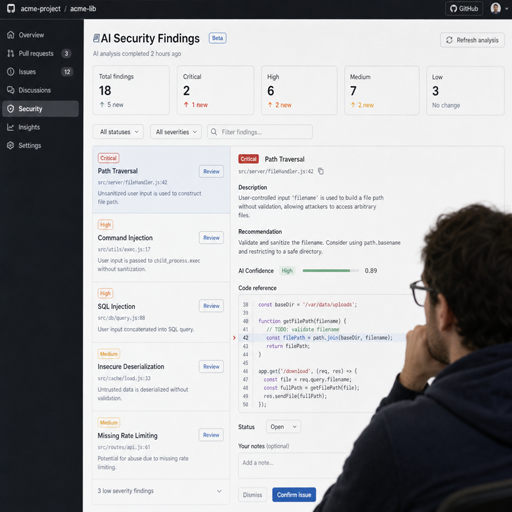
Anthropic has introduced OSS Scanner, a free, opt-in AI vulnerability scanner for open-source projects that want faster vulnerability assessment using Anthropic’s strongest models. The service is designed for maintainers of critical open-source software who can handle model-generated reports, reproduce findings, evaluate patches, and turn AI threat detection into practical fixes. For security teams, maintainers, and organizations that depend on open source, the launch is also a useful case study in modern cybersecurity AI, threat assessment, and AI risk management.
What did Anthropic launch, and why does it matter?
Anthropic launched OSS Scanner on October 8, 2026 as an opt-in service that gives eligible open-source projects periodic security scans at no cost. The key idea is simple: if advanced AI systems can find exploitable bugs quickly, defenders need access to similar speed before attackers use the same class of capability against widely used code. Anthropic says OSS Scanner was informed by its experience using Claude during Project Glasswing and is meant to help open-source maintainers receive vulnerability reports faster than a slower, fully human-reviewed process allows.
That matters because open-source software sits inside operating systems, cloud services, developer tools, enterprise products, public infrastructure, and consumer applications. A vulnerability in a widely depended-on package can create risk far beyond the original repository. OSS Scanner does not remove the need for human judgment, but it gives eligible maintainers another source of security signal: model-generated reports with reproduction details, explanations, and candidate fixes where available.
The launch also highlights a broader change in vulnerability assessment. Traditional scanners, fuzzers, manual audits, and bug bounty programs still matter, but frontier models can reason across code paths, project context, and exploit chains in ways that are beginning to affect defensive workflows. For organizations that rely on open source, the practical takeaway is not “AI solved security.” It is that AI-assisted threat assessment is becoming part of the security stack, and teams need processes for validating, prioritizing, and safely acting on its output.
OSS Scanner in plain language
OSS Scanner is a service that scans participating open-source repositories for security vulnerabilities. Maintainers enroll their projects, provide configuration and build instructions, and receive findings by email. Anthropic describes it as separate from Claude Security, its commercial code-scanning and patching product for enterprises; OSS Scanner is specifically aimed at open-source projects and is offered free to eligible maintainers.
The important word is “opt-in.” This is not presented as a drive-by scanner that sends unsolicited AI bug reports to every repository it can find. Core maintainers must enroll by submitting a pull request to Anthropic’s OSS Scanner repository, and Anthropic says it manually validates that the requester is a core maintainer before enrolling a project.
The service is aimed at projects with meaningful security impact. Anthropic says eligibility is based on criteria similar to Google OSS-Fuzz: established projects with critical impact on infrastructure and user security, including factors such as exposure to remote attacks and the number of users or downstream projects that depend on the software. Acceptance is case by case, and Anthropic notes that criteria may change as it learns how many projects enroll.
How the scanner works in practice
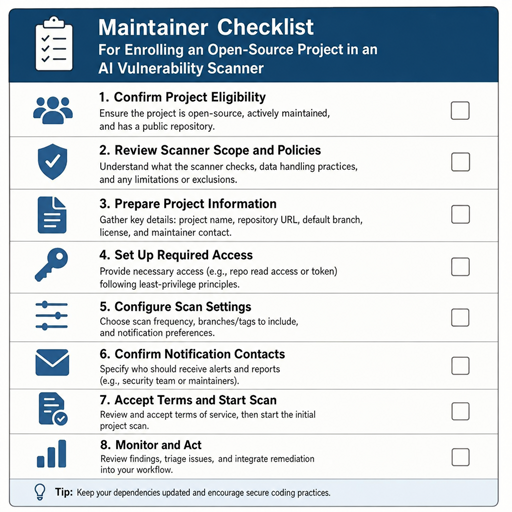
The enrollment flow starts with a configuration file. Maintainers add a directory for their project in Anthropic’s OSS Scanner GitHub repository and provide details such as the project repository, primary security contact, and Dockerfile path. The Dockerfile matters because it defines how the project is built and how dependencies are prepared before the actual security audit runs. Anthropic’s GitHub instructions explain that the scanner builds the project in an isolated virtual machine, then analyzes it with no Internet access.
That offline scanning design is an important risk-control detail. During setup, the build can use network access to fetch dependencies, but the later audit runs without Internet access inside a hardened environment. This helps contain the scanning process and reduces the risk that an autonomous agent will reach outside the intended environment during analysis. It also means maintainers need to be precise about build steps: if tests, dependencies, or generated assets are required, they should be available in the image before the offline audit begins.
A typical OSS Scanner report may include a reproducer, an explanation of the vulnerability, root-cause analysis, and a proposed patch when available. Anthropic says its pipeline includes agents to double-check bugs, propose patches, and perform root-cause analysis before reports are sent to maintainers. After the first scan, the service is expected to scan projects periodically to look for newly introduced vulnerabilities and issues missed in earlier scans, although Anthropic says frequency may depend on usage and other operational factors.
What maintainers need to provide
A good enrollment is not just a formality. It shapes the quality of the scanner’s output. At minimum, maintainers should expect to provide:
- Repository information: The Git repository to scan, optionally pinned to a branch.
- A primary contact: A public security email or alias that can receive reports and build failures.
- A Dockerfile: Build instructions that install dependencies and prepare the project for offline analysis.
- Optional additional contacts: CC addresses for report distribution, unless encrypted email is used.
- Optional PGP key: A way to receive encrypted reports; Anthropic notes that PGP cannot be combined with additional CCs.
- Optional threat model: Project-specific guidance that tells the scanner what matters, what is out of scope, and how severity should be judged.
The optional threat model may be one of the most useful inputs. Without it, the scanner has to infer security expectations from code and documentation. With it, maintainers can explain where untrusted input enters, what components are security-critical, which attack classes matter most, and how severity should be classified. That turns the scan from a generic vulnerability assessment into a more project-aware form of risk analysis.
What makes this different from ordinary vulnerability assessment?
Traditional vulnerability assessment often combines static analysis, dependency scanning, fuzzing, manual review, and penetration testing. OSS Scanner adds a frontier-model layer that can generate hypotheses, reason about exploitability, and produce human-readable reports. Anthropic says it was inspired in part by the positive impact of OSS-Fuzz, but OSS Scanner uses its strongest language models rather than relying only on fuzzing techniques.
That difference changes the workflow. A conventional tool may flag a pattern and leave the maintainer to determine whether it is exploitable. An AI-generated report may attempt to explain the path from bug to impact, produce a proof of concept, and suggest a patch. This can save time when the report is accurate, especially for maintainers who are already comfortable reproducing issues and reviewing security patches.
However, it also introduces a new class of review burden. Anthropic states that OSS Scanner outputs are model-generated and sent without human review or triage. That speed is the point, but it also means reports can be incorrect, duplicated, or misaligned with the project’s real threat model. For maintainers, the right posture is disciplined skepticism: treat findings as serious leads, not automatic truth.
A practical comparison
|
Approach |
Strength |
Limitation |
Best use |
|---|---|---|---|
|
Dependency scanning |
Finds known vulnerable packages quickly |
Usually cannot find new logic flaws |
Managing exposure to published CVEs |
|
Static analysis |
Detects risky code patterns at scale |
May produce false positives or miss context |
Secure coding checks in CI |
|
Fuzzing |
Discovers crashes and input-handling flaws |
Needs harnesses and coverage |
Parsers, libraries, protocol handling |
|
Manual review |
Deep context and judgment |
Expensive and hard to scale |
High-risk components and release gates |
|
AI vulnerability scanner |
Can reason across context and propose reproducers or patches |
Requires validation and careful triage |
Finding leads, accelerating threat assessment, supporting maintainers |
The lesson is not to replace every established control with AI. The better strategy is to combine techniques. AI threat detection can widen the search area, while reproducible tests, code review, fuzzing, and maintainer judgment help decide whether a finding is real and how it should be fixed.
Who should consider enrolling?
OSS Scanner is best suited for open-source projects with meaningful security impact and enough maintainer capacity to handle incoming reports. Anthropic explicitly notes that the service is built for projects that can already keep up with verified high- and critical-severity vulnerability reports and want to further secure their code. Projects that are overwhelmed by existing reports may be better served by slower, human-verified coordinated disclosure rather than a faster stream of unreviewed model output.
Good candidates include widely used libraries, network-facing tools, parsers for untrusted input, cryptography-adjacent components, infrastructure software, developer platforms, and projects with many downstream dependencies. A smaller project can still be security-sensitive if it processes attacker-controlled data or is embedded in important systems, but maintainers should be realistic about whether they can verify and patch findings promptly.
Organizations that depend on open-source components should also pay attention, even if they cannot enroll the project themselves. If a key dependency joins OSS Scanner, downstream users may eventually benefit from faster fixes. But enterprise security teams should not treat enrollment as a substitute for their own software composition analysis, patch management, and application security review.
How should maintainers prepare before signing up?
Maintainers should prepare the same way they would prepare for a serious external audit: make the project build reproducibly, define the security model, and decide how reports will be triaged. AI-generated findings can be useful only if someone is ready to read them, reproduce them, and determine whether the proposed fix is safe.
A practical readiness checklist looks like this:
- Confirm ownership and authority. Only core maintainers should enroll, and the project should have agreement on who can receive and act on sensitive reports.
- Create or verify a security contact. Use a public alias that will remain monitored, rather than a personal email that may become stale.
- Make the build deterministic. The Dockerfile should install all dependencies, build the project, and allow relevant tests to run in the scanner-like environment.
- Write a short threat model. Explain attack surfaces, trust boundaries, out-of-scope areas, and severity expectations.
- Define triage rules. Decide who reviews reports, how duplicates are handled, when to request a CVE, and how patches are tested.
- Prepare patch workflow. Security fixes may need private branches, embargo coordination, downstream notification, or release planning.
- Decide when to pause. Anthropic allows projects to set disabled: true or remove their project directory to stop receiving automated unvalidated reports.
This preparation is part of AI risk management. The risk is not only that the scanner misses something. It is also that a project receives a plausible but incorrect report, spends time on the wrong issue, or applies a patch that changes behavior in a harmful way. A defined process keeps the team from treating AI output as either magic or noise.
The security benefits are real, but not automatic
The strongest argument for OSS Scanner is speed. Anthropic says its existing coordinated vulnerability disclosure process includes human review, but that review takes time; OSS Scanner is the fast track for projects that want findings as soon as they are scanned. In a world where attackers may also use AI to accelerate exploit development, faster defensive discovery can reduce the window between bug introduction and remediation.
Another benefit is depth. Anthropic says each report can include a self-contained reproducer, explanation, bisection where possible, and candidate patch. Those details can be extremely valuable because they reduce the initial effort required to understand a finding. For maintainers with strong triage practices, a high-quality reproducer can quickly separate a real vulnerability from a theoretical concern.
The third benefit is accessibility. Many important open-source projects cannot afford regular commercial penetration tests or large internal security teams. A no-cost scanner gives selected projects access to a kind of analysis that would otherwise be out of reach. That does not solve the underlying funding problem in open source, but it can add defensive coverage where the software supply chain needs it most.
Still, no scanner can guarantee security. OSS Scanner should be seen as one input into a broader security program, not a certification. A clean report does not prove the absence of vulnerabilities, and a noisy report does not prove a project is unsafe. The value comes from how findings are validated, prioritized, and resolved.
The biggest risks are triage, trust, and disclosure
The main operational risk is maintainer overload. Open-source projects already receive low-quality automated reports, vague “AI found a bug” submissions, and duplicate findings. Anthropic acknowledges that OSS Scanner’s reports are not human-reviewed before delivery and that inaccuracies are possible. Even a strong true-positive rate can still create work if severity is inflated, threat assumptions are wrong, or patches need substantial redesign.
The trust question is also important. A free scanner run by a frontier AI company can create real defensive value, but it also concentrates sensitive vulnerability knowledge inside one vendor’s infrastructure. Anthropic says reports are held in an isolated, locked-down cloud project available only to Anthropic security staff who need access, and that scanning agents run only after Internet access is disabled inside hardened sandboxes. Maintainers should still review the terms, understand what data is shared, and decide whether the arrangement fits their project’s governance expectations.
Disclosure is another area to watch. Anthropic says it will not place a 90-day coordinated disclosure period on unvalidated OSS Scanner findings because they may contain false positives. If a finding is later manually validated through Anthropic’s existing CVD process, disclosure may follow that policy starting from the time the maintainer is notified of human validation. Anthropic also says it may impose a disclosure period on some high-severity scanner reports in the future, with notice and an opt-out option.
For maintainers, the safest approach is to set expectations before the first report arrives. Decide how quickly high-impact findings will be reviewed, whether security releases can be cut outside the normal cadence, and how downstream users will be informed. Those decisions are easier to make before an AI-generated report claims remote code execution in a widely used component.
How security teams should use the news
Enterprise security teams should view OSS Scanner as a signal about where cybersecurity AI is going. The same underlying trend that helps open-source maintainers can also change internal application security, third-party risk, and supply-chain defense. The right response is not panic; it is preparation.
Start by mapping the open-source dependencies that matter most to your organization. Which packages are exposed to untrusted input? Which ones sit in authentication, authorization, cryptography, networking, serialization, or update mechanisms? Which dependencies would create the highest business impact if a critical vulnerability appeared tomorrow? That dependency map turns generic vulnerability assessment into targeted risk analysis.
Next, update your intake process for AI-generated findings. Whether reports come from OSS Scanner, bug bounty hunters, internal tools, or vendors, teams need a consistent way to validate exploitability, assign severity, check affected versions, and track remediation. AI can accelerate discovery, but security outcomes still depend on ownership and follow-through.
Finally, avoid outsourcing judgment. If a dependency is scanned by OSS Scanner, that is useful information. It does not mean your organization can skip patch testing, compensating controls, runtime monitoring, or incident response planning. The best AI risk management programs combine machine-speed detection with human accountability.
Best practices for acting on AI-generated vulnerability reports
When a report arrives, the first goal is to determine whether it is real, reproducible, and relevant. The second goal is to fix it without creating a regression. A disciplined process can help maintainers and internal security teams get value from AI threat detection without being overwhelmed.
Use this workflow:
- Authenticate the source. Confirm the report came through the expected channel and has the expected project identifier or report format.
- Reproduce the issue. Run the provided proof of concept in a controlled environment before debating severity.
- Identify affected versions. Determine whether the issue affects released versions, unreleased code, or only unusual configurations.
- Check the threat model. Ask whether the required attacker access, input path, and impact match the project’s real security assumptions.
- Review the proposed patch skeptically. A candidate patch may demonstrate a fix, but it may not be production-ready.
- Add regression coverage. Convert the reproducer into a test where appropriate so the vulnerability does not return.
- Coordinate release and communication. Decide whether the fix needs a security advisory, CVE request, downstream notification, or embargo.
- Feed back signal quality. Reply with corrections, duplicates, severity adjustments, or patch outcomes so the scanner can improve. Anthropic specifically invites maintainers to respond to emailed reports with feedback.
This workflow keeps the human in control. The AI system can suggest where to look, explain why a path may be exploitable, and draft a patch. Maintainers still decide whether the report is valid, whether the fix is acceptable, and how to communicate risk to users.
A broader shift in cybersecurity AI
OSS Scanner is part of a larger movement toward AI-assisted defense. Anthropic announced it alongside a wider Cyber Mission that includes critical infrastructure work, support for open-source security, and programs intended to give defenders access to advanced capabilities. The company frames the effort around a near-term imbalance: highly capable AI models can be used by attackers, while many defenders still lack comparable tools and resources.
For open source, the stakes are especially high. Maintainers often protect code used by banks, hospitals, governments, startups, and infrastructure providers, yet many projects operate with limited funding and limited security staff. A free scanner can help, but it does not replace sustainable maintenance, secure design, contributor review, or long-term funding.
For AI governance, OSS Scanner is a useful example because it shows both sides of AI risk management. The same technology that can improve vulnerability discovery can also increase the volume and speed of sensitive findings. Responsible deployment therefore requires consent, sandboxing, clear disclosure rules, data protection, feedback loops, and respect for maintainer capacity.
The bottom line
Anthropic’s OSS Scanner is a notable step for open-source security because it gives eligible projects free access to AI-assisted vulnerability assessment and faster reports than a fully human-reviewed process can usually provide. Its value will depend on report quality, maintainer readiness, safe disclosure practices, and the ability to turn findings into durable fixes.
For maintainers, the best next step is to assess readiness: build process, security contact, threat model, triage capacity, and patch workflow. For organizations that depend on open source, the best next step is to strengthen dependency risk analysis and prepare for a future where AI-generated vulnerability reports become normal. Used carefully, cybersecurity AI can improve defensive speed; used carelessly, it can add noise to teams that are already stretched thin.
