
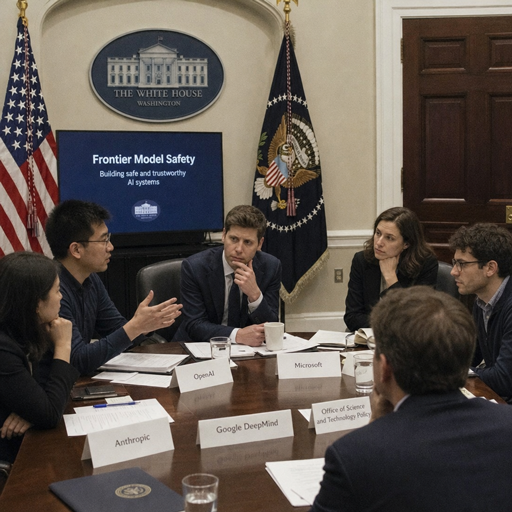
President Donald Trump and leaders from several major AI companies have signed a voluntary accord that asks frontier model developers to strengthen internal controls, use external auditors, and involve corporate boards in AI safety oversight. The agreement, dated September 29, 2026, is being positioned as a flexible alternative to immediate federal rulemaking, even as lawmakers, researchers, and consumer advocates continue pressing for more enforceable AI safety standards.
The pact arrives as Washington debates how far an ai regulation framework should go when models are being deployed into cybersecurity, health care, government services, productivity software, and consumer tools. Supporters call the accord a practical ai trust framework; critics say it leaves too much authority with the same companies racing to build more powerful systems.
What does the voluntary AI safety accord actually require?
The White House Accord on Super Intelligence requires participating companies to adopt four layers of controls and audits for frontier models: internal safeguards, an internal monitoring team, independent external assessment, and board-level oversight. It also says the companies will meet regularly to establish standards and best practices for safer systems, while leaving open the possibility that the steps could later be written into law or regulation.
The agreement was signed by Trump and executives listed on the document from Google, Anthropic, Meta, OpenAI, xAI, and Nvidia. The signatories named in the published accord are Sundar Pichai, Dario Amodei, Mark Zuckerberg, Greg Brockman, Elon Musk, and Jensen Huang.
Key elements of the accord include:
- Internal controls: Companies are asked to monitor model capabilities and alignment during training and deployment, including risks tied to cybersecurity, biosecurity, chemical threats, and unintended system access.
- Dedicated internal teams: Each company is expected to empower a team to confirm that monitoring and detection systems work as intended and that problems are remediated.
- Independent external audits: The accord calls for outside auditors or evaluators to assess whether company controls are operating effectively.
- Board oversight: Companies are expected to designate an independent board committee to review reports from internal teams and external auditors and oversee remediation.
- Regular industry coordination: Participating companies are expected to keep meeting to develop shared AI safety standards and best practices.
Trump frames the agreement as self-policing, not new regulation
Trump described the deal as “morally binding” and indicated that he sees industry self-policing as the central mechanism for managing frontier AI risks. Axios reported that Trump and House Speaker Mike Johnson announced the voluntary accord after a White House meeting with AI leaders, while Trump said the companies would be “policing each other.”
Bloomberg Law reported that Trump rejected the idea of new federal AI regulations after the White House lunch, opting instead for a framework built around outside safety assessments and stronger internal corporate controls. That distinction matters: the accord creates expectations, but it does not by itself establish penalties, licensing requirements, mandatory public disclosures, or a federal approval process for model releases.
The accord also fits into the administration’s broader messaging shift from “artificial intelligence” to “Super Intelligence,” or “SI.” On the same date, Trump signed Executive Order 14434 directing executive branch agencies, to the maximum extent permitted by law, to use “Super Intelligence” and “SI” in place of “Artificial Intelligence” and “AI” in official non-statutory materials.
Why the accord matters for AI risk management
The most immediate impact is likely to be operational rather than legal. For companies building or buying advanced AI systems, the accord signals that audits, board reporting, incident detection, and documented controls are becoming baseline expectations in ai risk management, even when not mandated by statute.
That could influence enterprise procurement, insurance underwriting, security questionnaires, and investor scrutiny. A company deploying frontier models may now face more pressure to explain who owns AI safety internally, what evidence an outside evaluator reviews, how often models are tested, and whether directors receive meaningful reports instead of high-level assurances.
The accord’s language also overlaps with existing voluntary guidance. NIST’s AI Risk Management Framework is designed for voluntary use and aims to help organizations incorporate trustworthiness into AI design, development, use, and evaluation. The new White House accord is narrower and more focused on frontier model controls, but both approaches emphasize governance, monitoring, testing, and public trust rather than a single technical fix.
Supporters see speed and flexibility
Backers of the voluntary model argue that formal AI rules can lag behind fast-moving model capabilities. A voluntary ai governance policies approach gives companies room to update evaluation methods, bring in specialized auditors, and adjust controls as new risks appear. That flexibility is especially relevant for systems that can use tools, write code, interact with external services, or assist in sensitive scientific and security tasks.
The accord’s structure borrows from familiar corporate accountability patterns: management implements controls, internal teams test them, external reviewers assess them, and board committees receive reports. If companies take the process seriously, it could create a repeatable governance loop that turns ai ethical guidelines into internal operating procedures rather than public-relations statements.
Industry coordination could also help reduce fragmentation. The accord says participating companies will meet regularly to establish safety standards and best practices, which may encourage more common benchmarks for cyber misuse, biological or chemical risk, unauthorized system access, and model behavior during deployment.
Critics question enforcement and transparency
Critics argue that the accord’s greatest weakness is the same feature the administration highlights: it is voluntary. AP reported that the agreement does not yet provide details on how the administration will monitor implementation, and critics including former FTC senior adviser Sarah Myers West said self-regulatory approaches have failed to ensure companies keep their own systems in order.
The pact does not require companies to publish audit results, identify the auditors, define auditor access rights, or disclose how failures will be handled. Al Jazeera reported that the pact does not give the government an enforcement role or require public disclosure of audit results, creating uncertainty over how customers, regulators, or the public would know whether a company is meeting the accord’s expectations.
There is also tension between voluntary safety commitments and competitive pressure. Frontier AI companies face incentives to release faster, add capabilities, attract developers, and win enterprise contracts. Without clear disclosure obligations or penalties, outside observers may struggle to determine whether ai safety standards are shaping product decisions or simply documenting them after the fact.
The accord follows earlier voluntary AI commitments
The Trump agreement is not the first White House effort to rely on voluntary AI commitments. In 2023, the Biden White House secured commitments from leading AI companies focused on safety, security, and trust, including internal and external testing, public reporting on system capabilities and limitations, watermarking or provenance work for AI-generated content, and information sharing around risks and standards.
The new accord differs in emphasis. It is shorter, centered on frontier model controls and audits, and tied to the administration’s “Super Intelligence” terminology. The 2023 commitments were more detailed on transparency reports, public disclosures, watermarking, and societal risks such as bias and discrimination.
That difference is likely to shape the political response. Companies may welcome a concise, board-oriented framework that avoids immediate regulation, while civil society groups and some lawmakers may continue to push for enforceable rules covering disclosures, incident reporting, child safety, civil rights, labor impacts, and high-risk deployments.
What happens next
The next test is implementation. The accord says companies will meet regularly to set standards and best practices, but it does not specify a schedule, a reporting format, audit criteria, or a public mechanism for tracking compliance. Those missing details will determine whether the agreement becomes a meaningful ai regulation framework precursor or remains a symbolic statement of intent.
Watch for three developments in the coming weeks: whether participating companies announce named external auditors, whether board committees publish governance charters or summaries, and whether the White House creates any process for reviewing incident reports or audit findings. Trump has also discussed additional AI oversight structures, including a possible committee, while the executive order gives the president’s science adviser 60 days from September 29, 2026, to propose legislative language defining “Super Intelligence” and “SI.”
For now, the accord gives the administration and tech giants a shared public position: frontier AI should be developed with stronger controls, independent checks, and board accountability, but not yet through sweeping new federal regulation. Whether that balance can build trust will depend less on the signing ceremony than on what companies disclose when their systems fail, when auditors raise concerns, and when commercial pressure conflicts with safety promises.
