
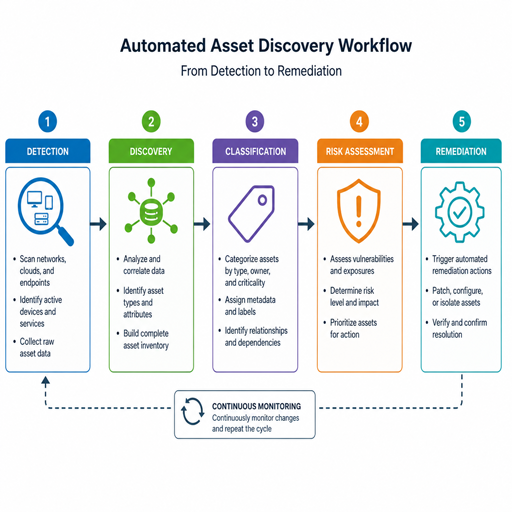
You cannot secure what you cannot see. Automated asset discovery gives security and IT teams a living inventory of devices, cloud resources, applications, users, services, and other technology assets that may create risk if they go unmanaged. This list breaks down practical ways automated discovery improves security, supports better operations, and helps teams choose asset discovery solutions that fit modern environments.
Why does automated asset discovery matter for security?
Automated asset discovery matters because security decisions depend on accurate visibility. If a laptop, virtual machine, container, SaaS application, database, or network device is missing from the inventory, it can also be missing from patching, monitoring, vulnerability scanning, access review, and incident response. Strong automated asset management reduces those blind spots by continuously finding assets, enriching them with context, and helping teams act before small gaps become serious exposure.
Manual inventory work can still have value, especially for validation and ownership details. But modern environments change too quickly for spreadsheets alone. Remote work, cloud deployments, temporary workloads, mergers, contractors, and shadow IT all create assets faster than many teams can document by hand.
1. Build a complete and current inventory
A reliable security program starts with knowing what exists. Automated asset discovery tools scan, integrate, or listen across environments to identify endpoints, servers, network equipment, virtual machines, cloud resources, software, and other assets. Instead of relying on a static list that becomes outdated, teams gain a more current view of the attack surface.
This is the foundation for it asset discovery because every downstream control depends on it. Vulnerability management, endpoint protection, encryption, identity governance, configuration management, and backup planning all become stronger when the underlying inventory is accurate. When new assets appear, the right teams can decide whether they are approved, protected, and properly configured.
A complete inventory should answer practical questions:
- What assets are connected or active?
- Where are they located: on-premises, cloud, remote, or hybrid?
- Who owns them or uses them?
- What software, services, or workloads are running?
- Which assets are critical to business operations?
- Which assets are unknown, unmanaged, or outside policy?
The security benefit is simple: unknown assets are unmanaged risk. Automated discovery helps turn unknowns into visible, accountable items.
2. Reduce shadow IT and unmanaged technology
Shadow IT often starts with good intentions. A team signs up for a tool to move faster, spins up a cloud resource for a project, or connects a device that solves an immediate problem. The risk appears when these assets never enter approved asset tracking software, access controls, monitoring systems, or data protection processes.
Asset discovery solutions help reveal these hidden systems. They can expose unknown devices on a network, unsanctioned software, cloud services outside central governance, or workloads created without standard security controls. Once discovered, security teams can evaluate whether the asset should be approved, secured, migrated, restricted, or removed.
This does not have to become a blocker for productivity. A mature approach treats discovery as a way to support safer technology use. When business teams understand that discovery helps protect data, maintain uptime, and avoid accidental exposure, the conversation becomes less about punishment and more about responsible enablement.
3. Strengthen vulnerability management with better context
Vulnerability programs often struggle because scanning results are disconnected from asset reality. A scanner may identify thousands of findings, but not every finding carries the same urgency. Automated asset management improves prioritization by connecting vulnerabilities to asset type, ownership, exposure, business importance, and environment.
For example, a vulnerable internal test server may matter, but a vulnerable internet-facing production system that handles sensitive data usually deserves faster attention. Asset discovery tools help security teams understand that difference. They provide the context needed to group assets, assign remediation work, and reduce time wasted on low-value tasks.
Good asset context also helps prevent missed patches. If an asset is not in scope for vulnerability scanning, endpoint management, or patch automation, it can remain exposed long after a fix exists. Continuous discovery closes that gap by flagging newly created or previously unknown systems for assessment.
4. Improve incident response speed
During an incident, every minute spent searching for basic asset details slows containment. Responders need to know what the asset is, where it lives, who owns it, what it connects to, what data it may access, and whether similar assets exist elsewhere. Automated asset discovery gives teams a faster starting point.
When discovery data is integrated with security tools, incident responders can move from alert to action with less guesswork. They can identify affected systems, compare them with related assets, isolate endpoints, review ownership, and understand whether an alert points to a one-off issue or a broader pattern.
A useful incident response inventory includes:
- Hostname, IP address, and device type
- User or business owner
- Operating system and installed software
- Network location and cloud region, when relevant
- Tags for business criticality or data sensitivity
- Recent changes, new services, or unexpected exposure
- Relationships with other systems or applications
The result is not just faster response. It is clearer decision-making under pressure.
5. Support cloud asset management across changing environments
Cloud environments are dynamic by design. Teams can create compute instances, storage buckets, databases, containers, functions, identities, and network rules quickly. That flexibility is valuable, but it also makes cloud asset management difficult without automation.
Automated discovery helps security teams see what exists across cloud accounts, projects, regions, and services. It can identify assets that are publicly exposed, missing tags, lacking ownership, or drifting away from approved configurations. In cloud environments, discovery should go beyond counting resources; it should explain risk context.
Cloud visibility is especially important for temporary assets. Short-lived workloads may still process sensitive data, connect to production systems, or introduce vulnerable components. If discovery runs only occasionally, these assets may appear and disappear without review. Continuous or frequent discovery helps teams manage risk even when the environment changes throughout the day.
6. Find misconfigurations before attackers do
Many security incidents begin with simple configuration mistakes. An open port, weak access rule, forgotten database, exposed storage location, or outdated service can create an opportunity for attackers. Automated asset discovery tools help reveal the assets where those mistakes may exist.
Discovery alone does not fix misconfiguration, but it provides the visibility needed to detect and prioritize it. When asset data is combined with policy checks, configuration baselines, or cloud security controls, teams can quickly identify assets that do not meet expected standards.
This is where asset discovery solutions become more valuable than a basic inventory. A list of assets is helpful, but a list enriched with configuration state, ownership, exposure level, and policy status is much more actionable. Security teams can turn findings into tickets, route them to the right owners, and verify that changes were completed.
7. Improve access governance and identity security
Assets and identities are closely connected. Users, service accounts, applications, machines, and workloads all need access to something. If assets are unknown, the permissions tied to them can also go unchecked.
Automated asset discovery supports better identity governance by helping teams understand which systems exist and who can access them. This is particularly important for privileged systems, administrative interfaces, shared services, and cloud resources. When an asset is decommissioned, discovery can also help identify related accounts, keys, tokens, or permissions that should be removed.
Security teams can use discovery data to ask better access questions:
- Does this asset have an owner responsible for access reviews?
- Are privileged accounts limited to approved users?
- Are service accounts still needed?
- Is access aligned with the asset’s business purpose?
- Are abandoned systems still granting permissions?
Better visibility reduces the risk of excessive access lingering in the environment.
8. Make asset ownership clear and actionable
An asset without an owner is hard to secure. If no one knows who is responsible for a server, application, cloud resource, or device, remediation work can stall. Automated asset management should therefore connect technical discovery with ownership data whenever possible.
Ownership may come from endpoint management systems, cloud tags, directory groups, procurement records, CMDB entries, ticketing systems, or business unit mapping. Even when ownership is not perfect, automated discovery can highlight gaps that need cleanup. Missing owner fields are not just administrative issues; they create delays when vulnerabilities, incidents, or compliance questions arise.
Clear ownership also improves accountability without relying on blame. Teams know which assets they are responsible for, security teams know where to route issues, and leaders can see where unmanaged risk is concentrated. This makes asset tracking software more than a recordkeeping tool; it becomes part of daily security operations.
9. Detect unauthorized or risky software
Software inventory is a major part of security visibility. Unknown applications, outdated tools, unauthorized remote access utilities, unapproved browser extensions, and abandoned services can all increase risk. Automated asset discovery tools can help identify what is installed, running, or exposed across the environment.
This matters because software risk changes over time. A tool that was acceptable last year may become unsupported, vulnerable, or unnecessary. A temporary application installed for a project may remain long after the project ends. Discovery helps teams find these leftovers and decide what to update, remove, or monitor.
Software discovery is also useful for license hygiene and operational planning, but the security value is especially strong. When teams know which versions are deployed and where, they can respond more quickly to vulnerability alerts and reduce unnecessary software sprawl.
10. Strengthen compliance and audit readiness
Many compliance programs require evidence that assets are identified, protected, monitored, and managed. Manual evidence gathering can be slow and inconsistent, especially when different teams maintain separate inventories. Automated asset discovery creates a stronger source of evidence by showing what assets exist and how they are categorized.
For audit readiness, the goal is not just to have a list. Teams need repeatable processes that show how assets enter inventory, how ownership is assigned, how exceptions are handled, and how changes are reviewed. Asset discovery solutions can support these processes by providing consistent records and highlighting gaps.
A practical compliance-focused discovery process should show:
- How new assets are detected
- How assets are classified by type and sensitivity
- How ownership is assigned or corrected
- How unmanaged assets are investigated
- How decommissioned assets are removed or archived
- How discovery data supports control testing
This makes compliance less reactive. Instead of scrambling before an audit, teams can maintain better evidence throughout the year.
11. Prioritize risk using business context
Not every asset carries equal risk. A development sandbox, a public-facing production application, a finance system, and an employee laptop all require different handling. Automated asset management becomes more powerful when discovery data is enriched with business context.
Useful context may include business function, criticality, data sensitivity, internet exposure, regulatory scope, environment, and owner. With that information, security teams can prioritize remediation based on actual impact rather than treating every asset the same. This helps reduce noise and makes security work easier to justify.
For example, if a vulnerability affects hundreds of assets, business context helps determine where to start. Internet-facing systems, assets with sensitive data, and systems supporting core operations may rise to the top. This does not mean lower-risk assets are ignored; it means teams can sequence work intelligently.
12. Support mergers, remote work, and hybrid infrastructure
Business change creates inventory change. Mergers introduce unfamiliar systems. Remote work adds networks and devices outside traditional offices. Hybrid infrastructure spreads assets across data centers, cloud platforms, SaaS tools, and employee locations. Manual tracking often struggles to keep pace.
Automated asset discovery gives teams a practical way to regain visibility during change. It can help identify inherited systems, unmanaged endpoints, duplicate tools, and assets that do not match standard controls. During transitions, discovery data helps teams decide what to secure first and what to retire over time.
This is especially helpful when timelines are tight. A perfect inventory may not be available immediately, but automated discovery can quickly create a working picture of the environment. That working picture becomes the basis for risk reduction, integration planning, and operational cleanup.
13. Reduce alert fatigue with cleaner asset data
Security tools generate better alerts when they understand the assets involved. If asset data is incomplete, alerts may lack ownership, priority, environment, or business context. That forces analysts to investigate basic details repeatedly, increasing fatigue and slowing response.
Automated asset discovery improves signal quality by feeding more accurate data into security operations. When alerts include asset type, owner, criticality, and exposure, analysts can triage faster. They can also suppress irrelevant noise more safely when they understand the asset context.
Cleaner asset data also supports automation. Routing, enrichment, escalation, and remediation workflows depend on reliable fields. If the data is wrong, automation can create confusion; if the data is current, automation becomes a force multiplier.
14. Improve lifecycle management from onboarding to retirement
Every asset has a lifecycle. It is requested, approved, deployed, used, changed, maintained, and eventually retired. Security gaps often appear when assets move through that lifecycle without consistent tracking.
Automated asset discovery helps validate each stage. New assets can be detected and checked against onboarding requirements. Active assets can be monitored for patching, configuration, and ownership. Retired assets can be verified as removed from networks, cloud accounts, access lists, and monitoring scopes.
Lifecycle visibility is especially important for abandoned assets. These systems may no longer have active owners, but they can still contain data, credentials, or vulnerable software. Discovery helps find them before they become an easy target.
How should you choose between asset discovery solutions?
Choose asset discovery solutions by matching them to the environments, risks, and workflows your organization actually uses. A tool that works well for office endpoints may not be enough for cloud infrastructure, and a cloud-focused platform may not cover unmanaged network devices. The best choice is usually the one that improves visibility, integrates with existing tools, and turns findings into action rather than producing another static inventory.
Use this checklist when evaluating asset discovery tools:
- Coverage: Confirm support for endpoints, servers, cloud assets, network devices, containers, SaaS, or other assets you need to track.
- Discovery methods: Look for the right mix of agent-based, agentless, API, network, and integration-based discovery.
- Update frequency: Decide whether periodic scans are enough or whether you need near-real-time visibility.
- Context and enrichment: Prioritize ownership, business unit, criticality, exposure, software, and configuration data.
- Integration: Check whether the tool connects with vulnerability scanners, SIEM, EDR, CMDB, ITSM, identity, and cloud platforms.
- Workflow support: Make sure findings can become tickets, alerts, reports, or automated actions.
- Data quality controls: Look for deduplication, normalization, confidence scoring, and clear handling of stale assets.
- Usability: Choose a platform that security, IT, cloud, and operations teams can actually use.
The right solution should reduce uncertainty. If it finds assets but does not help assign ownership, prioritize risk, or support remediation, its value will be limited.
Common mistakes that weaken asset discovery programs
Even strong tools can disappoint when the process around them is weak. Automated discovery should be treated as an operational capability, not a one-time implementation project. The following mistakes are common and avoidable:
- Relying on a single discovery source. One source may miss cloud assets, offline devices, unmanaged software, or temporary workloads. Use multiple sources where appropriate.
- Ignoring data cleanup. Duplicate, stale, or conflicting records reduce trust. Build rules for normalization and review.
- Failing to assign owners. Discovery without accountability creates visibility but not action.
- Scanning too infrequently. Fast-changing environments need frequent updates to stay useful.
- Separating inventory from security workflows. Asset data should support vulnerability management, incident response, access review, and compliance.
- Collecting more data than teams can use. More fields are not always better. Focus on the data needed for decisions and action.
- Not defining success. Decide what improvement looks like, such as fewer unknown assets, faster remediation routing, or better cloud coverage.
Avoiding these mistakes helps teams move from asset discovery to asset control. That is where security value becomes visible.
A practical rollout plan for automated asset management
A successful rollout does not need to begin with every asset type and every integration at once. Start with the areas where unknown assets create the most risk, then expand coverage over time. A phased approach helps teams learn, clean data, and prove value without overwhelming operations.
Consider this sequence:
- Define the scope. Decide whether the first phase covers endpoints, servers, cloud resources, network devices, or a high-risk business unit.
- Identify data sources. Connect existing systems such as endpoint tools, cloud platforms, network scans, CMDBs, identity systems, and vulnerability tools.
- Normalize asset records. Create consistent naming, tagging, owner, environment, and status fields.
- Find unknowns. Compare discovered assets against approved inventories to identify gaps.
- Assign ownership. Route unknown or unmanaged assets to the teams most likely to validate them.
- Prioritize security actions. Focus first on exposed, critical, vulnerable, or ownerless assets.
- Integrate workflows. Connect discovery outputs to ticketing, alerting, reporting, and remediation processes.
- Measure improvement. Track trends in unmanaged assets, stale records, missing owners, and remediation speed.
This kind of rollout makes automated asset management manageable. It also builds confidence because each phase produces a clear operational benefit.
Key takeaways for stronger security visibility
Automated asset discovery is not just an IT inventory function. It is a security capability that helps teams find unknown assets, prioritize risk, respond faster, and manage hybrid environments with more confidence. The strongest programs combine asset discovery tools with ownership, context, workflow, and regular data quality review.
Keep these priorities in focus:
- Visibility must be continuous enough to match the pace of change.
- Asset data is most valuable when it includes ownership and business context.
- Cloud asset management requires dedicated attention because resources change quickly.
- Discovery should connect directly to remediation, not stop at reporting.
- Asset tracking software works best when security, IT, cloud, and operations teams share responsibility for data quality.
When the inventory is accurate, security teams spend less time guessing and more time reducing risk. Automated discovery turns scattered technology into a clearer, more manageable attack surface—and that clarity is the first step toward stronger protection.
